

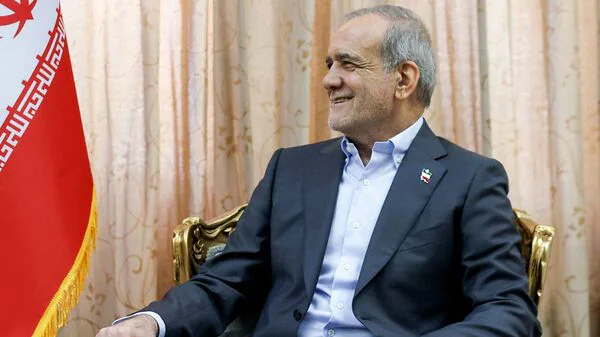
Iran Says It Has Not Abandoned Negotiations Despite Fresh Clashes With Israel


The remarks came after Israel and Iran traded fire for the first time since an April ceasefire, raising fears of a renewed regional conflict and prompting US President Donald Trump to push for an immediate halt to hostilities.
'We have neither abandoned the field nor the negotiating table'
Quick answers to key questions
.5 QUESTIONS1What did Iranian President Masoud Pezeshkian say about negotiations with Israel?⌵Masoud Pezeshkian stated that Iran has not abandoned negotiations and remains committed to both defending its interests and pursuing diplomacy, emphasizing that 'diplomacy and defense are the two wings of national power.'
2Why did tensions between Israel and Iran escalate recently?⌵Tensions escalated after Iran launched missiles at Israel in response to Israeli strikes near Beirut, marking a significant confrontation after the April ceasefire.
3How did US President Donald Trump intervene in the Israel-Iran conflict?⌵Donald Trump urged both Israel and Iran to immediately cease hostilities and indicated that negotiations for a broader peace arrangement were ongoing, while maintaining US sanctions against Iran.
4What warning did Israeli Prime Minister Netanyahu issue regarding future Iranian attacks?⌵Netanyahu warned that any future Iranian attack would draw a military response from Israel, emphasizing their right to self-defense.
5Should regional powers continue to push for a ceasefire between Israel and Iran?⌵Yes, regional powers like Egypt, Saudi Arabia, Turkey, Pakistan, and Qatar have been urging for diplomatic efforts to pressure both sides to halt attacks and maintain the fragile ceasefire.
In a post on X, Pezeshkian said Iran remained committed to defending its interests while also pursuing diplomacy.
"Our priority is national security and the peace of our people. We will defend the rights of the nation with authority and will not retreat in the face of any threat."
"Diplomacy and defense are the two wings of national power; we have neither abandoned the field nor the negotiating table."
Pezeshkian added that Iran hoped to emerge from the crisis successfully through "unity and rationality."
Trump pushes for immediate ceasefireTrump said both Israel and Iran appeared willing to stop fighting and that negotiations toward a broader peace arrangement were continuing.
"Both sides, Israel and Iran, are looking to do an immediate CEASEFIRE! Final negotiations on 'Peace' are proceeding, subject to ignorance or stupidity getting in its way."
The US president also said Washington's blockade and pressure measures against Iran would remain in effect until a final agreement is reached.
"The Blockade will remain in place, and in full force and effect, until a 'Final Deal' is reached."
Earlier in the day, Trump had issued a direct appeal to both countries.
"Israel and Iran must immediately stop 'shooting'."
Israel and Iran signal pause in fightingFollowing Trump's intervention, both countries indicated they were stepping back from further escalation.
Israeli Prime Minister Benjamin Netanyahu said the current round of fighting had ended for now.
"At the moment, the fire has ceased."
However, Netanyahu warned that any future Iranian attack would draw a military response.
"If Iran makes the mistake and returns to attacking us, we will respond with force."
Iran's military also announced it was suspending offensive operations while warning that future Israeli actions could trigger harsher retaliation.
"Further aggression and hostile acts... will be met with much more severe and crushing measures than before."
Israel details strikes on Iranian military sitesThe latest confrontation began after Iran launched missiles at Israel in response to Israeli strikes near Beirut.
The Israeli military said it subsequently carried out large-scale attacks on Iranian military infrastructure.
According to the Israel Defense Forces, fighter jets targeted facilities linked to Iran's ballistic missile program.
"The targeted infrastructure produced unique materials that serve as critical components for the development of ballistic missiles."
The IDF later said it also struck Iranian air-defense systems in western and central Iran to maintain what it described as aerial superiority.
Also Read | 'You might soon be left alone against Iran': Trump's warning to Netanyahu Tehran accuses Washington of backing IsraelIran blamed the United States for the escalation, arguing that Israel would not act independently in such operations.
Iranian Foreign Ministry spokesman Esmail Baghaei told reporters in Tehran:
"No one believes that the Israeli regime would take any action without coordination with the United States."
The accusation came despite Washington's public efforts to preserve the ceasefire and prevent a wider war.
Regional powers seek to preserve truceDiplomatic efforts intensified as regional governments sought to prevent the conflict from reigniting.
Officials said Egypt, Saudi Arabia, Turkey, Pakistan and Qatar had urged Washington to pressure Israel to halt strikes on Iran and Beirut while simultaneously encouraging Tehran to stop attacks on Israel.
Meanwhile, Pakistani Prime Minister Shehbaz Sharif appealed for restraint.
"The recent surge in violence in the Middle East is a stark reminder of the dangers associated with a tenuous ceasefire."
Sharif urged all parties to: "Exercise restraint and give peace a little more chance."
Ceasefire remains fragileDespite the pause in fighting, tensions remain high across the region.
Israel continues operations against the Iran-backed militant group Hezbollah in Lebanon, while Iran maintains pressure around the strategically important Strait of Hormuz, a key route for global oil and gas shipments.
The conflict reached its 100th day on Monday, with diplomats still struggling to transform the April ceasefire into a lasting peace agreement.
Also Read | Netanyahu credits Trump for helping de-escalate Israel-Iran tensions
Legal Disclaimer:
MENAFN provides the
information “as is” without warranty of any kind. We do not accept any
responsibility or liability for the accuracy, content, images, videos,
licenses, completeness, legality, or reliability of the information
contained in this article. If you have any complaints or copyright issues
related to this article, kindly contact the provider above.
Comments
No comment