

Basalt Fiber Market Size, Share, Growth, Analysis, Report, 2034


| Market Metric | Details & Data (2025-2034) |
|---|---|
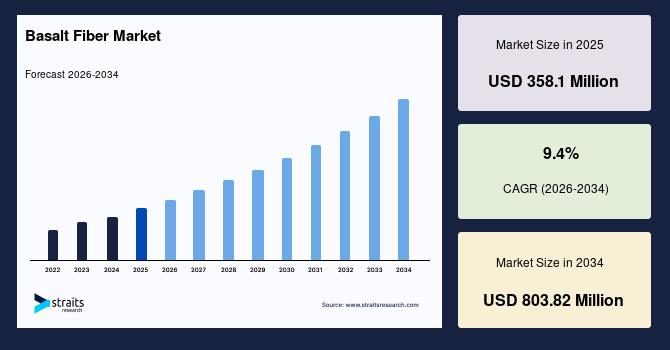
| 2025 Market Valuation | USD 358.1 Million |
| Estimated 2026 Value | USD 391.76 Million |
| Projected 2034 Value | USD 803.82 Million |
| CAGR (2026-2034) | 9.4% |
| Study Period | 2022-2034 |
| Dominant Region | Asia Pacific |
| Fastest Growing Region | North America |
| Key Market Players | Kamenny Vek, Zhejiang GBF Basalt Fiber Co, Mafic SA, Technobasalt-Invest LLC, ISOMATEX SA Inc. |
Download Free Sample Report to Get Detailed Insights.
Basalt Fiber Market Growth Factors Sustainable PropertiesBasalt rock, which is readily available in nature, is used to make basalt fiber. Plagioclase, feldspar, pyroxene, and magnetite make up the extrusive, igneous rock known as basalt, which has a fine-grained structure. Compared to glass fibers, this fiber has several superior mechanical qualities, including a higher tensile strength and a lower manufacturing cost. Basalt fibers are environmentally friendly since they can be recycled. Due to their natural origins and the fact that the recycled basalt fibers in resin have the same properties as fresh basalt powder, basalt fibers are categorized as sustainable materials.
Due to its recyclability and eco-friendliness, basalt fiber is becoming increasingly popular and taking the place of glass fiber. Basalt fiber and basalt composites are also anticipated to be used more frequently in the construction and infrastructure, automotive and transportation, and other end-use industries as a result of the strict laws prohibiting the use of glass fibers.
Market Restraints Availability of Substitute MaterialsSubstitute materials are expected to hamper the growth of the global basalt fiber market. Substitutes, such as carbon fiber and glass fiber, dominate the market, and therefore, their usage for reinforcing applications is continuously increasing at a significant pace. As basalt fiber is new in the market, its manufacturing is limited, which indirectly markets the substitute materials. Hence, the market may observe restrictions on its growth during the forecast period.
Market OpportunityThe market for basalt fiber has a lot of potential to grow because of a growing focus on high-performance and sustainable materials worldwide. Basalt fibers are becoming more popular as an environmentally acceptable substitute for glass and carbon fibers as a result of growing government initiatives for green building, the expansion of renewable energy, and the use of lightweight materials in aircraft and automobiles. Demand is expected to be driven by expanding investments in infrastructure projects throughout the Middle East and Asia-Pacific, as well as by the growing use of electric vehicles and wind energy.
Furthermore, new opportunities for manufacturers to scale up supply and serve a variety of end-use sectors are being created by developments in basalt fiber composites and growing manufacturing facilities across the globe.
Regional AnalysisAsia-Pacific dominated the basalt fiber industry in 2024 with over 40% of the market share and is anticipated to hold the largest share throughout the forecast period. The growth can be attributed to the growing population, industrialization, and urbanization in the countries of this region, which has led to the robust growth of various end-user industries such as construction, automotive, renewable energy, electrical and electronics, etc., that use basalt fibers extensively for several applications. The growing automotive industry in the Asia-Pacific is expected to boost the demand for basalt fiber as it is a reinforcement for automotive parts. India has also observed a rise in automobile production in recent years. Additionally, infrastructural developments and various initiatives taken by the governments, such as 100 Smart Cities and Housing for All by 2022, will also drive market growth in the region.
Europe Basalt Fiber Market TrendsEurope is expected to be the second-largest region in the global basalt fiber industry due to the presence of countries like Russia and Germany, the top producers and suppliers in the European and global markets. The growing usage of basalt fiber in the wind energy sector is also boosting the demand in the region. Furthermore, the growing construction and infrastructure activities, the electrical and electronics industry, and the automotive industry in Europe are also anticipated to augment the market growth in the region. Because of the strict rules that are in place in the EU for issues like greenhouse gas emissions and automobile emissions, the region has experienced a rise in the demand for basalt fibers.
Additionally, there have been a number of R&D initiatives focusing on the application of basalt fiber in the automotive sector. For the research project to create novel composite materials based on basalt fiber and bio-resin for the automobile industry, EIT Raw Materials, the European raw materials association, granted a sizeable sum of money. Therefore, throughout the projection period, the market for basalt fiber in Europe would grow due to the expansion of the construction and automotive industries, as well as increased R&D.
North America Basalt Fiber Market TrendsNorth America will witness significant growth over the forecast period. The region's market is expected to increase as a result of factors like rising demand from different end-user industries, such as the aerospace and alternative energy sectors. The US dominates the North American market for basalt fiber. In Shelby, North Carolina, Mafic USA has started operations at the largest basalt fiber production facility in the world. It's the first one of its kind in North America.
This is a significant advancement in the company's mission to introduce basalt fiber to North American markets and to scale up production of the product for profitability. Due to the expansion of the construction, automotive, aerospace, mining, and wind energy industries in the LAMEA region, the market for basalt fibers in the LAMEA region is anticipated to gain momentum in the near future. The expansion is largely attributed to the expanding presence of basalt fiber manufacturers and the expanding use of basalt fiber by various end-use sectors.
However, the preference for substitutes is anticipated to restrict regional market expansion. In 2018, Arab Mining Company developed its first facility in Fujairah to produce Basalt Fiber Rebar. This is the first factory of its kind in the Middle East and Africa region. Arab Mining Company and Fujairah Natural Resources Corporation struck an agreement to develop a high-quality basalt fiber rebar manufacturing facility.
Product Type InsightsThe market is segmented into basalt rebar, basalt roving, basalt fabric, mesh and grid, and chopped strands. The mesh & grids segment is anticipated to post a significant revenue growth rate. Basaltic mesh is used to reinforce cellular concrete blocks, improving heat efficiency and enabling successful resistance to wind loads, leading to an increase in the masonry's specified resistance. Compared to metal alternatives, using a basaltic grid increases heat efficacy and heat retention by an order of magnitude.
Form InsightsThe market is segmented into continuous basalt fiber and discrete basalt fiber. The continuous basalt fiber segment held the largest share in 2024, capturing nearly 67% of the global market, and is expected to remain the dominant segment throughout the forecast period. This growth can be attributed to efficient and environmentally friendly properties, making it suitable for applications such as reinforcing nets, pipes, containers, and electrical insulation. Continuous basalt fiber is used in the construction and composite industry owing to its features like higher strength than steel, superior efficiency, and resistance to electromagnetic radiation and UV rays. Additionally, the easy availability in various sizes and compatibility with various resins are further expected to boost the market growth.
End-Use Industry InsightsThe market is segmented into construction and infrastructure, automotive and transportation, electrical and electronics, chemical, wind energy, marine, and others. The construction and infrastructure segment will dominate the market during the forecast period. The growing demand for basalt fiber due to growth in the construction industry, especially in civil engineering applications, is expected to augment the market growth. It is used for strengthening concrete structural materials as it improves the durability and flexural strength of the structural material. Its use as concrete reinforcement is high in hydraulic engineering and construction in seismically hazardous regions.
Basalt fiber has various applications, such as bridges, tunnels, residential buildings, soft roofing, and reusable shutters, as it has environmentally friendly properties, good compatibility with concrete, and the ability to mix at high concentrations. Additionally, various government initiatives, along with investments in infrastructural projects, including new construction of railways, highways, underground metro lines, pavement linings, and others, are also anticipated to fuel the market growth. For instance, as per the India Brand Equity Foundation (IBEF), India plans to spend 1.4 USD trillion on infrastructure development in the next five years.
List of Key and Emerging Players in Basalt Fiber Market-
Kamenny Vek
Zhejiang GBF Basalt Fiber Co
Mafic SA
Technobasalt-Invest LLC
ISOMATEX SA Inc.
OTELOGY GmbH
Sudaglass Basalt Fiber Technology
Shanxi Basalt Fiber Technology Co Ltd
Mudanjiang Basalt Fiber Co
Russian Basalt LLC.
-
September 2025: Mafic SA has announced a new R&D partnership with a leading construction company to develop basalt fiber-reinforced concrete products. This collaboration will focus on creating more sustainable and durable building materials, which could lead to a new product line for Mafic SA in the coming months.
August 2025: While not a new product launch, Technobasalt-Invest, LLC supplied basalt materials for the Sunshine Skyway Bridge's complex overhaul repairs in Florida. This is a significant development in the company's portfolio and demonstrates the adoption of its materials in large-scale infrastructure projects in a new market.
| Report Metric | Details |
|---|---|
| Market Size in 2025 | USD 358.1 Million |
| Market Size in 2026 | USD 391.76 Million |
| Market Size in 2034 | USD 803.82 Million |
| CAGR | 9.4% (2026-2034) |
| Base Year for Estimation | 2025 |
| Historical Data | 2022-2024 |
| Forecast Period | 2026-2034 |
| Report Coverage | Revenue Forecast, Competitive Landscape, Growth Factors, Environment & Regulatory Landscape and Trends |
| Segments Covered | By Product Type, By Form, By End-Use Industry |
| Geographies Covered | North America, Europe, APAC, Middle East and Africa, LATAM |
| Countries Covered | US, Canada, UK, Germany, France, Spain, Italy, Russia, Nordic, Benelux, China, Korea, Japan, India, Australia, Taiwan, South East Asia, UAE, Turkey, Saudi Arabia, South Africa, Egypt, Nigeria, Brazil, Mexico, Argentina, Chile, Colombia |
Download Free Sample Report to Get Detailed Insights.
Basalt Fiber Market Segments By Product Type-
Basalt Rebar
Basalt Roving
Basalt Fabric
Mesh and Grid
Chopped Strands
Others
-
Continuous Basalt Fiber
Discrete Basalt Fiber
-
Construction and Infrastructure
Automotive and Transportation
Electrical and Electronics
Chemical
Wind Energy
Marine
Others
-
North America
Europe
APAC
Middle East and Africa
LATAM

Legal Disclaimer:
MENAFN provides the
information “as is” without warranty of any kind. We do not accept any
responsibility or liability for the accuracy, content, images, videos,
licenses, completeness, legality, or reliability of the information
contained in this article. If you have any complaints or copyright issues
related to this article, kindly contact the provider above.
Comments
No comment