

Electric Farm Tractor Market Size, Share, Growth, Analysis, 2034


| Market Metric | Details & Data (2025-2034) |
|---|---|
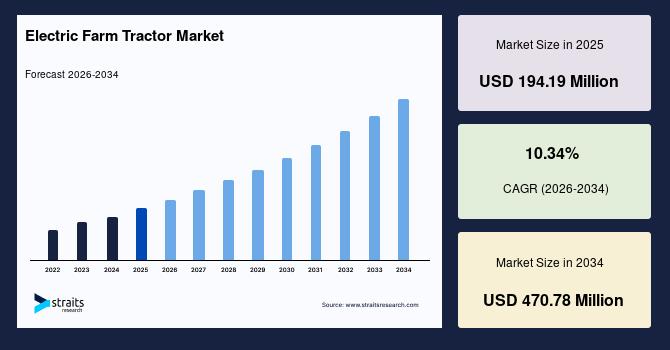
| 2025 Market Valuation | USD 194.19 Million |
| Estimated 2026 Value | USD 214.27 Million |
| Projected 2034 Value | USD 470.78 Million |
| CAGR (2026-2034) | 10.34% |
| Study Period | 2022-2034 |
| Dominant Region | Asia Pacific |
| Fastest Growing Region | North America |
| Key Market Players | Alke, Cummins Inc., Deere & Company, Escorts Limited, Fendt |
Download Free Sample Report to Get Detailed Insights.
Market Growth Factors Rising Popularity of Electric Tractors to Foster Market GrowthThe demand for electric farm tractors has grown due to the many advantages associated with their use, such as lower fuel costs, lower carbon emissions, and increased efficiency in using energy sources. To ensure the vehicle's dependability, many farmers are switching from traditional farm tractors to electric ones. Furthermore, the automotive industry's production and widespread adoption of cutting-edge technologies are two additional critical factors likely to drive the market's growth.
Farm Loan Waivers and Credit Financing Provided by Government to Propel GrowthThe provision of farmer loan programs encourages farmers to invest in agricultural machinery. In various regions of the world, national governments have initiated various relief programs for farmers in the form of loan wavier and mechanization initiatives for agricultural production. A nation's agricultural sector is significantly impacted by the role that subsidies from the government play. For instance, the Farm Service Agency (FSA) of the United States offers guaranteed and direct farm ownership and operating loans to family-sized farmers who cannot obtain commercial credit from a bank, a farm credit institution, or any other lender. FSA loans can be used to purchase land, livestock, equipment, feed, seed, and supplies. The market for agricultural equipment has expanded significantly as a result.
Governments from several nations have actively encouraged using electric farm tractors and other agricultural machinery globally. As a result, traditional agricultural practices have given way to a more contemporary method. India is unquestionably in the growth stage, despite having a lesser level of mechanization than other rising nations like China and Brazil. For instance, the Indian government is promoting electric-powered farm tractors by offering subsidies on agricultural electric tractors, which is projected to improve the electric tractor industry. This is being done to increase the level of green mechanization. The Rashtriya Krishi Vikasa Yojana, an initiative of the government, aims to encourage the expansion of the agricultural industry (RKVY). The Scheme, which aims to increase the degree of electric farm mechanization in India's agricultural sector, is being implemented throughout the country with 100% central aid. Similarly, the Canadian government has implemented the "Canadian Agricultural Loans Act" (CALA) program, which offers farmers a loan of up to USD 500 000 for purchasing land or a tractor. Consequently, it is anticipated that the government initiative will fuel market expansion for electric farm tractors.
Market Restraint Expansion of Rental Market to Restrict Market GrowthThe most significant investment in agricultural activities is the acquisition of farm equipment such as tractors and harvesters, which also accounts for the most significant proportion of the total market for equipment rentals worldwide. The cost of the equipment available to farmers reflects the significant sums of money that must be invested at each stage of the process, from conceptualization to production to distribution. The low adoption rate of agricultural machinery in developing nations is mainly attributable to the inability of smaller farmers to make significant financial investments.
Renting farm equipment is a popular option among farmers because it enables them to increase productivity and decrease turnaround time, thereby enhancing the company's overall productivity and profitability. Renting farm equipment is less expensive than obtaining a traditional loan from a financial institution to purchase agricultural machinery. As a result, the global demand for farm equipment rental services has been driven by the scarcity of farm labor and the accompanying rise in labor wages. The growing incorporation of cutting-edge technology into agricultural rental equipment significantly improves operational efficacy and financial investment returns. It makes it possible for farmers with smaller plots of land to rent expensive farm equipment, enabling them to increase the quantity and quality of their harvest in a shorter time.
The market is severely constrained by factors including the prevalence of traditional tractors, which are popular because they have powerful engines that can drive various heavy machinery. Additionally, whereas conventional tractors have been in use for a long time and are produced by many manufacturers, electric farm tractors are still developing and continue to see many technological breakthroughs. Furthermore, many developing nations lack adequate charging infrastructure, contributing to the widespread use of conventional tractors.
Market Opportunity Growth of Precise Farming to Boost Market OpportunitiesFarmers must place a high value on productivity and efficiency to increase business growth as the demand for agricultural products from a growing population puts constant pressure on the agricultural industry. Farmers wanting to produce more with fewer resources frequently turn to a method of farming known as precision agriculture. This farming method may effectively solve the problem of high food demand in various geographical areas. It also enables farmers to increase the operational efficiency of their businesses and production levels, bridging the gap between the number of agricultural products available and the quantity consumers are willing to purchase. Precision farming technology efficiently utilizes water, seeds, land, fertilizers, and agricultural equipment. Consequently, both the quantity and quality of harvested crops increase.
Regional AnalysisDue to the rapidly increasing demand for tractors in China and India, Asia-Pacific region has held the largest share of the global market for electric farm tractors. This is reflected by the region's geographically dominant position in the market. The agricultural sector constitutes an essential part of India's economy. As a result, tractors are an essential component in completing large-scale operations. In addition, in the region, there is a noticeable rise in the demand for electric farm tractors, which is being done to raise the field's overall productivity.
North America Market TrendsNorth America is anticipated to dominate the global market for electric tractors due to the rising demand for compact tractors in the U.S. But due to consumers' evolving preferences for electrified vehicles, it is projected that Europe's share of the global market for electric tractors will rise dramatically shortly.
Type of Tractor InsightsThe market is segmented into Compact electric tractors, Utility electric tractors, Row-crop electric tractors and high-power electric tractors. Compact electric tractors represent a significant segment in the electric farm tractor market, characterized by their smaller size and suitability for various agricultural tasks on smaller farms or for specialized operations. Although the initial investment for electric tractors can be higher, they offer significant cost savings in the long run. Lower maintenance costs, fewer moving parts, and savings on fuel contribute to the overall cost-effectiveness of electric tractors.
Utility electric tractors help reduce greenhouse gas emissions and air pollution compared to their diesel counterparts. As environmental concerns and regulations become more stringent, the demand for electric tractors that offer cleaner operations continues to rise. Companies such as John Deere are also exploring the utility electric tractor market with initiatives aimed at integrating electric drivetrains into its range of tractors.
Row-crop electric tractors are a specialized segment within the electric farm tractor market, tailored for tasks such as planting, cultivating, and harvesting row crops like corn, soybeans, and cotton. Advances in battery technology and electric drivetrains have increased the viability of electric tractors for row-crop applications.
As the agricultural sector faces increasing pressure to reduce its carbon footprint, high-power electric tractors offer a zero-emission solution that helps farmers comply with environmental regulations and contribute to sustainable farming practices. Many governments are promoting the adoption of electric vehicles through subsidies, tax breaks, and grants which will help the market as well as every segment.
Application InsightsThe market is segmented into light-duty tractors, medium-duty tractors, and heavy-duty tractors. Light-duty electric tractors are specialized and designed for smaller-scale agricultural tasks and operations. As urban and suburban farming becomes more popular, there is increasing demand for compact and efficient agricultural equipment. Light-duty electric tractors are well-suited for these settings, offering a quiet and environmentally friendly option for small-scale farming and gardening.
Medium-duty electric tractors are designed for a range of agricultural tasks that fall between the capabilities of light-duty and high-power tractors. These tractors are suitable for moderately large farming operations and tasks such as tilling, planting, and small-scale hauling. Farmers are increasingly seeking versatile equipment that can perform a variety of tasks efficiently. Medium-duty electric tractors meet this demand by offering the power needed for multiple agricultural applications while providing the benefits of electric propulsion.
Heavy-duty electric tractors represent the most robust segment within the electric farm tractor market, designed to handle the most demanding agricultural tasks such as deep plowing, large-scale tilling, and substantial hauling. For instance, Monarch Tractor offers a powerful electric tractor designed for heavy-duty applications. This tractor combines high torque and advanced battery technology to handle demanding agricultural tasks.
Battery Type InsightsThe market is divided into lithium-ion batteries, lead-acid batteries, and others. Lithium-ion (Li-ion) batteries are the predominant energy storage solution for electric farm tractors, offering a balance of high energy density, long life cycles, and efficient performance. These batteries are crucial in providing the necessary power and range for electric tractors, from light-duty to heavy-duty applications. Lithium-ion batteries offer a high energy density, which allows electric tractors to operate for extended periods without frequent recharging. Li-ion batteries have a longer lifespan compared to other battery technologies, making them a cost-effective investment over time.
Lead-acid batteries are one of the oldest types of rechargeable batteries and have been traditionally used in various applications, including automobiles and backup power systems. In the electric farm tractor market, lead-acid batteries are utilized primarily for their cost-effectiveness and reliability. Lead-acid batteries are generally cheaper to manufacture and purchase compared to lithium-ion batteries. This lower initial cost makes them an attractive option for farmers with budget constraints, especially in developing regions.
Drivetrain Technology InsightsThe market is segmented into hybrid electric farm tractors, plug-in hybrid electric farm tractors, and battery electric farm tractors. By utilizing electric power for certain tasks and optimizing the use of the ICE, HEFTs can significantly reduce overall fuel consumption and greenhouse gas emissions. The combination of electric and ICE power in HEFTs offers an extended operational range compared to fully electric tractors. Plug-in Hybrid Electric Farm Tractors (PHEFTs) combine an internal combustion engine (ICE) with an electric motor and battery pack, offering a flexible and efficient solution for agricultural operations. PHEFTs can significantly reduce fuel consumption and greenhouse gas emissions compared to traditional diesel tractors.
Battery Electric Farm Tractors (BEFTs) represent a significant shift towards sustainable and efficient farming practices. These tractors are powered entirely by batteries, eliminating the need for fossil fuels and reducing the environmental impact of agricultural operations. BEFTs produce zero emissions during operation, contributing to cleaner air and reduced greenhouse gas emissions. This aligns with global efforts to combat climate change and supports sustainable agricultural practices.
List of Key and Emerging Players in Electric Farm Tractor Market-
Alke
Cummins Inc.
Deere & Company
Escorts Limited
Fendt
Kubota Corporation
Motivo Engineering
Solectrac Inc.
Sonalika
Monarch Tractor
Yanmar Holdings Co. Ltd.
AutoNxt Automation Pvt. Ltd.
Celestial
Ztractor
EcoFactor
-
In August 2022, Meritor, Inc., a top provider of drivetrain, mobility, brake, aftermarket, and electric powertrain solutions for the commercial vehicle and industrial markets has been fully acquired by Cummins Inc. (NYSE: CMI).
In January 2023, The MK-V, a fully electric, driver-optional, smart tractor produced by Monarch Tractor, announced the expansion of its business to Hyderabad, India. In addition to supporting the worldwide supply chain, Monarch Tractor will embrace the new market opportunity to intensify its R&D activities in the United States.
| Report Metric | Details |
|---|---|
| Market Size in 2025 | USD 194.19 Million |
| Market Size in 2026 | USD 214.27 Million |
| Market Size in 2034 | USD 470.78 Million |
| CAGR | 10.34% (2026-2034) |
| Base Year for Estimation | 2025 |
| Historical Data | 2022-2024 |
| Forecast Period | 2026-2034 |
| Report Coverage | Revenue Forecast, Competitive Landscape, Growth Factors, Environment & Regulatory Landscape and Trends |
| Segments Covered | By Type of Tractor, By Application, By Battery Type, By Drivetrain Technology |
| Geographies Covered | North America, Europe, APAC, Middle East and Africa, LATAM |
| Countries Covered | US, Canada, UK, Germany, France, Spain, Italy, Russia, Nordic, Benelux, China, Korea, Japan, India, Australia, Taiwan, South East Asia, UAE, Turkey, Saudi Arabia, South Africa, Egypt, Nigeria, Brazil, Mexico, Argentina, Chile, Colombia |
Download Free Sample Report to Get Detailed Insights.
Electric Farm Tractor Market Segments By Type of Tractor-
Compact Electric Tractors
Utility Electric Tractors
Row-Crop Electric Tractors
High-Power Electric Tractors
-
Light-Duty Tractor
Medium-Duty Tractor
Heavy-Duty Tractor
-
Lithium-Ion batteries
Lead-Acid Batteries
Others
-
Hybrid Electric Farm Tractor
Plug-in Hybrid Electric Farm Tractor
Battery Electric Farm Tractor
-
North America
Europe
APAC
Middle East and Africa
LATAM

Legal Disclaimer:
MENAFN provides the
information “as is” without warranty of any kind. We do not accept any
responsibility or liability for the accuracy, content, images, videos,
licenses, completeness, legality, or reliability of the information
contained in this article. If you have any complaints or copyright issues
related to this article, kindly contact the provider above.
Comments
No comment