




403
Sorry!!
Error! We're sorry, but the page you were looking for doesn't exist.
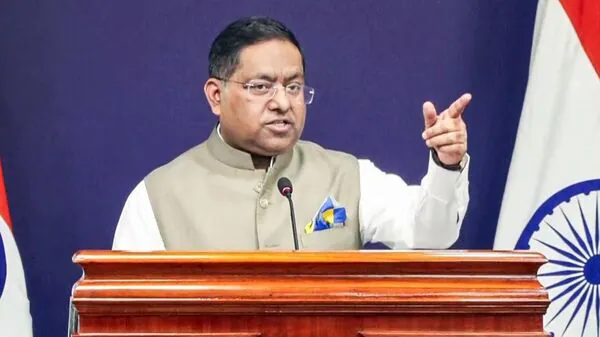
'Unwarranted': India Rejects References To Jammu And Kashmir In China-Pakistan Joint Statement
(MENAFN- Live Mint) India on Tuesday strongly rejected "unwarranted" references to Jammu and Kashmir in a joint statement issued by China and Pakistan, reiterating that the Union Territory and Ladakh "have been, are and will" remain an integral part of the country and that no other nation has the locus standi to comment on it.India rejects unwarranted references
India's position is consistent and well known to the concerned parties, External Affairs Ministry spokesperson Randhir Jaiswal said.
"India categorically rejects unwarranted references to the Union Territory of Jammu and Kashmir in the Joint Statement between China and Pakistan," he said.
J&K, Ladakh will always remain part of IndiaThe joint statement was issued during Pakistan Prime Minister Shehbaz Sharif's recent visit to China.
"The Union Territories of Jammu and Kashmir and Ladakh have been, are and will always remain integral and inalienable parts of India. No other country has the locus standi to comment on the same," Jaiswal said.
Also Read | Why Did China Include Cash-Strapped & 'Friendless' Afghanistan In CPEC? India doesn't recognize 1963 boundary agreementIndia also criticised the mentioning of projects under the China-Pakistan Economic Corridor (CPEC) in the joint statement, and said New Delhi rejects any moves to reinforce or legitimise Islamabad's illegal occupation of territories.
"As regards the so-called China-Pakistan Economic Corridor (CPEC) projects, some of which are in India's sovereign territory, we resolutely oppose and reject any moves by other countries to reinforce or legitimise Pakistan's illegal and forcible occupation of these territories, impinging on India's sovereignty and territorial integrity," he said.
Jaiswal said this has been clearly conveyed to Pakistani and Chinese authorities several times.
"We have also seen references to the so-called 'trans-boundary water resources cooperation' between China and Pakistan. As the two countries do not share any boundary, the question of so-called 'trans-boundary water resources cooperation' does not arise," he said.
Also Read | Pakistan rejects Donald Trump's invite to sign Abraham Accords: What are they?"India has never recognised the so-called 1963 boundary agreement between Pakistan and China," he added.
What China-Pakistan joint statement saidEarlier, following the visit of Pakistan PM Sharif to China from May 23-26 at the invitation of Premier Li Qiang, the two countries issued a joint statement on Tuesday.
The statement said that the Pakistani side briefed the Chinese side on the latest developments on the situation in Jammu and Kashmir.
China, for its part, reiterated that the Jammu and Kashmir dispute is left over from history, and should be properly and peacefully resolved in accordance with the UN Charter, relevant UN Security Council resolutions and bilateral agreements.
The two sides expressed readiness to conduct trans-boundary water resources cooperation under the principle of equality and mutual benefit, it said, without specifying any details of collaboration as the rivers emanating from China that flow to Pakistan pass through India.
India has kept the Indus Waters Treaty in abeyance until Pakistan takes credible and irreversible steps to end support for terrorism.
China reiterated its "unwavering support" for Pakistan in defending its national sovereignty, independence, and territorial integrity, and firmly supported Pakistan's efforts to safeguard its national security, stability, development and prosperity.
Also Read | China, Pakistan agree to expand CPEC to Afghanistan for regional 'peace...'Beijing and Islamabad also agreed to advance high-quality Belt and Road cooperation, hold the meeting of the CPEC Joint Cooperation Committee and promote the high-quality development of the upgraded version of CPEC 2.0.
They agreed to advance the Karakoram highway (Thakot to Raikot) realignment project in a phased and orderly manner and agreed to leverage the potential of the Gwadar Port and build it into a regional connectivity hub.
Key Takeaways- India maintains a firm stance on its territorial integrity regarding Jammu and Kashmir. The joint statement from China and Pakistan is viewed as an infringement on India's sovereignty. India expresses strong opposition to projects under the China-Pakistan Economic Corridor that affect its territorial claims.

Legal Disclaimer:
MENAFN provides the
information “as is” without warranty of any kind. We do not accept
any responsibility or liability for the accuracy, content, images,
videos, licenses, completeness, legality, or reliability of the information
contained in this article. If you have any complaints or copyright
issues related to this article, kindly contact the provider above.
Most popular stories
Market Research

More Story








Comments
No comment