




403
Sorry!!
Error! We're sorry, but the page you were looking for doesn't exist.
Natural Cosmetics Market Size, Share And Forecast To 2033
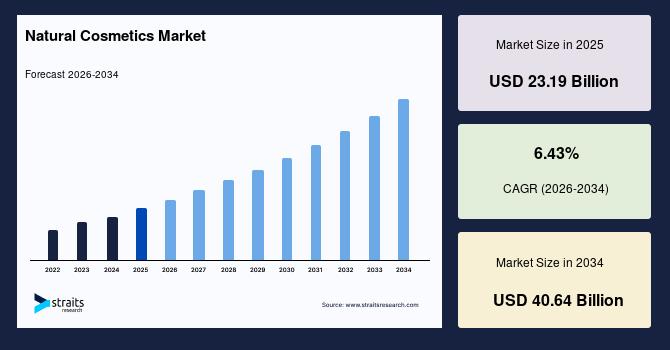
| Market Metric | Details & Data (2025-2034) |
|---|---|
| 2025 Market Valuation | USD 23.19 Billion |
| Estimated 2026 Value | USD 24.68 Billion |
| Projected 2034 Value | USD 40.64 Billion |
| CAGR (2026-2034) | 6.43% |
| Study Period | 2022-2034 |
| Dominant Region | North America |
| Fastest Growing Region | Asia-Pacific |
| Key Market Players | L'Oréal S.A., The Estée Lauder Companies Inc., Unilever PLC, Beiersdorf AG, Natura andCo Holding S.A. |
Download Free Sample Report to Get Detailed Insights.
Natural Cosmetics Market Growth Factor Advanced Natural Actives Accelerate Consumer Shift toward Science-Backed BeautyThe increasing integration of clinically effective, bioactive ingredients into clean formulations propels market growth. As consumer expectations rise, brands are moving beyond traditional“free-from” labels to offer skincare that avoids harsh chemicals and delivers visible results through advanced, nature-inspired science.
-
For example, in July 2025, Byrdie spotlighted a surge in demand for high-performance natural actives gaining traction within the clean beauty segment. These include exosomes, tiny extracellular vesicles that support skin regeneration, alongside PDRN (salmon DNA) for deep hydration and tissue repair, and miniproteins that stimulate collagen production and wound healing.
This convergence of clean beauty principles with bioactive performance reshapes consumer expectations and product development. As shoppers demand ingredient safety and visible efficacy, brands that successfully bridge natural sourcing with advanced dermatological science are experiencing stronger market traction and long-term brand loyalty.
Market Restraint Labelling Ambiguity and Greenwashing Undermine Consumer TrustThe ongoing lack of regulatory clarity around terms like“natural,”“clean,” and“organic” has opened the door to widespread greenwashing. While consumer demand for transparency is at an all-time high, many brands continue to exploit vague definitions, marketing products as“natural” despite including synthetic preservatives, artificial fragrances, or petrochemical-derived ingredients. This inconsistency has eroded consumer trust, especially among ingredient-conscious shoppers who rely on label claims to make informed decisions. Inconsistent labelling is further compounded by misleading marketing visuals such as plant imagery or“free-from” tags that may not accurately reflect a product's formulation. As a result, consumers often face confusion or disappointment, negatively impacting brand credibility and repeat purchase rates.
Market Opportunity Ai-Powered Formulation Tools Open New Frontiers for Scalable Natural Cosmetic InnovationA key opportunity lies in harnessing AI-driven platforms to streamline product development and personalisation. As clean beauty brands compete to launch efficacious, naturally derived formulations at speed, digital formulation tools are emerging as strategic enablers, particularly for R&D teams aiming to balance ingredient safety, regulatory compliance, and evolving consumer demands.
-
For example, in April 2025, Nouryon introduced BeautyCreationsTM, an AI-powered formulation discovery tool, at the in-cosmetics Global event in Amsterdam. Developed in collaboration with Albert Invent, the platform enables formulators to use natural language to describe desired claims, textures, and ingredient preferences, then rapidly generates optimised formulations from Nouryon's extensive clean beauty database. The tool significantly shortens development timelines while improving ingredient transparency and product safety, two critical factors in natural beauty.
As AI tools become more accessible, natural cosmetic brands, particularly emerging and mid-sized players, can leverage these platforms to scale innovation pipelines without compromising clean-label values.
Regional AnalysisNorth America is leading in the global natural cosmetics market, driven by widespread consumer preference for clean-label beauty products and a mature ecosystem of natural product innovation. High awareness about ingredient safety, combined with increasing consumers prioritising eco-conscious and cruelty-free formulations, fuels robust demand across skincare, haircare, and makeup segments. Regulatory support for organic and naturally derived ingredients further reinforces market maturity, allowing retailers and brands to communicate product transparency. The region also benefits from advanced retail infrastructure and strong e-commerce penetration, making natural cosmetics accessible across diverse demographics.
-
The United States remains a leading force in the natural cosmetics market, supported by high consumer awareness around clean beauty, ingredient safety, and ethical sourcing. Retail ecosystems from department stores to digital-first platforms are embracing natural brands and offering curated clean beauty sections to meet rising demand. Ongoing innovation in formulation, especially with biotech-derived actives and minimal preservatives, is shaping the future of natural beauty. A growing preference for wellness-integrated personal care and functional botanicals is also expanding the product range in this market.
Canada's natural cosmetics sector is growing steadily, fueled by rising environmental consciousness and strong support for plant-based, non-toxic personal care. Regulatory clarity around labelling and organic certification has made it easier for brands to build trust with consumers seeking clean alternatives. Natural cosmetics are available through pharmacies, organic lifestyle stores, and green e-commerce platforms. Indigenous herbal knowledge and locally grown botanicals are also gaining prominence in product development.
Asia-Pacific is rapidly emerging as a high-potential region in the natural cosmetics space, fueled by evolving consumer perceptions and a growing shift toward wellness-oriented lifestyles. Urban millennials and Gen Z consumers are becoming more conscious of what they apply to their skin, favouring products with recognisable ingredients, plant-based actives, and minimal synthetic intervention. Cultural traditions rooted in herbal and holistic skincare are being modernised into premium natural offerings, particularly in markets like Japan, Korea, and India. Digital-first beauty platforms are major in shaping consumer awareness, supported by influencer-driven campaigns and live-streamed product tutorials. Consumer interest also gravitates toward minimalist beauty routines, emphasising quality over quantity.
-
China is emerging as a high-growth market in natural cosmetics, supported by a rapidly evolving consumer mindset focused on ingredient transparency and skin health. Traditional herbal ingredients are being reimagined into premium skincare and cosmetics lines with modern textures and formats. The rising popularity of beauty livestreaming and social commerce amplifies the visibility of clean and natural brands. Domestic product development increasingly incorporates native botanicals, often promoted through cultural storytelling and sustainability claims.
India's natural cosmetics market is expanding rapidly, rooted in a strong herbal and Ayurvedic personal care tradition. Consumers across age groups are increasingly drawn to ingredient-focused products that emphasise purity, minimal processing, and traditional remedies. Urban consumers are shifting toward eco-conscious routines, favouring brands that offer plant-based actives and cruelty-free assurances. E-commerce platforms and speciality organic stores are critical in making natural products more accessible. Innovations combining modern science with classical Ayurvedic principles are also shaping the market's premium segment.
Europe exhibits steady growth in the natural cosmetics market, underpinned by its longstanding cultural affinity for botanical-based personal care and deep-rooted sustainability values. Consumers in the region demonstrate a high degree of label literacy, actively seeking products free from synthetic additives, parabens, and microplastics. Regulatory frameworks across the EU further support natural formulation standards and labelling practices, enabling trust and consistency in the marketplace. The region also fosters collaborations between cosmetic brands and sustainability-focused research institutions to develop innovative bio-based ingredients.
-
Germany is prominent in Europe's natural cosmetics market, characterised by its highly ingredient-literate consumer base and long-standing preference for organic, plant-based formulations. Natural cosmetics are widely available through health shops, drugstores, and certified organic retailers, where strict standards guide product formulation and labelling. Consumers consistently demand transparency, with a clear aversion to synthetic dyes, fragrances, and petrochemical derivatives. Sustainability considerations such as carbon-neutral production, biodegradable packaging, and local sourcing continue influencing purchasing decisions, fostering strong brand loyalty in the natural beauty industry.
The UK's natural cosmetics market is growing quickly, driven by rising environmental concerns and a cultural shift toward minimalist, wellness-oriented beauty routines. \ There is particular demand for multi-functional skincare products with clean formulations and visible efficacy. Natural cosmetics are gaining traction in both mainstream retail and boutique wellness spaces. The market also benefits from upcycled ingredients, waterless formulations, and plastic-free packaging innovations. UK consumers are highly responsive to organic, vegan, and cruelty-free certifications, viewing them as essential to authenticity and brand credibility in natural beauty.
Skincare products continue to represent the most dominant segment within the natural cosmetics landscape, reflecting consumer preferences and the high rate of innovation in clean-label formulations. Natural skincare covers a wide spectrum, including moisturisers, cleansers, facial oils, sunscreens, and serums. Many prioritise plant-based actives like chamomile, centella asiatica, and rosehip oil. Consumers increasingly opt for formulations that promise hydration, anti-ageing, and barrier repair without synthetic additives such as parabens, sulfates, or silicones. With beauty influencers, dermocosmetic collaborations, and AI-driven skin diagnostics further shaping demand, brands focusing on efficacy-backed natural skincare outperform those relying solely on heritage or green branding.
Ingredient Type InsightsPlant-based ingredients form the cornerstone of innovation in the natural cosmetics market, owing to their perceived safety, traditional usage, and rising traceability across the supply chain. Ingredients such as aloe vera, turmeric, tea tree oil, and green tea extract are increasingly favoured for their anti-inflammatory, antimicrobial, and antioxidant properties. Modern extraction techniques such as cold pressing and supercritical CO2 extraction ensure these actives retain their potency without synthetic preservatives. Moreover, regulatory scrutiny has pushed brands to validate ingredient claims through dermatological testing, clinical trials, or third-party certifications (e.g., COSMOS, ECOCERT).
Distribution Channel InsightsOnline retail channels have emerged as the fastest-growing segment in the distribution of natural cosmetics, driven by changing consumer behaviour, enhanced logistics, and the digital-first strategies of both legacy and indie brands. E-commerce platforms, from global marketplaces like Amazon and Sephora to D2C brand websites, offer broad access to clean beauty products across urban and rural areas. These channels allow brands to share ingredient transparency, user testimonials, before-and-after visuals, and sustainability certifications with more credibility and immediacy than physical shelves. Online retailers are also collaborating with dermatologists and wellness influencers to co-develop content that bridges the gap between clinical efficacy and clean beauty, making the segment even more resilient and consumer-centric.
End-User InsightsFemale consumers aged 25–45 represent the most significant end-user segment in the natural cosmetics market, owing to their strong influence over beauty purchasing decisions and heightened awareness around ingredient safety. This demographic is often characterised by its focus on skincare maintenance, anti-ageing, preventive care, and a strong inclination toward ethical consumption. This cohort is also highly engaged with beauty content on platforms like Instagram, YouTube, and TikTok, where peer reviews, influencer tutorials, and dermatologist advice often influence final purchase decisions. In response, brands are designing campaigns emphasising authenticity, local sourcing, and wellness, targeting this group through emotional and scientific messaging.
Company Market ShareThe global natural cosmetics market is highly competitive, driven by increasing consumer awareness of health and environmental issues. Key players, ranging from established beauty giants to specialised natural brands, focus on innovation in formulations, emphasising natural and organic ingredients, and ensuring transparency in sourcing. Companies are also expanding their distribution channels, particularly through e-commerce, and investing in personalised skincare solutions to meet evolving demands, aiming for a balance between efficacy and natural integrity.
Weleda AG: Weleda AG, a pioneer in natural and organic cosmetics, demonstrates a business pattern rooted in its long-standing commitment to biodynamic farming and holistic principles. Its growth is driven by a strong brand reputation for high-quality, certified natural products and a focus on sustainability and ethical sourcing. Weleda appeals to consumers seeking authentic natural ingredients and a transparent production process, building loyalty through consistent adherence to strict natural standards like NATRUE.
Recent News:-
In March 2025, Weleda partnered with Princess Madeleine of Sweden to co-develop minLen, a new natural skincare brand. This collaboration aims to address the trend of children and young people using unsuitable active ingredients, offering a 100% natural, gentle, and family-friendly skincare range. This strategic move expands Weleda's reach into a new demographic while reinforcing its commitment to natural and safe formulations.
-
L'Oréal S.A.
The Estée Lauder Companies Inc.
Unilever PLC
Beiersdorf AG
Natura andCo Holding S.A.
Weleda AG
Burt's Bees (a Clorox Company)
Heritage Store (Nutraceutical Wellness Inc.)
Hauschka (WALA Heilmittel GmbH)
Korres S.A. Natural Products
Laboratoires Nuxe S.A.
Yves Rocher (Groupe Rocher)
The Honest Company, Inc.
100% Pure (Purity Cosmetics, Inc.)
-
September 2024- Weleda unveiled the expansion of its facial care portfolio with the launch of its new Smoothing Face Care and Face Cleansers range. This launch significantly expanded Weleda's daily facial care and cleansing offerings, emphasising plant-rich ingredients and natural efficacy.
January 2025- Burt's Bees introduced new additions to its Rescue Lip Relief lip care line, with innovative, naturally derived formulations. This product, offered in a squeezy tube, is enriched with responsibly sourced beeswax, shea, and cocoa butters to protect the lip's natural moisture barrier.
April 2025- To expand its sustainable offerings, Unilever acquired UK-founded Wild Cosmetics, known for its refillable deodorants and body care, for nearly £100 million. Wild achieved a 77% revenue increase in 2023, driven by its plastic-free packaging and refill model. The deal marks one of Unilever's most high-profile investments in the eco-personal care space and aligns with its broader sustainability goals under the“Clean Future” initiative.
| Report Metric | Details |
|---|---|
| Market Size in 2025 | USD 23.19 Billion |
| Market Size in 2026 | USD 24.68 Billion |
| Market Size in 2034 | USD 40.64 Billion |
| CAGR | 6.43% (2026-2034) |
| Base Year for Estimation | 2025 |
| Historical Data | 2022-2024 |
| Forecast Period | 2026-2034 |
| Report Coverage | Revenue Forecast, Competitive Landscape, Growth Factors, Environment & Regulatory Landscape and Trends |
| Segments Covered | By Product Type, By Ingredient Type, By Distribution Channel, By End-User |
| Geographies Covered | North America, Europe, APAC, Middle East and Africa, LATAM |
| Countries Covered | US, Canada, UK, Germany, France, Spain, Italy, Russia, Nordic, Benelux, China, Korea, Japan, India, Australia, Taiwan, South East Asia, UAE, Turkey, Saudi Arabia, South Africa, Egypt, Nigeria, Brazil, Mexico, Argentina, Chile, Colombia |
Download Free Sample Report to Get Detailed Insights.
Natural Cosmetics Market Segments By Product Type-
Skincare Products (e.g., moisturisers, cleansers, serums)
Haircare Products (e.g., shampoos, conditioners, hair oils)
Makeup and Colour Cosmetics (e.g., foundations, lipsticks, eyeliners)
Fragrances and Deodorants (e.g., natural perfumes, roll-ons, sprays)
Baby Care Products (e.g., baby lotions, shampoos, rash creams)
Men's Grooming Products (e.g., shaving gels, face washes, beard oils)
-
Plant-Based Extracts (e.g., aloe vera, chamomile, green tea)
Essential Oils and Botanicals (e.g., lavender oil, jojoba oil, tea tree)
Mineral-Based Components (e.g., zinc oxide, clay, mica)
Animal-Derived Natural Ingredients (e.g., beeswax, lanolin, milk protein)
Certified Organic Compounds (e.g., Ecocert/USDA-certified bases)
Marine-Based Extracts (e.g., seaweed, algae, pearl powder)
-
Natural and Organic Speciality Retail Stores
Pharmacies and Health Stores
Online Retail and E-commerce Platforms
Supermarkets and Hypermarkets
Beauty Salons and Wellness Centers
Direct-to-Consumer (DTC) Subscription Models
-
Individual Consumers
Professional Spas and Salons
Cosmetic Dermatology Clinics
Resort and Hotel Wellness Centres
Baby and Maternal Care Centres
Cruise Liners, Airlines and Hospitality Chains
-
North America
Europe
APAC
Middle East and Africa
LATAM

Legal Disclaimer:
MENAFN provides the
information “as is” without warranty of any kind. We do not accept
any responsibility or liability for the accuracy, content, images,
videos, licenses, completeness, legality, or reliability of the information
contained in this article. If you have any complaints or copyright
issues related to this article, kindly contact the provider above.
Most popular stories
Market Research

More Story








Comments
No comment