

Electric Propulsion Systems Market Size, Share & Growth Forecast By 2033


| Market Metric | Details & Data (2025-2034) |
|---|---|
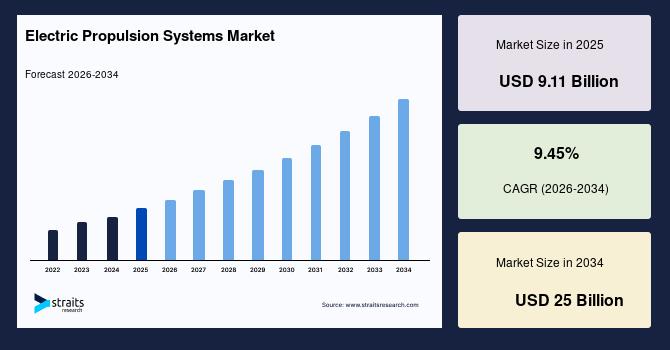
| 2025 Market Valuation | USD 9.11 Billion |
| Estimated 2026 Value | USD 10.19 Billion |
| Projected 2034 Value | USD 25 Billion |
| CAGR (2026-2034) | 9.45% |
| Study Period | 2022-2034 |
| Dominant Region | North America |
| Fastest Growing Region | Asia Pacific |
| Key Market Players | SpaceX, Boeing, Lockheed Martin, Airbus, Northrop Grumman |
Download Free Sample Report to Get Detailed Insights.
Electric Propulsion Systems Market Growth Factors Transition to Electrification in Automotive and Aerospace SectorsThe transition toward electrification in the automotive and aerospace industries is a major driver for the global electric propulsion systems market. Governments worldwide are setting ambitious targets for reducing carbon emissions, prompting investments in electric vehicles and aircraft.
-
For example, the European Union's "Fit for 55" initiative aims to reduce greenhouse gas emissions by 55% by 2030, significantly boosting EV adoption. In 2024, global EV sales surpassed 12 million units, a 35% increase from 2023, according to the International Energy Agency (IEA). In aerospace, initiatives such as the Airbus ZEROe project, which focuses on developing hydrogen-electric propulsion for commercial aviation by 2035, highlight the growing emphasis on electric propulsion.
Furthermore, the advancements in energy storage technologies, such as solid-state batteries, enhance the feasibility of electric propulsion in diverse applications. Companies like Panasonic and CATL are investing heavily in battery research, ensuring long-term growth for the market.
Restraining Factors High Initial Costs and Infrastructure ChallengesThe high initial costs associated with electric propulsion systems and the need for more supportive infrastructure in emerging economies pose significant challenges. Developing electric propulsion solutions requires substantial investment in R&D, advanced manufacturing processes, and high-quality components.
-
For instance, the cost of electric powertrains for EVs can be 30-50% higher than internal combustion engines, according to BloombergNEF's 2024 report. Similarly, deploying electric propulsion in the aviation and maritime sectors demands robust charging and energy distribution networks, which are limited in many regions.
For example, while the U.S. has made significant progress in EV charging infrastructure, developing countries in Asia and Africa lag behind, creating a barrier to widespread adoption.
Moreover, concerns about battery life, range limitations, and the availability of raw materials for battery production, such as lithium and cobalt, add to the complexities. Addressing these challenges will require coordinated efforts from governments, industry stakeholders, and financial institutions.
Market Opportunity Innovation in Electric Aircraft and Maritime PropulsionThe development of electric aircraft and maritime vessels presents a transformative opportunity for the electric propulsion systems market. As aviation and shipping industries face mounting pressure to reduce emissions, electric propulsion emerges as a viable solution.
-
For example, in 2024, Ampaire, an electric aircraft manufacturer, successfully conducted test flights of its hybrid-electric aircraft, showcasing the potential for regional air travel. Similarly, Norway-based Yara International launched the world's first fully electric autonomous container ship, Yara Birkeland, in 2024, significantly reducing operational emissions.
Governments are also supporting these innovations through funding and policy initiatives.
-
For instance, the U.S. Department of Energy's ARPA-E program allocated USD 40 million in 2024 to develop advanced electric propulsion systems for aviation. Such initiatives accelerate the adoption of electric propulsion across industries, ensuring long-term market growth.
Moreover, integrating renewable energy sources, such as solar and wind power, with electric propulsion systems further enhances sustainability and cost-effectiveness.
-
For instance, solar-powered propulsion systems for small satellites are gaining traction, offering reliable and eco-friendly alternatives for space missions. This integration highlights electric propulsion systems' versatility and growth potential in achieving global sustainability goals.
North America leads the global electric propulsion systems market, accounting for 38% of the market share. Robust investments in space exploration and satellite deployment drive this dominance. The U.S., home to major players like SpaceX, Boeing, and Lockheed Martin, spearheads advancements in electric propulsion technology. NASA's Artemis program, which aims to establish a sustainable presence on the Moon, extensively uses electric propulsion systems for cargo transport and lunar gateway operations. Additionally, in March 2024, the U.S. government announced a USD 2 billion funding initiative to support private space companies in developing next-generation propulsion technologies. Canada also contributes to the regional market, with its space agency's RADARSAT program relying on electric propulsion for earth observation satellites.
Europe is experiencing significant electric propulsion systems market growth, primarily due to collaborative initiatives among space agencies and private firms. The European Space Agency (ESA) has prioritized electric propulsion for its Earth Explorer missions to enhance Earth observation capabilities. In 2024, ESA's collaboration with Airbus successfully launched a satellite powered by Hall Effect Thrusters, reducing mission costs by 30%. Moreover, countries like Germany and France heavily invest in electric propulsion R&D to strengthen their aerospace industries. The European Commission's Horizon Europe program allocated €500 million in 2024 to propulsion system innovation, emphasizing sustainability and efficiency.
Asia-Pacific Market TrendsAsia-Pacific is the fastest-growing electric propulsion systems market region, driven by increasing investments in space programs and satellite deployment. China, India, and Japan lead the regional market with ambitious space exploration agendas. China's Tiangong space station extensively uses electric propulsion for orbital adjustments, while India's ISRO launched its GSAT series satellites equipped with electric propulsion systems in 2024. Additionally, Japan's Hayabusa-2 mission demonstrated the effectiveness of ion propulsion in asteroid exploration. Government-backed projects, such as India's“Gaganyaan” human spaceflight program, emphasize electric propulsion to achieve cost efficiency. China has announced a USD 3 billion investment in next-generation propulsion systems for 2025, targeting a 20% increase in satellite launches by 2030.
The global market is witnessing growth globally, with certain key countries making significant contributions driven by its robust aerospace and defense sectors and growing investments in space exploration, advanced engineering capabilities and environmental focus.
United States Market TrendsThe U.S. remains a dominant force in the global electric propulsion systems market, leveraging its robust aerospace and defense sectors and growing investments in space exploration. In collaboration with private companies like SpaceX, NASA has been advancing electric propulsion technology to power next-generation spacecraft. In October 2024, NASA announced the successful testing of its Advanced Electric Propulsion System (AEPS), designed to support long-duration missions, including Mars exploration. Additionally, the U.S. Department of Defense has been integrating electric propulsion into military satellite systems to enhance fuel efficiency and maneuverability. With government funding and technological innovation from private players, the U.S. is poised to lead the market.
Germany Market TrendsGermany is a leader in Europe's market due to its advanced engineering capabilities and environmental focus. The country's automotive and aerospace industries are at the forefront of electrification efforts. In September 2024, the German Aerospace Center (DLR) announced a €300 million initiative to develop hybrid and fully electric propulsion systems for commercial aircraft. Moreover, major German companies like Airbus have spearheaded efforts to design electric-powered urban air mobility solutions. The German government's commitment to reducing carbon emissions and its emphasis on sustainable technologies further bolsters the growth of this market segment.
China Market TrendsChina is rapidly expanding its market, driven by significant space exploration and satellite technology investments. In November 2024, the China National Space Administration (CNSA) unveiled plans to launch a constellation of 300 satellites equipped with advanced electric propulsion systems by 2028. This initiative is part of China's ambition to dominate the global satellite communication and navigation sectors. Key players like the China Academy of Space Technology (CAST) are innovating propulsion systems that reduce launch costs and improve satellite performance. Additionally, China's push for green technology aligns with its broader objectives to establish leadership in the space and defense industries.
India Market TrendsIndia's market is gaining traction, driven by the Indian Space Research Organisation's (ISRO) advancements in satellite technology. In August 2024, ISRO successfully tested its high-thrust electric propulsion engine, marking a significant milestone in the country's space exploration efforts. This technology will power future communication satellites, reducing their weight and launch costs. India's focus on indigenization, coupled with government initiatives like the“Make in India” campaign, fosters domestic manufacturing and innovation in electric propulsion. These developments position India as a competitive player in the global market.
Type InsightsThe ion propulsion segment dominates the market due to its high efficiency and suitability for long-duration space missions. This propulsion system uses ionized gas to produce thrust, making it highly efficient for interplanetary travel. A key example is NASA's Dawn spacecraft, which successfully used ion propulsion to explore the asteroid belt. The growth of this segment is fueled by increasing investments in deep-space exploration missions by space agencies such as NASA and ESA. Moreover, the private sector, including companies like SpaceX and Blue Origin, is exploring ion propulsion for commercial space travel, further propelling market expansion. According to a report by the European Space Agency in 2024, ion propulsion has reduced mission costs by 40% compared to traditional chemical propulsion systems.
Component InsightsPPUs are critical components of electric propulsion systems, converting power from the spacecraft's solar arrays into usable energy for the thrusters. Advancements in power electronics and the increasing efficiency of solar panels drive the segment's growth.
-
For instance, Boeing's recent PPU development for its satellite fleet has enhanced power efficiency by 20%, reducing overall mission costs. As satellites become more advanced and require higher power capacities, demand for PPUs is expected to rise. In 2025, industry estimates suggest a 12% annual growth in PPU installations for commercial satellites, particularly in the communication sector.
The satellite segment dominates due to the increasing deployment of low-earth orbit (LEO) and geostationary satellites for communication, earth observation, and defense applications. Electric propulsion reduces satellite launch weight, enabling cost-effective and efficient satellite operations.
-
For example, SpaceX's Starlink project has adopted electric propulsion for its mega-constellation of internet satellites, significantly lowering operational costs. According to the Satellite Industry Association (SIA), global satellite launches are projected to grow by 15% annually from 2024 to 2033, bolstered by demand from the telecom and defense sectors.
The commercial sector leads the electric propulsion systems market due to rising investments in satellite-based internet services and interplanetary missions by private firms. Companies like OneWeb and Amazon's Project Kuiper are heavily investing in electric propulsion for satellite deployment. OneWeb launched 36 satellites equipped with electric propulsion systems in 2024, marking a milestone in commercial satellite operations. Additionally, electric propulsion systems' cost savings and environmental benefits make them attractive for commercial operators aiming for sustainable growth.
Competitive AnalysisThe global market is characterized by a highly fragmented landscape featuring numerous local and regional players alongside established industry leaders. Key players are at the forefront of innovation, continually expanding their service portfolios to meet increasing demand.
These companies drive advancements in technology and operational efficiency, while other firms contribute significantly by providing specialized services and cutting-edge solutions. This diverse competitive environment underscores the market's rapid market growth and dynamic evolution, where ongoing innovation and service diversification are critical for success.
List of Key and Emerging Players in Electric Propulsion Systems Market-
SpaceX
Boeing
Lockheed Martin
Airbus
Northrop Grumman
NASA
China Academy of Space Technology (CAST)
Indian Space Research Organisation (ISRO)
Aerojet Rocketdyne
Thales Alenia Space
Aerospace Corporation
SITAE
Bellatrix Aerospace
Busek Co. Inc.
Accion Systems Inc., DAIHATS
DIESEL MFG. LTD.
Northrop Grumman Innovation Systems
-
December 2024- SpaceX announced the deployment of its Starship spacecraft equipped with a new generation of ion propulsion systems for deep-space missions. This innovation aims to enhance fuel efficiency and payload capacity, aligning with NASA's Artemis program objectives.
November 2024- Airbus unveiled its prototype electric-powered urban air mobility vehicle at the Berlin Air Show, showcasing a hybrid propulsion system for zero-emission urban transport. This marks a significant step in sustainable aviation technology.
April 2024- NASA has developed an advanced propulsion technology to facilitate future planetary exploration missions using small spacecraft. Not only will this technology enable new types of planetary science missions, one of NASA's commercial partners is already preparing to use it for another purpose to extend the lifetimes of spacecraft that are already in orbit.
The global electric propulsion systems market is witnessing exponential growth, driven by advancements in satellite technology, space exploration, and the increasing demand for fuel-efficient propulsion systems. Major trends include the integration of electric propulsion in commercial spacecraft, military satellites, and urban air mobility solutions. Regionally, North America leads due to technological innovation and government support, while Europe and Asia-Pacific are rapidly catching up with investments in sustainable technologies and space programs.
Despite these advancements, the market faces challenges such as high development costs, technical complexities, and the need for significant infrastructure upgrades. Additionally, regulatory hurdles and concerns over the environmental impact of manufacturing propulsion systems may restrain growth.
However, opportunities abound as governments and private companies invest in cleaner and more efficient propulsion technologies. Innovations such as ion thrusters and Hall-effect propulsion systems are expected to transform the industry. Furthermore, collaborations between space agencies and private firms are accelerating the development and deployment of next-generation systems, ensuring robust market expansion in the coming years.
Report Scope| Report Metric | Details |
|---|---|
| Market Size in 2025 | USD 9.11 Billion |
| Market Size in 2026 | USD 10.19 Billion |
| Market Size in 2034 | USD 25 Billion |
| CAGR | 9.45% (2026-2034) |
| Base Year for Estimation | 2025 |
| Historical Data | 2022-2024 |
| Forecast Period | 2026-2034 |
| Report Coverage | Revenue Forecast, Competitive Landscape, Growth Factors, Environment & Regulatory Landscape and Trends |
| Segments Covered | By Type, By Component, By Application, By End-User |
| Geographies Covered | North America, Europe, APAC, Middle East and Africa, LATAM |
| Countries Covered | US, Canada, UK, Germany, France, Spain, Italy, Russia, Nordic, Benelux, China, Korea, Japan, India, Australia, Taiwan, South East Asia, UAE, Turkey, Saudi Arabia, South Africa, Egypt, Nigeria, Brazil, Mexico, Argentina, Chile, Colombia |
Download Free Sample Report to Get Detailed Insights.
Electric Propulsion Systems Market Segments By Type-
Ion Propulsion
Hall Effect Thrusters
Arcjet Systems
Others
-
Power Processing Units
Thrusters
Propellant Management Systems
-
Satellites
Spacecraft
Others
-
Commercial
Defense
Government
Research Organizations
-
North America
Europe
APAC
Middle East and Africa
LATAM

Legal Disclaimer:
MENAFN provides the
information “as is” without warranty of any kind. We do not accept any
responsibility or liability for the accuracy, content, images, videos,
licenses, completeness, legality, or reliability of the information
contained in this article. If you have any complaints or copyright issues
related to this article, kindly contact the provider above.
Comments
No comment