




403
Sorry!!
Error! We're sorry, but the page you were looking for doesn't exist.
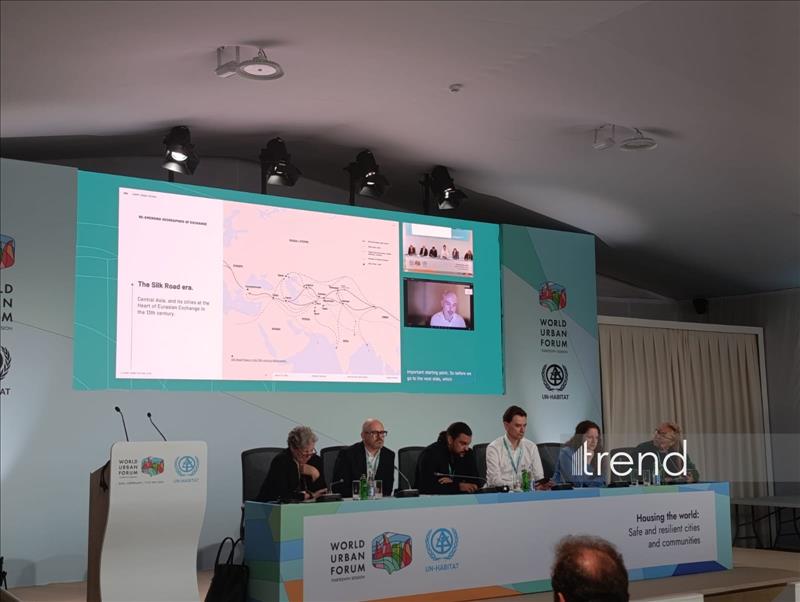
Silk Road Experience Applicable To Creating Service Cities In Central Asia - British Architect
(MENAFN- Trend News Agency)
BAKU, Azerbaijan, May 22. The ancient Silk Road
cities can provide many clues for creating a 21st-century service
city in the Central Asian region, British architect Harry Dobbs,
founder of Harry Dobbs Design Ltd and member of the Alatau City
Development Council, said during a session titled "New Capitals and
New Cities of Central Asia. Water-Sensitive Urban Planning and
Housing for Climate Resilience" within the framework of WUF13,
Trend reports.
"And not only at the level of urban structure, but also at the level of urban culture: from the ancient culture of caravanserai to the culture of a modern business district. There are aspects of human dynamics and relationships that have actually not changed all that much, and they give us clues on how to create something that is simultaneously culturally connected and modern," he said.
Dobbs noted that technology could become part of this dynamic.
"Although today we have, as already mentioned, completely different scales and paces of urbanization, creating environmental, social, and technical challenges, we have also gained tools that allow us to address these problems in completely new ways. And this is where 'smart' technologies can help. They provide the opportunity to understand, monitor, and manage the efficiency and impact of cities in ways that were previously impossible. Therefore, if you combine the ancient logistics of a service city with the capabilities of a 'smart' city, we get not just a top-down digital infrastructure typical of a smart city, but a smart service city based on an open data ecosystem, where residents are at the center of service delivery and city development," he said.
Dobbs noted that this stimulates the search for solutions, supporting the local economy and the service sector.
"And, in essence, this creates a city that is not only physical infrastructure, but also social and informational infrastructure - a system of thinking that puts residents at the center of developing urban services and solutions. An integrated digital, social, and physical infrastructure makes technical and sustainable development not just an engineering task, but a culturally meaningful and people-oriented process," he said.
Meanwhile, today Baku is hosting the final day of WUF13.
On the first day of the forum, a ministerial meeting on the New Urban Agenda, a ministerial roundtable, women's and civil society assemblies, business sessions, and discussions on urban well-being took place. The forum also featured a flag-raising ceremony for the UN and Azerbaijan.
The second day of the forum was marked by the first-ever Leaders' Summit. On this day, high-level discussions were held on the global housing crisis, urbanization policy, and urban sustainability. Also, as part of WUF13, the Mexico City pavilion was inaugurated, presented as a key platform for expanding cooperation with the Latin American region and preparing for WUF14.
--
Legal Disclaimer:
MENAFN provides the
information “as is” without warranty of any kind. We do not accept
any responsibility or liability for the accuracy, content, images,
videos, licenses, completeness, legality, or reliability of the information
contained in this article. If you have any complaints or copyright
issues related to this article, kindly contact the provider above.
Most popular stories
Market Research

More Story


Comments
No comment