

Canned Tuna Market Size, Share, Growth, Report By 2034


| Market Metric | Details & Data (2025-2034) |
|---|---|
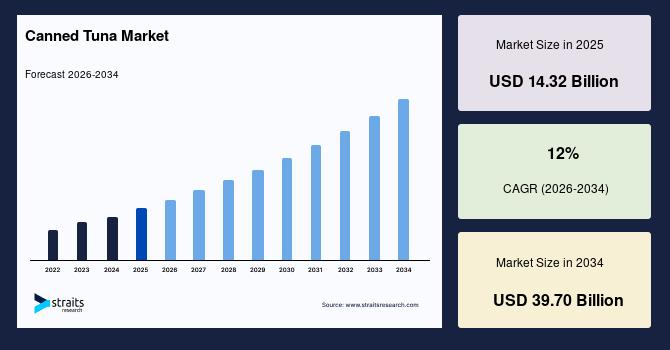
| 2025 Market Valuation | USD 14.32 Billion |
| Estimated 2026 Value | USD 16.03 Billion |
| Projected 2034 Value | USD 39.70 Billion |
| CAGR (2026-2034) | 12% |
| Study Period | 2022-2034 |
| Dominant Region | Europe |
| Fastest Growing Region | North America |
| Key Market Players | Frinsa, Century Pacific Food Inc., Jealsa, Thai Union Group PCL., Trimline International |
Download Free Sample Report to Get Detailed Insights.
Canned Tuna Market Dynamics Emerging Trends in Canned Tuna MarketRising Preference toward Ready-to-Cook Products
The growing dependency on ready-to-cook (RTC) and convenience food is a key trend driving the global market, as busy lifestyles and urbanization increase demand for quick, protein-rich meal options. Consumers are increasingly seeking shelf-stable, easy-to-use products that require minimal preparation while still offering nutritional value, making canned tuna a preferred choice. This trend is further supported by rising single-person households and on-the-go eating habits, which strengthen demand for ready-to-eat and ready-to-cook seafood formats. Manufacturers are also innovating with flavored, pre-seasoned, and meal-kit-style tuna products to expand usage occasions. For example, StarKist offers ready-to-eat tuna pouches that can be directly consumed or added to salads and sandwiches, aligning with the growing convenience food trend.
Shift Toward Sustainable Sourcing & Eco-Friendly Packaging
Rising consumer awareness about ocean conservation and food transparency drives tuna brands to rethink sourcing and packaging practices. Companies shift toward pole-and-line fishing, certified supply chains, and partnerships with groups like Marine Stewardship Council to ensure responsible catch methods. At the same time, manufacturers adopt recyclable cans, reduce plastic components, and introduce traceability tools such as QR codes showing catch origin. For example, John West implements its“Trace Your Tuna” initiative. Each pack carries a code that consumers can enter online to see details such as the fishing vessel, catch location, method (like pole-and-line or purse seine), and processing journey.
Canned Tuna Market DriversIncreasing Demand for Long Shelf-life Food and Culinary Versatility Drives Market
Increasing demand for long shelf-life and emergency food storage solutions is driving the canned tuna market as consumers and institutions increasingly prefer foods that remain safe for long durations without refrigeration. Busy urban lifestyles and limited storage space further strengthen this preference. Canned tuna offers durability, affordability, and ease of storage, making it suitable for pantry stocking, emergency kits, and institutional reserves such as schools, hospitals, and military facilities. Its long usability and minimal spoilage risk enhance its reliability as a stable protein source, supporting consistent demand across both household and large-scale consumption settings.
The rising popularity of global cuisines and convenience-based cooking formats is also a strong driver for the market. Consumers increasingly experiment with international dishes such as sushi bowls, pasta salads, sandwiches, and fusion wraps, where canned tuna serves as a versatile ingredient. It provides quick preparation, consistent taste, and easy portion control, making it ideal for both home cooking and food service operations. Quick-service restaurants and cafes also use canned tuna to reduce cooking time while maintaining menu variety.
Canned Tuna Market RestraintsMercury Contamination Concerns and Strong Competition from Alternative Proteins Restraints Market
Mercury contamination concerns act as a key restraint by influencing consumer perception and consumption frequency. Health agencies issue guidelines that limit tuna intake, especially for pregnant women and children. This creates caution among broader health-conscious groups. Media coverage further amplifies the risk, even when levels remain within safety limits. This mechanism directly affects demand stability and brand trust. Over time, such concerns slow market growth by limiting consumption occasions and restricting penetration in sensitive consumer segments.
Strong competition from alternative proteins restrains the canned tuna market by reducing its share in the overall protein consumption basket. Consumers increasingly choose plant-based proteins, fresh seafood, chicken, or eggs due to variety, pricing, or sustainability perceptions. Many alternatives also offer similar convenience and nutritional value, making substitution easier. This shifts consumer preference away from canned tuna, especially among younger and environmentally aware groups. As a result, adoption slows, and growth potential weakens in both mature and emerging markets where protein choices continue to expand.
Canned Tuna Market OpportunitiesIncreasing Preference for Functional & Fortified Tuna Products and Traceable Supply Chain Branding Offers Opportunities to Market Players
Increasing preference for functional and fortified tuna products creates a strong growth opportunity as consumers shift toward foods that offer added health benefits. Manufacturers can enrich canned tuna with vitamin D, calcium, or enhanced omega-3 to target immunity, bone strength, and brain health needs. This approach expands tuna's role from a basic protein source to a daily wellness product. Brands are introducing condition-specific variants such as heart-health or immunity-focused packs. As preventive healthcare awareness rises globally, fortified tuna can attract premium buyers and increase value-added product sales across urban and aging populations.
Traceable supply chain branding offers a significant growth opportunity as consumers demand transparency in seafood sourcing. Brands can use QR codes or blockchain systems to display catch location, fishing methods, and sustainability certifications. This builds trust and differentiates products in a crowded market. Traceability can become a standard expectation, especially in developed markets and premium segments. Companies that invest early in transparent sourcing can strengthen brand loyalty and justify higher pricing. As sustainability concerns grow, traceable tuna products can capture environmentally conscious consumers and expand market share globally.
Regional Insights Europe: Market Dominance by Strong Mediterranean Dietary Influence and High Frequency Seafood ConsumptionEurope accounted for a share of 35.74% in 2025, driven by strong Mediterranean dietary habits acting as a key driver for the canned tuna market in Europe. In countries such as Spain, Italy, and Greece, tuna is commonly used in everyday meals like salads, pasta, and sandwiches. This regular inclusion creates stable and repeat consumption patterns. The diet also emphasizes healthy fats and lean protein, which aligns well with tuna's nutritional profile. As consumers continue to follow traditional eating habits, demand remains consistent, supporting steady market growth and long-term product relevance across the region. According to the European Food Safety Authority, around 60% of individuals across European Union countries include fish and seafood in their diets, with many consuming these products several times a week.
Spain's canned tuna market is driven by the seafood culture, as consumers regularly include fish-based products in their daily meals. Tuna is widely used in home cooking across Spain, especially in simple dishes like tuna salad, empanadas, pasta, and sandwiches. This habitual usage supports consistent household demand throughout the year. For example, families often prepare“ensalada de atún” for quick lunches, reflecting its everyday role in diets. As a result, tuna remains a trusted, convenient, and affordable protein source, ensuring steady consumption and long-term market stability.
In Italy, the high weekly consumption of canned tuna acts as a strong driver for the market, as it reflects deep integration of tuna into everyday eating habits. Consumers regularly include tuna in simple meals such as pasta al tonno, rice bowls, sandwiches, and salads, especially during weekday lunches and quick dinners. This frequent usage builds routine demand and reduces dependence on fresh protein preparation.
North America: Fastest Growth Driven by Rising Health Consciousness and Demand for Lean Protein NutritionNorth America is expected to grow at a CAGR of 4.81% during the forecast period, driven by the growing focus on healthy eating strongly. Consumers increasingly prefer lean protein, low-fat food options, and omega-3-rich diets for weight management, fitness, and heart health benefits. Canned tuna fits these needs well, as it provides high-quality protein with minimal fat and supports balanced nutrition. Its easy availability and quick consumption make it a practical choice for daily meals. As health awareness rises, tuna continues to gain acceptance as a convenient and trusted protein staple.
In the US, the canned tuna market is strongly driven by rising health awareness among consumers who actively choose foods that support fitness, heart health, and weight management. Tuna is widely valued as a lean protein source that is low in fat while naturally providing omega-3 fatty acids, which are linked to better cardiovascular and brain health. This nutritional profile makes it highly suitable for modern diet preferences such as high-protein and low-calorie eating plans. Its easy availability, affordability, and ready-to-eat nature further strengthen its appeal.
The Canada canned tuna market is steadily growing due to the increasing demand for convenient meal solutions and pantry-stable foods. Consumers prefer foods that are easy to store, require no preparation, and support flexible meal planning in busy routines. Canned tuna meets these needs due to its long shelf life and ability to stay safe without refrigeration, making it ideal for regular household stocking. It is also commonly kept for emergency food reserves and quick meals during time constraints.
Canned Tuna Market Segmentation Analysis By TypeThe skipjack tuna segment accounted for a share of 55.21% in 2025, driven because it offers a stable and abundant supply throughout major fishing regions. It is widely available in large schools, which supports consistent harvesting and reduces sourcing risks for manufacturers. The species processes easily, so producers achieve high efficiency in cleaning, cooking, and canning operations. Its relatively low cost helps brands maintain affordable pricing for consumers. Skipjack also provides a mild taste that suits many recipes, making it highly suitable for large-scale commercial production and steady global demand across retail and food service channels.
The yellowfin tuna segment is expected to grow at a CAGR of 4.45% during the forecast period due to increasing consumer preference for premium seafood options. It offers a richer taste and firmer texture compared to standard varieties, which appeals to quality-focused buyers. Its higher protein content also supports fitness-oriented and health-conscious diets, strengthening demand. Rising interest in gourmet and restaurant-style meals at home further supports its use in packaged products.
By Sales ChannelThe supermarkets segment is expected to grow at a CAGR of 3.86% during the forecast period driven by the wide product assortment that allows consumers to choose from different brands, pack sizes, and price ranges in one place. This variety improves shopping convenience and helps buyers compare options easily before purchasing. Strong shelf visibility and organized layouts increase product discovery and encourage impulse buying. Supermarkets also maintain consistent stock availability, ensuring consumers find their preferred products during every visit.
The online segment is expected to grow at a CAGR of 5.41% during the forecast period due to rising e-commerce penetration and digital adoption among consumers. Increasing internet access and smartphone usage make grocery shopping easier, especially for urban households. Online platforms provide a wide range of brands, pack sizes, and price comparisons in one place, improving purchase convenience. Home delivery services save time and encourage repeat buying of pantry staples like canned tuna.
C ompetitive LandscapeThe canned tuna market is highly fragmented, with the presence of large multinational food companies, strong regional brands, private-label manufacturers, and smaller local processors. Established players mainly compete on brand reputation, consistent product quality, global supply chain strength, sustainability certifications, and wide distribution networks across supermarkets and retail chains. Emerging players focus on competitive pricing, niche product positioning such as premium or flavored tuna variants, and faster adaptation to changing consumer preferences, especially in online retail channels. Product innovation, packaging differentiation, and sourcing efficiency also serve as key competitive levers across all market participants.
List of Key and Emerging Players in Canned Tuna Market-
Frinsa
Century Pacific Food Inc.
Jealsa
Thai Union Group PCL.
Trimline International
Bumble Bee Foods, LLC.
Grupo Calvo
Wild Planet Foods
Thunnus Overseas Group
Aneka Tuna Indonesia
American Tuna
Ocean Brands GP.
StarKist
Trader Joes
Safeway
-
In March 2026, Thai Union advanced its end-to-end digital traceability system across its global seafood supply chain to improve transparency from vessel catch to retail shelf.
In November 2025, Thai Union was honored with the 2025 Sustainability Disclosure Award, recognizing its leadership in ESG transparency under the SeaChange sustainability framework.
| Report Metric | Details |
|---|---|
| Market Size in 2025 | USD 14.32 Billion |
| Market Size in 2026 | USD 16.03 Billion |
| Market Size in 2034 | USD 39.70 Billion |
| CAGR | 12% (2026-2034) |
| Base Year for Estimation | 2025 |
| Historical Data | 2022-2024 |
| Forecast Period | 2026-2034 |
| Report Coverage | Revenue Forecast, Competitive Landscape, Growth Factors, Environment & Regulatory Landscape and Trends |
| Segments Covered | By Type, By Sales Channel |
| Geographies Covered | North America, Europe, APAC, Middle East and Africa, LATAM |
| Countries Covered | US, Canada, UK, Germany, France, Spain, Italy, Russia, Nordic, Benelux, China, Korea, Japan, India, Australia, Taiwan, South East Asia, UAE, Turkey, Saudi Arabia, South Africa, Egypt, Nigeria, Brazil, Mexico, Argentina, Chile, Colombia |
Download Free Sample Report to Get Detailed Insights.
Canned Tuna Market Segments By Type-
Skipjack Tuna
Yellowfin Tuna
Bluefin Tuna
Others
-
Retail Outlets
Supermarket
Hypermarket
Online Market
Others
-
North America
Europe
APAC
Middle East and Africa
LATAM

Legal Disclaimer:
MENAFN provides the
information “as is” without warranty of any kind. We do not accept any
responsibility or liability for the accuracy, content, images, videos,
licenses, completeness, legality, or reliability of the information
contained in this article. If you have any complaints or copyright issues
related to this article, kindly contact the provider above.
Comments
No comment