

Cryogenic Valves Market Size, Share & Demand By 2034


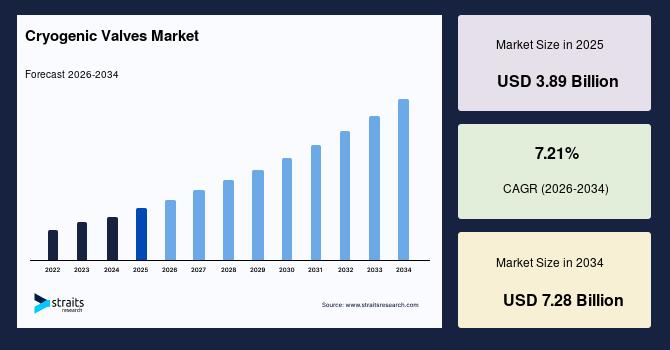
| Market Metric | Details & Data (2025-2034) |
|---|---|
| 2025 Market Valuation | USD 3.89 Billion |
| Estimated 2026 Value | USD 4.17 Billion |
| Projected 2034 Value | USD 7.28 Billion |
| CAGR (2026-2034) | 7.21% |
| Study Period | 2022-2034 |
| Dominant Region | Asia Pacific |
| Fastest Growing Region | North America |
| Key Market Players | Emerson Electric Co., Flowserve Corporation, Parker Hannifin Corporation, Velan Inc., Herose GmbH |
Download Free Sample Report to Get Detailed Insights.
Cryogenic Valves Market Dynamics Emerging Trends in the Cryogenic Valves MarketAutomation and Smart Valve Integration in Cryogenic Systems
Automation and smart valve integration are advancing performance standards in cryogenic valve applications across LNG, hydrogen, and industrial gas sectors. Electrically and pneumatically actuated valves equipped with digital positioners and embedded sensing technologies enable precise control under extreme low-temperature conditions. Connectivity with SCADA and distributed control systems supports continuous monitoring, remote adjustments, and faster response to operational changes. Enhanced control accuracy improves process stability and reduces human exposure in hazardous environments. Growing deployment in large-scale energy infrastructure highlights rising demand for intelligent valve systems designed for efficiency, reliability, and advanced process control.
IoT-Enabled Predictive Maintenance in Cryogenic Valves
IoT-enabled predictive maintenance is reshaping asset management practices for cryogenic valves in energy and industrial applications. Integrated sensors track parameters such as pressure, temperature, vibration, and valve position to detect early signs of wear or malfunction. Data collected is analyzed through cloud-based platforms, enabling timely maintenance decisions and minimizing unexpected equipment failures. Remote monitoring capabilities support efficient management of widely distributed assets, including LNG transport and storage networks. Increasing focus on operational continuity, cost optimization, and equipment longevity is accelerating adoption of predictive maintenance solutions powered by IoT technologies in cryogenic environments.
Cryogenic Valves Market DriversLNG Infrastructure Expansion and Ultra-Low Temperature Process Control Requirements Drives Market
The oil & gas industry is influencing demand for cryogenic valves through the continued build-out of LNG value chains, where valves are deployed across liquefaction trains, storage terminals, and regasification units. New LNG infrastructure projects are increasingly designed for higher throughput and multi-gas compatibility, which is pushing requirements toward valves that can maintain sealing performance under rapid thermal cycling and high-pressure differentials. At the same time, the shift toward LNG trading flexibility and spot cargo handling is increasing the need for faster isolation and control response in cryogenic systems, especially in export-oriented facilities and floating LNG configurations.
In the chemical and pharmaceutical sectors, demand is being shaped by process intensification and tighter control requirements in low-temperature environments rather than just volume expansion. In chemicals, cryogenic valves are increasingly integrated into gas separation, air liquefaction, and specialty gas handling systems where purity control and leak minimization directly affect downstream process efficiency. In pharmaceuticals, growth in biologics manufacturing and long-duration cold-chain storage is driving adoption of valves that can support sterile cryogenic environments, particularly in applications involving liquid nitrogen-based preservation, cell therapy storage, and vaccine logistics, where even minor thermal or particulate instability can affect product integrity.
Cryogenic Valves Market RestraintsSafety Concerns Regarding Operation of Liquefied Gases and Complex Maintenance Restrain Market Growth
Operation of liquefied gases such as LNG, liquid nitrogen, oxygen, and argon introduces inherent safety constraints due to extreme low temperatures and high expansion ratios. A small leak can rapidly vaporize into large gas volumes, creating risks of asphyxiation, fire hazards (in the case of oxygen-enriched environments), and over-pressurization in confined spaces. These conditions place strict requirements on system integrity, where even minor sealing failures in valves or joints can escalate into critical operational incidents. As a result, handling and transfer systems must maintain continuous structural stability under thermal cycling and pressure fluctuations, limiting operational flexibility.
Another key restraint comes from the complexity and cost of maintaining cryogenic safety standards across storage, transport, and processing infrastructure. Equipment such as cryogenic valves, insulation systems, and monitoring sensors require specialized materials and frequent validation to prevent brittle fracture and leakage. Additionally, compliance with stringent safety regulations increases engineering and maintenance overhead, particularly in LNG terminals and industrial gas facilities. This elevates lifecycle costs and can slow project execution timelines, especially in large-scale chemical, energy, and pharmaceutical installations where multiple cryogenic handling points are involved.
Cryogenic Valves Market OpportunityHydrogen-powered Aviation & Maritime Applications and Expanding Commercial Space Programs Offers Opportunities to Market Players
Hydrogen-powered aviation and maritime bunkering are opening new growth avenues for cryogenic valve manufacturers. Liquid hydrogen storage, transfer, and fueling systems require compact, lightweight, and safety-certified valve designs capable of handling extremely low temperatures and high-pressure cycles. Material innovation focused on resistance to hydrogen embrittlement is critical for long-term durability.
Fast-fill fueling infrastructure demands valves engineered for rapid flow rates and minimal leakage. Compliance with stringent aerospace and marine safety standards increases the need for precision-engineered components. Expanding investments in zero-emission aircraft and clean shipping corridors are strengthening demand for specialized cryogenic valve solutions.
Expanding commercial space programs and advanced propulsion technologies are creating strong demand for high-performance cryogenic valves. Applications involving liquid oxygen, liquid hydrogen, and liquid methane require valves that operate reliably under extreme pressure, temperature, and vibration conditions. Opportunities exist in developing lightweight and high-strength valve materials suitable for flight systems and reusable launch vehicles. Ground support infrastructure and in-orbit refueling systems also require high-flow, precision-controlled valve solutions. Increasing satellite deployments, deep-space exploration missions, and private sector launch activity are accelerating the need for durable, high-efficiency cryogenic valves tailored for aerospace environments.
Regional Analysis Asia Pacific: Market Dominance by Increasing LNG Dependency and Rising LNG Consumption in Fertilizers and Power SectorsAsia Pacific dominated the cryogenic valves market with a share of 37.94% in 2025 due to the rapid expansion of LNG import terminals and regasification capacity across China, India, and Southeast Asia, which leads to strong demand for cryogenic valves across storage tanks, transfer pipelines, and vaporization units handling ultra-low temperature LNG.
New onshore terminals and floating storage regasification units require extensive valve installations for isolation, throttling, and emergency shutdown functions. Long-term LNG procurement agreements and rising gas-fired power generation increase terminal utilization, supporting replacement cycles and maintenance demand. Strict requirements for leak tightness, thermal resistance, and operational safety accelerate adoption of high-performance cryogenic valve technologies across Asia Pacific LNG infrastructure.
China's cryogenic valves market is driven by the rising LNG import dependency and long-term supply contracts. Large-scale terminal construction increases procurement across liquefied gas storage tanks, unloading systems, and vaporization units requiring ultra-low-temperature flow control.
China's LNG imports are projected at about 70.5–75.5 million metric tons in 2026, reflecting rising demand from power generation and transport sectors. Around 35 LNG regasification terminals were operational in 2025, with a combined capacity of nearly 149 MTPA. Expansion continues with an additional 37.6 MTPA capacity expected in 2026. Key projects, including Tangshan II and Zhoushan II, are set to add roughly 584 billion cubic feet of capacity each by 2026–2027, strengthening import infrastructure and supporting higher LNG throughput.
The India cryogenic valves market is accelerating growth due to the rising LNG consumption in fertilizer and power sectors in India, increasing throughput at regasification terminals, driving higher utilization of cryogenic valves across storage, transfer, and vaporization systems. Fertilizer plants relying on natural gas feedstock require consistent LNG supply, intensifying flow cycles and operational stress on valves.
Gas-based power plants operating under peak load conditions further elevate demand for reliable flow control components. The Ministry of Petroleum and Natural Gas reports LNG contributes about 45–50% of India's total gas supply, indicating high import dependence. Petroleum Planning and Analysis Cell data shows the fertilizer sector accounts for roughly 30–32% of gas consumption, while the power sector holds about a 15–18% share.
North America: Fastest Growth Driven by LNG Exports and Deployment of Advanced TechnologiesNorth America is expected to grow at a CAGR of 6.81% during the forecast period due to the expansion of aerospace and space propulsion test infrastructure, which drives demand for cryogenic valves engineered for LOX, LH2, and liquid methane service. Programs led by NASA's Artemis program, SpaceX, and Blue Origin increase requirements for ground support equipment, propellant loading skids, and high-cycle test stands. Reusable launch vehicle development intensifies the need for valves with superior sealing, low leakage, and resistance to vibration, thermal shock, and rapid chill-down. Advanced in-space propellant storage and transfer research further stimulates custom valve design, qualification, and certification activity across commercial and government facilities.
The US cryogenic valves market is steadily growing due to LNG exports, anchored by large-scale liquefaction capacity along the Gulf Coast, accelerating procurement of cryogenic valves engineered for ultra-low-temperature service. The US has become the world's largest LNG exporter, with volumes increasing from 0.5 Bcf/d in 2016 to around 15.0 Bcf/d in 2025, driven by rapid expansion of liquefaction capacity. Annual exports surpassed 100 million metric tons (≈111 MMT) in 2025, capturing about 25% of global LNG trade and exceeding export volumes from Qatar and Australia.
Expansion of export terminals increases installation across liquefaction trains, cryogenic storage tanks, and marine loading arms, where tight shutoff, thermal stability, and leak prevention remain critical. High-throughput operations and continuous cycling conditions require durable valve materials and advanced sealing technologies.
The Canada cryogenic valves market is gaining momentum from a strong cluster of LNG export projects in British Columbia, creating steady demand across liquefaction units, storage facilities, and marine loading operations. Seven projects with ~50.3 MTPA capacity and nearly USD 109 billion in capital investment require significant volumes of valves designed for ultra-low temperature LNG applications. Stringent requirements for durability, thermal efficiency, and safety compliance accelerate deployment of advanced cryogenic valve technologies, while large-scale construction and commissioning activities sustain ongoing procurement and long-term maintenance and service agreements across Canada's expanding LNG infrastructure.
Cryogenic Valves Market Segmentation Analysis By Product TypeThe ball valves segment accounted for a share of 33.42% share in 2025 due to high demand in LNG storage tanks and transfer pipelines due to their tight shut-off capability that minimizes leakage and reduces boil-off gas losses. Their reliable sealing under ultra-low temperatures ensures safe handling of liquefied gases. Continuous operation cycles in terminals increase preference for durable, low-maintenance solutions. This supports strong adoption across critical cryogenic applications.
The globe valves segment is expected to grow at a CAGR of 7.85% during the forecast period, driven by rising demand for precise throttling and flow regulation in LNG vaporization units and pressure letdown systems. Accurate control of flow and pressure ensures stable regasification and prevents system fluctuations. Their ability to handle high-pressure differentials supports safe operation. Compatibility with automated control systems further enhances efficiency across cryogenic processing and distribution stages.
By ApplicationThe tanks & cold boxes segment is expected to grow at a CAGR of 6.08% during the forecast period, driven by the extensive use of cold boxes in air separation units across heat exchangers and low-temperature process sections. Complex internal piping networks require multiple valves for flow isolation, pressure control, and safety functions. Continuous industrial gas production increases reliance on durable, leak-tight solutions. This supports steady procurement across integrated cryogenic systems.
The transfer lines segment is expected to grow at a CAGR of 6.73% during the forecast period, driven by the expansion of LNG regasification terminals and import infrastructure. Installation of pipelines connecting storage tanks, vaporization units, and loading systems increases valve demand. Rising liquefied gas flow requires reliable isolation and control mechanisms. High-frequency operations and long pipeline networks strengthen adoption of durable, leak-tight cryogenic valves.
By Cryogen TypeThe LNG segment accounted for a 39.45% share in 2025, driven by the expansion of liquefaction and regasification terminals requiring large-scale deployment of cryogenic valves across processing trains, storage, and transfer systems. Each facility relies on extensive valve networks for isolation, pressure control, and safety under ultra-low temperatures. Rising terminal projects and capacity additions ensure consistent procurement. This sustains strong demand across global LNG infrastructure.
The hydrogen segment is expected to grow at a CAGR of 8.10% during the forecast period, driven by the development of liquid hydrogen transport infrastructure. Systems handling hydrogen at around –253°C require advanced cryogenic valves with reliable flow control and leak-tight performance. Increasing deployment of LH2 carriers, pipelines, and refueling networks strengthens demand. This drives adoption of advanced materials and precision sealing technologies.
By End-use IndustryThe oil & gas segment is expected to register a CAGR of 6.28% during the forecast period, driven by expanding LNG liquefaction, storage, regasification, and transportation infrastructure. Large-scale terminal developments and growing cross-border LNG trade require safe and efficient ultra-low temperature flow control. Rising natural gas consumption for power and industrial use supports wider valve deployment. This sustains demand across upstream, midstream, and downstream operations globally.
The food & beverages segment is anticipated to grow at a CAGR of 5.61% during the forecast period, driven by increasing adoption of cryogenic freezing, cold-chain preservation, and liquid nitrogen–based processing. Expansion of frozen food production, dairy processing, and ready-to-eat segments strengthens demand. Precise temperature control remains critical for product quality and safety. This supports steady adoption of cryogenic valve solutions.
List of Key and Emerging Players in Cryogenic Valves Market-
Emerson Electric Co.
Flowserve Corporation
Parker Hannifin Corporation
Velan Inc.
Herose GmbH
L&T Valves (Larsen & Toubro)
Bray International Inc.
Habonim Valve Solutions (Habonim Industrial Valves & Actuators)
Powell Valves
The Weir Group PLC
Schlumberger Limited (Cameron)
KITZ Corporation
Baker Hughes
Samson Controls Inc.
Alfa Laval
-
In July 2025, Alfa Laval acquired Fives Energy Cryogenics SAS, expanding its cryogenic engineering and system capabilities relevant to LNG and industrial gas handling.
In June 2025, Flowserve Corporation and Chart Industries announced a merger of equals, strengthening their combined position in industrial flow control systems, including LNG-related cryogenic applications.
In March 2025, Emerson Electric Co. supplied cryogenic valves from its Fisher and Vanessa portfolio for LNG terminal and liquefaction projects, supporting applications in LNG liquefaction, storage, and regasification systems across global facilities.
| Report Metric | Details |
|---|---|
| Market Size in 2025 | USD 3.89 Billion |
| Market Size in 2026 | USD 4.17 Billion |
| Market Size in 2034 | USD 7.28 Billion |
| CAGR | 7.21% (2026-2034) |
| Base Year for Estimation | 2025 |
| Historical Data | 2022-2024 |
| Forecast Period | 2026-2034 |
| Report Coverage | Revenue Forecast, Competitive Landscape, Growth Factors, Environment & Regulatory Landscape and Trends |
| Segments Covered | By Product Type, By Application, By Cryogen Type, By End-use Industry |
| Geographies Covered | North America, Europe, APAC, Middle East and Africa, LATAM |
| Countries Covered | US, Canada, UK, Germany, France, Spain, Italy, Russia, Nordic, Benelux, China, Korea, Japan, India, Australia, Taiwan, South East Asia, UAE, Turkey, Saudi Arabia, South Africa, Egypt, Nigeria, Brazil, Mexico, Argentina, Chile, Colombia |
Download Free Sample Report to Get Detailed Insights.
Cryogenic Valves Market Segments By Product Type-
Ball Valves
Gate Valves
Check Valves
Globe Valves
-
Transfer Lines
Tanks & Cold Boxes
Manifolds & Trains
-
LNG
Nitrogen and Oxygen
Hydrogen
-
Oil & Gas
Chemical
Food & Beverages
Medical
-
North America
Europe
APAC
Middle East and Africa
LATAM

Legal Disclaimer:
MENAFN provides the
information “as is” without warranty of any kind. We do not accept any
responsibility or liability for the accuracy, content, images, videos,
licenses, completeness, legality, or reliability of the information
contained in this article. If you have any complaints or copyright issues
related to this article, kindly contact the provider above.
Comments
No comment