




403
Sorry!!
Error! We're sorry, but the page you were looking for doesn't exist.
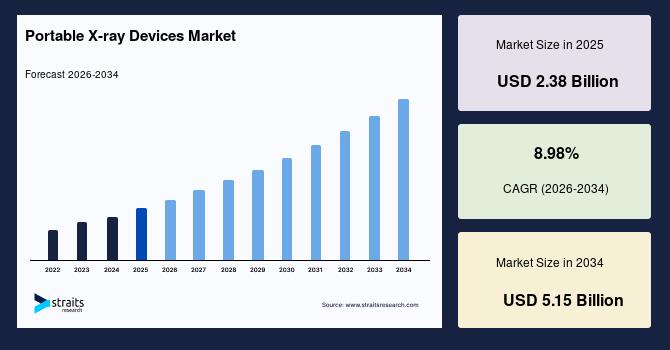
Portable X-Ray Devices Market Size, Share & Growth Graph By 2034
| Market Metric | Details & Data (2025-2034) |
|---|---|
| 2025 Market Valuation | USD 2.38 Billion |
| Estimated 2026 Value | USD 2.59 Billion |
| Projected 2034 Value | USD 5.15 Billion |
| CAGR (2026-2034) | 8.98% |
| Study Period | 2022-2034 |
| Dominant Region | North America |
| Fastest Growing Region | Europe |
| Key Market Players | Envista Holdings Corporation, GE Healthcare, Canon Medical Systems, MinXray, Koninklijke Philips NV |
Download Free Sample Report to Get Detailed Insights.
Emerging Trends in Portable X-ray Devices Market Shift toward Point-of-Care & Decentralized ImagingHealthcare delivery is steadily shifting from centralized radiology departments toward decentralized, point-of-care imaging models. Portable X-ray devices are increasingly deployed in ICUs, emergency rooms, ambulances, nursing homes, home healthcare, and remote or resource-limited clinics. This transition is driven by the need to avoid patient movement, especially for critically ill, elderly, or immobile patients, where transport can increase clinical risk. It also addresses infrastructure constraints in rural and emergency environments where fixed radiology setups are unavailable. For example, bedside chest radiography in ICUs allows rapid assessment of conditions such as pneumonia, fluid accumulation, or line placement without disrupting patient care. Overall, this trend improves diagnostic turnaround time, enhances clinical workflow efficiency, and expands imaging access beyond traditional hospital radiology infrastructure.
Shift toward AI Imaging WorkflowsPortable X-ray systems are increasingly being enhanced with artificial intelligence to support faster and more accurate image interpretation. AI algorithms are used to detect abnormalities such as fractures, lung infections, tuberculosis signs, and cardiopulmonary conditions directly from X-ray images. This transition reduces dependence on immediate specialist availability, particularly in emergency departments and remote care settings. Integration with cloud platforms and hospital information systems further enables real-time image sharing and remote radiologist review. For example, AI-enabled portable X-ray devices can prioritize critical cases by flagging suspected pneumothorax or severe pneumonia at the point of care. This trend improves diagnostic precision, accelerates reporting workflows, and enhances decision support in high-pressure and resource-constrained healthcare environments.
Portable X-ray Devices Market Drivers Growing Focus on Infection Control and Hospital-Acquired Infection (HAI) Reduction Drive MarketInfection control requirements in hospitals are increasing due to the need to limit hospital-acquired infections and protect critically ill patients in ICUs and isolation wards. This drives demand for portable X-ray devices as they eliminate the need for patient transport to radiology departments and reduce exposure in shared hospital spaces such as corridors, elevators, and waiting areas where infection spread risk is higher. Hospitals also use bedside imaging to maintain strict isolation protocols while ensuring uninterrupted diagnostic workflows. As a result, adoption of portable X-ray systems increases in critical care settings, leading to improved infection control, reduced cross-contamination risk, and more efficient ICU operations.
Examples:
-
In ICU settings, portable chest X-rays are routinely used to verify central line placement and assess ventilator-associated complications without moving critically ill patients to radiology rooms.
In tuberculosis isolation wards, bedside X-rays are performed to monitor lung condition progression while preventing patient movement across general hospital areas.
The expansion of home healthcare services and hospital-at-home programs increases demand for diagnostic tools that can function outside traditional hospital infrastructure. This drives demand for portable X-ray devices as healthcare providers require mobile imaging solutions for elderly patients, post-surgical recovery cases, and individuals with chronic conditions who need regular monitoring but benefit from home-based care. It also supports healthcare systems aiming to reduce hospital occupancy pressure and improve care delivery efficiency. As a result, portable imaging adoption grows in home care ecosystems, improving diagnostic accessibility and enabling continuous monitoring outside clinical facilities.
Examples:
-
Home healthcare providers use portable X-ray systems to evaluate suspected hip fractures in elderly patients with mobility limitations, avoiding emergency hospital transfers.
Orthopedic follow-up care is conducted at home using portable X-rays to assess healing progress after knee or ankle surgeries, reducing repeated outpatient hospital visits.
The use of ionizing radiation in portable X-ray devices acts as a key restraining factor in the market. This risk arises because frequent or improperly controlled exposure can affect both patients and healthcare professionals, especially in non-controlled environments outside dedicated radiology rooms. As a result, strict safety protocols, shielding requirements, and trained operator dependency become essential, which limits ease of deployment. This leads to cautious adoption in home care, field settings, and small clinics where regulatory compliance and safety infrastructure are harder to maintain. Overall, the perceived radiation risk slows widespread adoption and increases operational constraints, particularly in non-hospital environments.
Portable X-ray devices face a restraining factor due to relatively lower image resolution and consistency compared to fixed radiology systems. This limitation arises because compact design constraints, lower power output, and mobility-focused components can reduce imaging precision in certain complex diagnostic cases. As a result, clinicians may require repeat scans or confirmation through stationary X-ray systems for detailed evaluation, especially in advanced orthopedic or thoracic assessments, which reduces clinician confidence in standalone use.
Portable X-ray Devices Market Opportunities Growth in Emergency, Disaster, and Field Healthcare Applications Opens Growth Avenues in Portable X-ray Devices MarketRising demand for rapid diagnostic capability in emergency and field healthcare acts as a key growth opportunity for portable X-ray devices. This factor emerges from the need for immediate imaging in situations where hospital infrastructure is unavailable or patient movement is not feasible. Portable X-ray systems provide on-the-spot imaging in ambulances, disaster relief camps, military medical units, and offshore healthcare setups, enabling faster triage and treatment decisions. As a result, adoption increases in high-mobility and critical response environments, where speed and accessibility are more important than full radiology infrastructure.
Future scenario: Portable X-ray devices become standard equipment in emergency response kits and mobile medical units, supporting real-time diagnostics in disaster zones, battlefield care, and remote industrial sites with minimal setup time.
Examples:
-
Emergency medical teams use portable chest X-rays in ambulances to assess trauma patients with suspected rib fractures or pneumothorax before hospital arrival.
Offshore oil rigs deploy portable X-ray systems to diagnose workplace injuries such as fractures without requiring patient evacuation to mainland hospitals.
The expansion of veterinary healthcare services acts as a significant growth opportunity for portable X-ray devices. This factor arises from the need for flexible imaging tools that can be used in farms, animal shelters, equine facilities, and mobile veterinary clinics where transporting animals to imaging centers is difficult. Portable systems enable veterinarians to perform quick diagnostics for injuries, fractures, and internal conditions directly at the site of care. As a result, adoption grows in animal healthcare segments, supporting faster treatment decisions and improved animal welfare outcomes.
Future scenario: Portable X-ray devices become widely used in routine veterinary practice and field animal care programs, especially in rural and agricultural regions where mobile diagnostics become the primary imaging solution.
Examples:
-
Veterinarians use portable X-rays on farms to diagnose limb fractures in horses without needing to transport large animals to specialized clinics.
Mobile veterinary units use portable imaging to assess injuries in stray or shelter animals, enabling immediate treatment planning on-site.
North America led the market with a share of 38.50% in 2025. Growing chronic diseases, a rapidly evolving healthcare infrastructure, and technologically advanced players in this region contribute to the growth.
-
For instance, 2,281,658 new cancer cases were diagnosed in the U.S. in 2020, with 612,390 fatalities, according to the GLOBOCAN 2020 report. Similarly, according to a report published by Arthritis in Canada in August 2021, 1 in 5 Canadians aged 15 or older, or more than 6.0 million, had arthritis. Furthermore, according to the same source, approximately one in two seniors over 65 had arthritis. The increased prevalence of chronic diseases raises the demand for an accurate diagnosis and a timely treatment plan from healthcare providers. Therefore, there will be a surge in the need for portable X-ray equipment, which will spur market expansion in the North American region.
Europe is expected to grow at a CAGR of 10.20% over the forecast period. The market for portable X-ray devices in the region is growing due to the rising frequency of chronic conditions like cardiovascular disease, the aging population, the rising need for precise diagnosis, and favorable government initiatives.
-
For instance, according to estimates from the Global Cancer Observatory, 628,519 new cancer cases were identified in Germany in 2020, with 252,065 cancer fatalities. In addition, according to the World Population Ageing Report (2019), the U.K. population aged 65 and above was 12,499 thousand in 2019, with an expected increase of up to 18,775 thousand in 2050. Several age-related bone illnesses have been linked with the aging population, resulting in increased demand for portable X-ray devices for diagnosis, driving market growth.
In Asia-Pacific, some major factors affecting the market include the growing prevalence of chronic diseases, like arthritis and cancer, the upsurge in demand for effective diagnostic imaging techniques, the adoption of advanced technologies, and government policies. For instance, as per the Indian Ministry of Health & Family Welfare 2019-2020 annual report, the Ministry of Health & Family Welfare has taken steps to incorporate screening and management programs for five priority chronic diseases like cardiovascular diseases, cancer, and other chronic diseases to focus on early diagnosis and management of diseases which is expected to boost the market growth and increase demand for x-ray devices in the country, ultimately having a positive effect on the development of the market over the coming years.
In the Middle East and Africa region, growth in the geriatric population is one of the significant factors driving the market's growth.
-
For instance, per United Nations Population Fund's World Population Dashboard's Statistics 2021, approximately 3.4% of Kuwait's population is 65 years and above. Since this age group is more vulnerable to chronic and lifestyle disorders, the demand for portable X-ray devices is anticipated to increase owing to regular screening procedures and early diagnosis of the diseases.
The South American region is further bifurcated into Argentina, Brazil, and the Rest of South America. Brazil dominates the regional market. The main growth drivers for the regional market are the rising prevalence of chronic disorders, the expanding geriatric population, and the rising level of consumer awareness. The country shows a major shift in the private health sector, a supporting factor for the Brazilian portable X-ray devices market. According to the Global Cancer Observatory estimates, in 2020, 592,212 new cancer cases were diagnosed and 259,949 cancer deaths in Brazil. By 2040, there will likely be 995,000 new cases of cancer, according to the same source. The high burden of cancer disorders is expected to boost the market growth for portable X-ray diagnostic devices.
Portable X-ray Devices Market Segmentation Analysis By TechnologyThe digital X-ray segment is expected to grow at a rate of 10.40% during the forecast period. Digital X-ray systems use several solid-state detectors, such as silicon or amorphous selenium, to directly transform the transmitted X-ray radiation into a digital image, which is then shown on a computer. Digital X-rays are safer since they emit far less radiation than analog (traditional) X-rays. In addition, the digital system's high-quality image is produced immediately after the treatment, reducing the waiting period. These factors are leading to a global increase in the use of digital X-ray equipment, which is anticipated to fuel segment expansion over the projected period.
Analog X-ray is a traditional X-ray system used globally since the beginning that uses photographic plates to store X-ray images. In analog X-ray, an X-ray beam is generated and transmitted through a patient to produce an image on film or a radiation detector. Depending on tissue density, various soft tissues attenuate X-ray radiation differently; the denser the tissue, the whiter the image. Analog X-ray is used extensively in healthcare settings due to its many applications and is considered the first diagnostic procedure for medical conditions like fractures.
By ApplicationDental X-ray dominated the application segment in 2025 with a share of 34.60%. Portable X-ray systems are used in dentistry to visualize dental diseases and surrounding tissues that cannot be evaluated with a simple oral exam. Portable dental X-rays identify decay beneath an existing filling, visualize decay areas in teeth, and assist in tooth implants, braces, dentures, or other dental procedures, among many other functions. Compared to fixed systems, portable dental X-rays offer greater accuracy and versatility in capturing images of the dental portion of the body. As a result, they are highly recommended and utilized for dental procedures, which will fuel the segment's growth.
Mammography is a standard diagnostic and screening technique that employs low-dose X-rays to detect breast cancer in women with no visible symptoms (when it is most curable). The image produced by an X-ray is known as a mammogram. Mammograms fall into two categories: screening and diagnostic. The growing incidences of breast cancer across the globe are driving the demand for mammography procedures and are anticipated to fuel the segment's growth.
By ModalityThe handheld X-ray devices segment is expected to grow at a CAGR of 11.20% during the forecast period. Portable X-ray devices are considered mobile if they are equipped with wheels that allow for simple relocation from one location to another and if they are occasionally powered by an electric motor supplied by a battery that aids the movement of the mobile unit when the operator drives it with less effort. In addition, mobile diagnostics/screening vans are also equipped with mobile X-ray devices when deployed in rural or remote regions where radiology facilities are unavailable. With the increasing initiatives for expanding healthcare facilities in remote regions by governments and private entities, the mobile X-ray devices segment is expected to grow over the forecast period.
Handheld X-ray equipment is compact, highly portable, and can be operated with one hand. These devices are available in two types: a pistol design resembling a hairdryer operated by a trigger on the handle and a camera-like design operated by a push-button. These devices offer greater operating flexibility than the other X-ray devices, are highly convenient, occupy less space, and are cost-effective. These factors collectively drive the demand for handheld X-ray devices worldwide.
List of Key and Emerging Players in Portable X-ray Devices Market-
Envista Holdings Corporation
GE Healthcare
Canon Medical Systems
MinXray
Koninklijke Philips NV
FUJIFILM Holdings Corporation
Shimadzu Corporations
Carestream Health Inc.
Siemens Healthineers AG
-
In March 2026, OXOS Medical received clearance for pediatric use of its portable X-ray system (MC2), expanding clinical applicability beyond adult imaging.
In December 2025, Carestream underwent a major structural change where its business was split into two entities, with Carestream International acquired by Midea Group, while the US operations were separated into a standalone entity.
In November 2025, GE HealthCare agreed to acquire Intelerad Medical Systems for USD 2.3 billion, expanding its cloud-based enterprise imaging and workflow ecosystem.
| Report Metric | Details |
|---|---|
| Market Size in 2025 | USD 2.38 Billion |
| Market Size in 2026 | USD 2.59 Billion |
| Market Size in 2034 | USD 5.15 Billion |
| CAGR | 8.98% (2026-2034) |
| Base Year for Estimation | 2025 |
| Historical Data | 2022-2024 |
| Forecast Period | 2026-2034 |
| Report Coverage | Revenue Forecast, Competitive Landscape, Growth Factors, Environment & Regulatory Landscape and Trends |
| Segments Covered | By Technology, By Applications, By Modality |
| Geographies Covered | North America, Europe, APAC, Middle East and Africa, LATAM |
| Countries Covered | US, Canada, UK, Germany, France, Spain, Italy, Russia, Nordic, Benelux, China, Korea, Japan, India, Australia, Taiwan, South East Asia, UAE, Turkey, Saudi Arabia, South Africa, Egypt, Nigeria, Brazil, Mexico, Argentina, Chile, Colombia |
Download Free Sample Report to Get Detailed Insights.
Portable X-ray Devices Market Segments By Technology-
Analog X-ray
Digital X-ray
-
Dental X-ray
Mammography
Chest X-ray
Abdomen X-ray
-
Handheld X-ray Devices
Mobile X-ray Devices
-
North America
Europe
APAC
Middle East and Africa
LATAM

Legal Disclaimer:
MENAFN provides the
information “as is” without warranty of any kind. We do not accept
any responsibility or liability for the accuracy, content, images,
videos, licenses, completeness, legality, or reliability of the information
contained in this article. If you have any complaints or copyright
issues related to this article, kindly contact the provider above.
Most popular stories
Market Research

More Story








Comments
No comment