






403
Sorry!!
Error! We're sorry, but the page you were looking for doesn't exist.
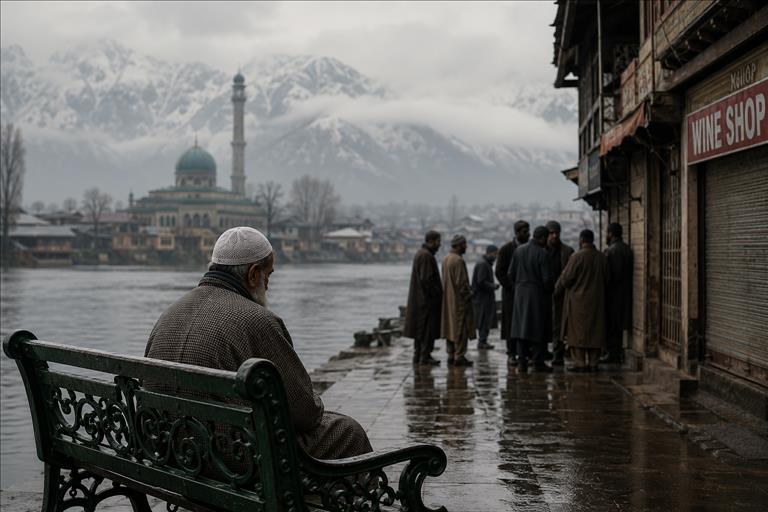
Kashmir's Liquor Economy Faces A Hard Calculation
(MENAFN- Kashmir Observer) Near midnight at Srinagar's Shri Maharaja Hari Singh Hospital, doctors moved quickly between a young crash victim with a fractured skull and two women waiting after a domestic assault complaint. Attendants standing near the emergency ward spoke in low voices and repeated the same word: sharab.
ADVERTISEMENT
Hospital workers in Kashmir describe a visible rise in alcohol-linked emergencies during recent years. Surgeons speak of road accidents involving young men, psychiatrists report growing addiction cases, social workers describe families selling jewelry and land to absorb mounting debt, and economists point toward another number that now sits at the center of a widening debate in Kashmir: ₹260 crore.
ADVERTISEMENT
That figure represents the valley's annual contribution to Jammu and Kashmir's liquor revenue, according to official excise data cited in the Union Territory's 2026-27 budget documents.
Officials project total liquor revenue for Jammu and Kashmir at nearly ₹3,000 crore this year, placing excise among the government's largest internal revenue streams.
A closer look at the numbers reveals a striking regional divide.
Jammu region hosts more than 220 liquor outlets and generates nearly ₹2,740 crore, or more than 91 percent of total excise revenue. Kashmir operates only four licensed liquor shops and contributes roughly ₹260 crore.
Five districts in the valley, including Pulwama, Shopian, Bandipora, Budgam and Kulgam, function without a single liquor outlet after sustained community opposition.
Jammu district alone contains 153 wine shops and 97 bars, according to excise records. That total exceeds the number of outlets operating in the entire valley many times over.
Those figures now fuel raging debate that reaches far beyond morality. Economists, doctors, religious leaders and business groups increasingly frame the issue through a harder question: Does liquor revenue actually benefit Kashmir economy?
Researchers and public finance analysts examining government data argue that the valley absorbs social and economic losses that vastly exceed the taxes collected through alcohol sales.
ADVERTISEMENT“The revenue looks impressive in budget speeches,” said Dr. Mujeeb Hassan, a Srinagar-based economist who studies public expenditure.“The larger picture emerges when healthcare costs, crime, lost productivity and family debt enter the calculation. Kashmir earns a very small fraction of total excise revenue while paying a disproportionately high social price.”
Official records show Jammu and Kashmir's liquor industry expanded dramatically after online auction reforms transformed the licensing system. Excise auction collections climbed from roughly ₹10 crore in 2020 to more than ₹1,118 crore in 2024-25. Alcohol sales increased sharply as well, rising from 471 lakh bottles in 2020-21 to more than 672 lakh bottles within three years.
Government officials defend the revenue as fiscally necessary.
Jammu and Kashmir's ₹1.27 lakh crore budget relies heavily on central assistance, which accounts for nearly two-thirds of public revenue. Excise collections support expenditures that include salaries, pensions, infrastructure, electricity purchases and welfare programs. Budget documents link state spending to crop insurance schemes, support for orphaned children and subsidized LPG programs.
Finance officials privately acknowledge that replacing ₹3,000 crore in annual revenue would strain an administration already dependent on federal support.
Kashmir critics of liquor policy respond with a narrower argument. They focus on the valley rather than the entire Union Territory.
Their case rests on a blunt equation.
Several local studies compiled by economists and public health researchers estimate that Kashmir Valley suffers annual alcohol-linked losses ranging between ₹1,500 crore and ₹2,500 crore. Those losses include healthcare spending, addiction treatment, workplace absenteeism, reduced productivity, domestic violence intervention, road accidents and illegal alcohol trade.
Researchers estimate that households in the valley spend ₹400 crore to ₹600 crore each year on alcohol consumption alone. Economists describe that spending as money diverted away from education, healthcare and savings.
At Srinagar's Institute of Mental Health and Neurosciences, psychiatrists say younger patients now come with addiction problems once associated largely with older men.
“Kashmir's median age remains very young,” said a senior psychiatrist at the hospital who requested anonymity because he lacked authorization to speak publicly.“Alcohol dependence affects educational performance, family relations and employability. Families often seek help after years of silent deterioration.”
Police officers and social workers describe a similar pattern inside homes.
A women's rights counsellor in downtown Srinagar recalled recent cases involving alcohol-linked domestic disputes.“Many families come very late,” she said.“Debt accumulates first, violence enters later. Children absorb the emotional damage throughout.”
Road safety officials also point toward rising concern. Traffic police officers estimate that alcohol contributes to a significant share of serious night-time accidents in urban areas, particularly among younger drivers.
Community leaders argue that the debate reaches deeper into Kashmir's cultural identity.
Kashmir's Muslim-majority population has long maintained social resistance toward alcohol consumption. Religious scholars and local elders frequently describe liquor outlets as incompatible with the valley's social traditions and Sufi heritage.
That tension surfaces sharply in public protests whenever authorities attempt to open new liquor shops in Kashmir towns.
Outside a mosque in south Kashmir's Shopian district, residents gathered recently after Friday prayers and discussed rumours of possible licensing changes. Shopian has no liquor outlet, a fact residents often mention with pride.
“Our society made this choice years ago,” said Ghulam Mohammad, a retired schoolteacher standing beside a row of shuttered storefronts.“People here believe alcohol harms families and damages the community atmosphere.”
Business leaders in Kashmir increasingly connect that argument to tourism branding.
Tourism operators market Kashmir as a destination centered on mountains, spirituality, gardens and family travel. Some entrepreneurs believe liquor expansion weakens that image at a moment when the valley seeks premium tourism growth.
“Kashmir already possesses a global identity,” said Mir Faisal, who operates a travel company in Srinagar.“Spiritual tourism, eco-tourism and wellness tourism offer stronger long-term returns than alcohol sales.”
Economic analysts also point toward sectors they believe could replace the valley's liquor revenue relatively quickly.
Tourism remains the largest candidate. Kashmir attracts most visitors arriving in Jammu and Kashmir each year, and economists estimate that modest growth in tourism taxes could exceed the valley's liquor income.
Horticulture gives another opening, as Kashmir produces roughly 1.8 million metric tons of apples annually, though farmers and exporters continue to struggle with limited cold storage, processing infrastructure and export access.
Handicrafts present additional possibilities, with pashmina shawls, walnut wood carving and hand-knotted carpets still commanding international recognition despite years of declining artisan income.
Technology firms and startup advocates see potential in Kashmir's young workforce. Remote work centers and IT services continue to expand gradually in Srinagar and other urban pockets.
Supporters of a valley-specific liquor ban argue that those sectors offer culturally acceptable revenue with stronger employment potential.
Their proposal avoids statewide prohibition.
Jammu region, where alcohol consumption carries wider social acceptance, would continue operating its existing excise network and retain most government revenue. Kashmir Valley would phase out its small liquor market while focusing on alternative sectors.
Read Also Tamil Nadu CM Acts on Public Demand, Closes Liquor Shops CM's Alcohol Remarks Trigger Political Row in KashmirEconomists backing the proposal estimate that reduced healthcare burdens, lower crime costs and improved productivity could generate annual gains exceeding the valley's current liquor revenue many times over.
Critics warn that prohibition could expand black-market activity. Bootlegging already exists in parts of the valley, fuelled partly by restricted legal access. Public health experts also caution that underground alcohol networks often produce dangerous spurious liquor.
Government officials have avoided committing to any policy shift. Political parties speak carefully about the issue because it touches religion, economics and regional identity simultaneously.
Still, the debate grows sharper with each budget cycle.
Kashmir's liquor revenue equals only a tiny fraction of the Union Territory's total budget. Supporters of prohibition see that number as proof the valley can absorb the transition. Opponents see symbolism overpowering fiscal reality.
Back at the Srinagar hospital, attendants continued moving stretchers through crowded corridors long after midnight. A doctor paused briefly before returning to another patient.
“Revenue enters government files,” he said softly.“Consequences arrive here.”
Legal Disclaimer:
MENAFN provides the
information “as is” without warranty of any kind. We do not accept
any responsibility or liability for the accuracy, content, images,
videos, licenses, completeness, legality, or reliability of the information
contained in this article. If you have any complaints or copyright
issues related to this article, kindly contact the provider above.
Most popular stories
Market Research

More Story



Comments
No comment