




403
Sorry!!
Error! We're sorry, but the page you were looking for doesn't exist.
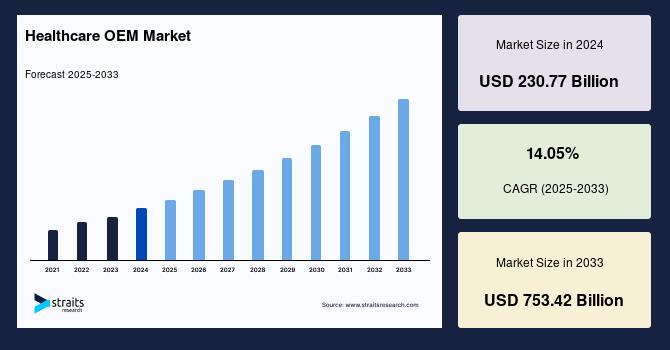
Healthcare OEM Market Size, Share & Growth Graph By 2033
| Market Metric | Details & Data (2024-2033) |
|---|---|
| 2024 Market Valuation | USD 230.77 Billion |
| Estimated 2025 Value | USD 263.19 Billion |
| Projected 2033 Value | USD 753.42 Billion |
| CAGR (2025-2033) | 14.05% |
| Study Period | 2021-2033 |
| Dominant Region | North America |
| Fastest Growing Region | Asia Pacific |
| Key Market Players | GE Healthcare, Siemens Healthineers, Koninklijke Philips N.V., Medtronic Plc, Becton Dickinson and Company |
Download Free Sample Report to Get Detailed Insights.
Healthcare OEM Market Trends Shift toward Digital Health TechnologiesOne significant trend shaping the global healthcare OEM market is the shift toward digital health technologies. Digital health solutions, such as telemedicine, wearable devices, and AI-powered diagnostics, are gaining traction due to their ability to enhance patient care, reduce costs, and improve healthcare access.
-
According to a report by McKinsey & Company, digital health adoption has accelerated globally, with telehealth usage increasing by 38 times compared to pre-pandemic levels in the United States. This trend is driving healthcare OEMs to integrate advanced digital components and software into their devices to offer better patient outcomes and more efficient healthcare delivery. The growing focus on remote patient monitoring and digital therapeutics is likely to propel market growth as OEMs innovate to meet the rising demand for connected and intelligent medical devices.
The rise in global healthcare spending, coupled with significant investments in healthcare infrastructure, is a crucial driver for the market. Governments and the private sector are increasingly investing in healthcare infrastructure to improve patient care and outcomes.
-
According to the World Bank, global healthcare spending accounted for 9.8% of GDP in 2020, highlighting the substantial investment directed toward health systems worldwide. This increase in expenditure is expected to drive market growth as healthcare facilities seek to upgrade their equipment with state-of-the-art OEM products.
Moreover, emerging economies like India and China are heavily investing in healthcare infrastructure development, creating a robust market environment for OEMs to expand their presence and offer advanced medical devices to healthcare providers.
Healthcare OEM Market Restraints Stringent Regulatory LandscapeOne of the primary restraints in the global healthcare OEM market is the stringent regulatory landscape. The healthcare sector is heavily regulated, with devices and equipment requiring rigorous testing, approvals, and certifications before commercialization. Regulatory bodies like the U.S. FDA (Food and Drug Administration), European Medicines Agency (EMA), and other regional authorities impose strict guidelines to ensure patient safety and efficacy, leading to prolonged approval timelines and increased costs for OEMs.
Additionally, navigating the complex regulatory environment remains a significant challenge for healthcare OEMs, especially for new market entrants. The need for compliance with varying regional regulations further complicates the situation, potentially hindering market growth as OEMs invest heavily in regulatory affairs and quality assurance.
Healthcare OEM Market Opportunities Growth in OutsourcingThe growing trend of outsourcing manufacturing and assembly processes presents a significant opportunity for the Healthcare OEM Market. With increasing pressure to reduce costs and focus on core competencies, many healthcare companies are outsourcing their production needs to OEMs. This trend is especially prominent in the development of complex and high-value medical devices such as implants, diagnostic equipment, and surgical instruments.
-
According to a report by Straits Research, the healthcare contract manufacturing market is expected to grow at a CAGR of 18.80% from 2023 to 2031, driven by the rising demand for cost-effective and high-quality OEM products. This opportunity provides OEMs with a platform to expand their service offerings, tap into new customer bases, and increase their market revenue by leveraging their expertise in manufacturing and compliance.
The North American Healthcare OEM Market is a dominant force in the global landscape, driven by advanced healthcare infrastructure, high healthcare expenditure, and a strong focus on technological innovation. According to the Centers for Medicare & Medicaid Services (CMS), U.S. healthcare spending reached USD 4.1 trillion in 2020, accounting for nearly 19.7% of the GDP. This high level of expenditure supports the demand for innovative and high-quality OEM products.
Additionally, the region's market growth is fueled by the increasing adoption of advanced medical devices, wearables, and digital health solutions. Furthermore, a robust presence of key market players, such as GE Healthcare, Medtronic, and Johnson & Johnson, coupled with extensive research and development activities, reinforces North America's leading position in the market.
The United States is the largest contributor to the North American market, accounting for the majority share due to its advanced healthcare system, extensive R&D investments, and significant market revenue generation. The U.S. market is characterized by the rapid adoption of digital health technologies, such as AI and IoT-enabled devices, and an increasing number of healthcare facilities opting for customized and high-tech OEM products. According to the U.S. FDA, the country witnessed over 13,000 new medical device approvals in 2021, reflecting the strong regulatory framework and innovation landscape.
Moreover, the growing trend of value-based care and the shift toward minimally invasive surgeries further drive the demand for specialized OEM products, solidifying the USA's market position.
Asia-Pacific Healthcare OEM Market TrendsThe Asia-Pacific region is emerging as a significant market for healthcare OEMs, driven by rapid economic growth, increasing healthcare expenditure, and rising demand for advanced medical devices. Countries such as China, India, Japan, and South Korea are witnessing substantial investments in healthcare infrastructure, which is fueling the market's expansion. According to the Asian Development Bank, healthcare spending in Asia-Pacific is projected to reach USD 2.7 trillion by 2030, driven by a growing middle class and an aging population. Moreover, the region's favorable regulatory environment and government initiatives to promote healthcare access further provide lucrative opportunities for healthcare OEMs to expand their footprint.
China represents a major growth hub within the Asia-Pacific healthcare OEM market due to its large population base, increasing prevalence of chronic diseases, and expanding healthcare infrastructure. The country's healthcare expenditure has been rising steadily, accounting for 6.6% of its GDP in 2021, as per the World Health Organization. Likewise, the "Healthy China 2030" initiative aims to expand healthcare access and quality, thereby increasing demand for advanced medical equipment. Moreover, the Chinese government's focus on promoting local manufacturing through favorable policies, coupled with the presence of domestic OEM players like Mindray Medical, positions China as a key market driver in the region.
Healthcare OEM Market Segmentation By TypeThe market is divided into healthcare software, medical devices, instruments, and others. The Medical Devices segment is a critical part of the market, encompassing a wide range of products such as diagnostic imaging systems, therapeutic devices, monitoring equipment, and wearable health technologies. This segment is driven by the increasing prevalence of chronic diseases, technological advancements, and the growing emphasis on early diagnosis and treatments.
OEMs play a pivotal role in designing and manufacturing high-quality, reliable, and innovative medical devices that meet stringent regulatory standards. The shift toward digital health and connected devices is further enhancing market growth as healthcare providers seek more efficient and integrated solutions for patient care and management.
By OEM SolutionsThe market is segmented into quality control and regulatory compliance, manufacturing and fabrication, packaging and sterilization, product design and development, order fulfillment and flexible distribution, technical support, project management, and others. The Product Design & Development segment in the global market focuses on creating innovative and customized medical devices tailored to meet specific clinical needs. This segment covers the entire development lifecycle, from concept creation and prototyping to testing and regulatory approvals. The demand for personalized medical devices, driven by advancements in 3D printing, AI, and robotics, fuels growth in this segment. OEMs collaborate with healthcare providers and research institutions to develop cutting-edge devices that enhance patient outcomes and operational efficiency. With the rising trend toward precision medicine and value-based care, this segment is expected to witness significant market growth in the coming years.
By ApplicationThe market is bifurcated into healthcare administration, dentistry, surgery, laboratory, veterinary, pharmaceutical and cosmetics, ophthalmology, dialysis, and others. The surgery segment in the global market provides specialized surgical instruments, implants, and equipment designed for various types of surgical procedures. The demand for minimally invasive surgeries, which offer quicker recovery times and fewer complications, is driving the growth of this segment. OEMs are focused on developing precision instruments and advanced surgical devices that meet the specific requirements of complex surgeries such as cardiovascular, neurosurgery, and orthopedic procedures. With the growing global surgical volume and increasing investments in surgical technology, this segment is poised for substantial growth, allowing OEMs to expand their market size by catering to the evolving needs of surgeons and healthcare facilities.
By End-UsersThe market is bifurcated into hospitals, the private sector, and the public sector. The hospital segment is a significant end-user in the global market, demanding a variety of medical devices, diagnostic equipment, and surgical tools to provide comprehensive patient care. Hospitals rely on OEMs for high-quality, innovative, and cost-effective products that meet rigorous regulatory standards and improve clinical outcomes. With increasing healthcare expenditure and infrastructure development, particularly in emerging economies, hospitals are upgrading to more advanced technologies, fueling market growth in this segment. OEMs are partnering with hospitals to deliver customized solutions that enhance operational efficiency, patient safety, and care quality, driving the expansion of their market share in the global healthcare industry.
List of Key and Emerging Players in Healthcare OEM Market GE Healthcare Siemens Healthineers Koninklijke Philips N.V. Medtronic Plc Becton Dickinson and Company Stryker Corporation Boston Scientific Corporation Cognizant Canon Medical Systems Corporation Fujifilm Holdings Corporation Johnson & Johnson Recent Development-
March 2024- Nonin Medical, a prominent supplier of SpO2 monitoring solutions, and Corscience, a prominent supplier of CO2 monitoring solutions, formed a strategic alliance to jointly engage in the promotion of each other's original equipment manufacturer (OEM) product offerings.
May 2024- Watson-Marlow Fluid Technology Solutions (WMFTS) enhanced DriveSure with cutting-edge technology to provide a comprehensive peristaltic panel mount pump solution specifically designed for original equipment manufacturers (OEMs).
As per our research analysts, the future scope of the Healthcare OEM market looks promising, with numerous opportunities for growth driven by technological advancements, the demand for personalized healthcare, and the expansion of global healthcare infrastructure. However, OEMs will need to navigate challenges related to regulatory compliance, quality standards, and sustainability. Those who can innovate, adapt to changing market dynamics, and maintain a focus on quality and compliance will be well-positioned to capitalize on the evolving landscape of the healthcare industry.
Moreover, as healthcare systems worldwide transition towards more integrated and efficient models, the role of OEMs in providing innovative, cost-effective, and high-quality medical devices and components will be crucial.
Report Scope| Report Metric | Details |
|---|---|
| Market Size in 2024 | USD 230.77 Billion |
| Market Size in 2025 | USD 263.19 Billion |
| Market Size in 2033 | USD 753.42 Billion |
| CAGR | 14.05% (2025-2033) |
| Base Year for Estimation | 2024 |
| Historical Data | 2021-2023 |
| Forecast Period | 2025-2033 |
| Report Coverage | Revenue Forecast, Competitive Landscape, Growth Factors, Environment & Regulatory Landscape and Trends |
| Segments Covered | By Type, By OEM Solutions, By Applications, By End-Users |
| Geographies Covered | North America, Europe, APAC, Middle East and Africa, LATAM |
| Countries Covered | US, Canada, UK, Germany, France, Spain, Italy, Russia, Nordic, Benelux, China, Korea, Japan, India, Australia, Singapore, Taiwan, South East Asia, UAE, Turkey, Saudi Arabia, South Africa, Egypt, Nigeria, Brazil, Mexico, Argentina, Chile, Colombia |
Download Free Sample Report to Get Detailed Insights.
Healthcare OEM Market Segments By Type-
Healthcare Software
Medical Device
Instruments
Others
-
Quality control and Regulatory Compliance
Manufacturing and Fabrication
Packaging and Sterilization
Product Design and Development
Order Fulfilment and Flexible Distribution
Technical Support
Project Management
Others
-
Healthcare Administration
Dentistry
Surgery
Laboratory
Veterinary
Pharmaceutical and cosmetics
Ophthalmology
Dialysis
Others
-
Hospital
Public-sector
Private-sector
-
North America
Europe
APAC
Middle East and Africa
LATAM

Legal Disclaimer:
MENAFN provides the
information “as is” without warranty of any kind. We do not accept
any responsibility or liability for the accuracy, content, images,
videos, licenses, completeness, legality, or reliability of the information
contained in this article. If you have any complaints or copyright
issues related to this article, kindly contact the provider above.
Most popular stories
Market Research

More Story








Comments
No comment