




403
Sorry!!
Error! We're sorry, but the page you were looking for doesn't exist.
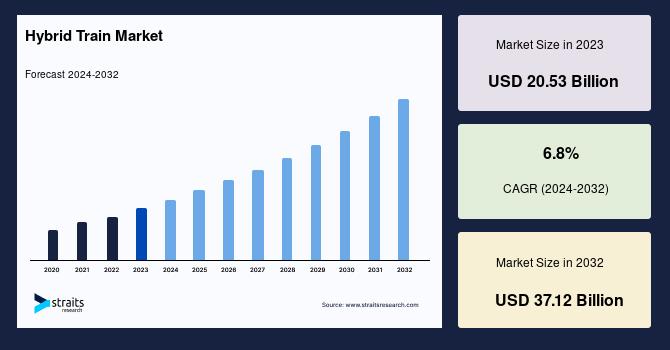
Hybrid Train Market Size, Share & Growth Graph By 2032
| Market Metric | Details & Data (2023-2032) |
|---|---|
| 2023 Market Valuation | USD 20.53 Billion |
| Estimated 2024 Value | USD 21.93 Billion |
| Projected 2032 Value | USD 37.12 Billion |
| CAGR (2024-2032) | 6.8% |
| Study Period | 2020-2032 |
| Dominant Region | Europe |
| Fastest Growing Region | Asia Pacific |
| Key Market Players | Alstom SA, Ballard Power Systems Inc., Bombardier Inc., China Railway Rolling Stock Corporation (CRRC), Kawasaki Heavy Industries Ltd. |
Download Free Sample Report to Get Detailed Insights.
Hybrid Train Market Growth Factors Advantages of Hybrid Trains over Conventional TrainsHybrid trains exhibit various advantages, such as the capability to attain zero emissions, economic benefits, flexibility to run on alternate fuels, and power generation from regenerative braking compared to conventional trains, which promote the market's growth. In addition, hybrid trains are more efficient in terms of traveling time and safety than traditional trains, owing to their ability to generate regenerative power by applying brakes. Furthermore, battery-operated trains possess advantages such as less price, lower emissions, less maintenance, and more effortless operation, which are projected to fuel their demand in the upcoming years. Moreover, the introduction of hydrogen gas-powered trains, which do not liberate carbon emissions, consume less energy than diesel fuel, and produce low noise and vibration, is expected to fuel the market growth during the forecast period.
Rising Environmental Awareness and Strict Government RegulationsDiesel and other conventional fuel-powered locomotives emit harmful pollutants and gases such as nitrogen oxide, carbon dioxide, particulate matter, and sulfur dioxide. These air pollutants severely impact human health, causing diseases such as stroke, cardiac disorders, lung cancer, and asthma. In addition, these are harmful to the environment, as nitrogen dioxide is considered to be 240 times more destructive to the ozone layer than carbon dioxide. Governments worldwide are implementing several policies, regulations, and initiatives to lessen the negative consequences of these toxic pollutants on people and the environment. New regulations are expected to raise the interest of key players in developing hybrid train technologies, which, in turn, is expected to fuel the growth of the hybrid train market in the upcoming years.
Hybrid Train Market Restraint High Cost for Development of Hybrid Trains and InfrastructureAlthough hybrid trains possess various advantages compared to conventional trains, the high cost associated with research and development of hybrid train technologies compared to traditional counterparts is expected to restrain the market growth. Hybrid trains are classified based on propulsion types such as hydrogen-powered, battery-powered, electro-diesel, gas-powered, and others. Each fuel source needs a different infrastructure for its storage and thus incurs additional building infrastructure costs.
For example, hydrogen-powered trains necessitate entirely new infrastructure for storing hydrogen gas; because hydrogen is a small molecule, it can leak through existing pipelines. Thus, reliability and safety in hydrogen storage increase the cost of building infrastructure, which is expected to impede market growth during the forecast period. On the contrary, savings associated with enhanced fuel efficiency can provide a quick return on the initial investment, which is anticipated to neutralize the effect of the rising cost of the development of hybrid trains and infrastructure. However, solar-powered trains require the installation of solar panels on the roof of trains, stations, and platforms to propel the trains using solar power, which further raises the cost of building infrastructure, thereby hampering the market growth.
Hybrid Train Market Opportunity Government Initiatives and Investment in Alternative Fuel-Powered Hybrid TrainsIncreasing government initiatives toward using alternative fuels such as biofuels (bio-ethanol, bio-methanol, bio-DME, and bio-LPG), solar, hydrogen, gasoline, and other renewable energies to power the hybrid trains is expected to rise the research and development activities in this sector. In addition, an increase in investment in solar-powered hybrid trains in developing economies such as China, India, Japan, Germany, and France is expected to offer remunerative opportunities for players operating in the market. Moreover, critical potential advantages of using alternative fuels, such as low carbon emissions, cost benefits, less maintenance, biodegradability, and low toxicity, are the major factors attracting investments and government support for using alternative fuels in the railway sector. Thus, all these factors collectively are predicted to provide potential opportunities for expanding the global market during the forecast period.
Hybrid Train Market Regional Analysis Europe: Dominant Region Growing at A Cagr of 6.8%Europe is the highest revenue contributor and is estimated to grow at a CAGR of 6.8% during the forecast period. Key market trend such as the rise in adoption of the hybrid locomotive in parts of German has enhanced the growth of the hybrid train market in Europe.
-
For instance, in June 2020, a well-known cargo logistical company D.B. Cargo purchased 50 hybrid shunters from Toshiba Infrastructure Systems & Solutions Corporation and Verkehrsverbund Mittelsachsen (VMS) 11 battery-electric trains. These 11 battery electric trains will serve an 80-km range between Leipzig and Chemnitz, two major cities of Saxony.
Furthermore, the rise in adoption of a hybrid passenger train in the U.K. enhanced the market's growth.
Asia-Pacific: Growing RegionAsia-Pacific is expected to grow at a CAGR of 7% and reach USD 9,250 million during the forecast period. Recent market trend, such as the launch of the new hybrid electric train in the Philippines, has boosted the market's growth in Asia-Pacific. Furthermore, the rise in adoption of hybrid locomotives by railway Freight companies is the primary factor that fuels the market growth in Japan. For instance, Japan Freight Railway Company adopted yard-track shunting hybrid locomotives that offer reduced noise levels, improved ease of maintenance, and reduced NOx emissions. China is predicted to provide growth opportunities for the hybrid train market, owing to the development of high-speed hybrid trains.
North America is the third largest region. The major growth factor in North America is the development of a hybrid railcar that uses an internal combustion engine and hybrid electric batteries to run the train. This hybrid railcar is used for regional transport in the U.S., offering reduced fuel consumption and emissions. The presence of several federation bodies that helps to provide incentives for switching trains to hybrid trains is another growth factor in the market. In addition, Canada's transportation companies are introducing new energy-efficient hybrid trains that generate less noise during operations. These are the major market trends incorporated by North America that, in turn, escalate the development of the hybrid train market.
By Propulsion TypeThe electro-diesel segment is the highest contributor to the market and is estimated to grow at a CAGR of 6.8% during the forecast period. A rise in demand for diesel-electric locomotives, owing to its benefits such as less maintenance, high efficiency, ease of use, sustainability, reliability, and less fuel utilization over conventional locomotives, is expected to drive the growth of the hybrid train market during the forecast period. In addition, the diesel-electric locomotive is reliable for electrified and non-electrified trains. Thus, it is most widely used in the rail industry for passenger and freight applications.
Battery operated is the second largest segment. The surge in demand for battery-operated hybrid trains from passenger and freight applications is expected to fuel the market's growth during the forecast period. In addition, a shift in preference of passengers toward electrified trains for sustainable, more efficient, and reliable rail transportation notably contributes to the growth of the global market. Power density and durability are the key challenges in hybrid locomotives which can be met by developing newer battery technologies such as lithium -ion and nickel-cadmium. However, recharging batteries at regular intervals is impractical for heavy-weight freight applications, which is expected to hamper the market's growth in the upcoming years.
By ApplicationThe passenger segment is the highest contributor to the global hybrid train market and is estimated to grow at a CAGR of 6.7% during the forecast period. A rise in demand for efficient and safe hybrid trains for public transport efficiently and safely with fewer carbon emissions is expected to drive the market's growth during the forecast period. Moreover, a rapid increase in construction activities of railway infrastructures is anticipated to boost the demand for hybrid trains, thereby fueling market growth. In addition, a rise in population, fast urbanization, and improved connection between urban and sub-urban areas are anticipated to increase demand for hybrid trains for passenger use, propelling the market's expansion during the forecast period.
The freight segment is the second largest. The development of the latest technology that helps hybrid freight locomotives run along the long stretch is the primary factor contributing to the market's growth. In addition, freight transportation company such as Deutsche Bahn is incorporating hybrid locomotives for transporting cargo. Hybrid freight locomotives can save 30% diesel, equivalent to saving 1 million liters per year, as stated by Sigrid Nikutta (CEO of D.B. Cargo). This is the primary factor that is predicted to offer new opportunities for expanding the hybrid freight train market.
By Operating SpeedThe 100-200 km/h segment is the highest contributor to the market and is estimated to grow at a CAGR of 7% during the forecast period. The major market trend of using high-speed hybrid locomotives for freight transportation has enhanced the demand for the 100-200 km/h segment.
-
For instance, Alstom developed an eco-friendly battery-powered shunted freight locomotive capable of running at 120km/hr. This hybrid locomotive is powered by two batteries, Prima H3 and Prima H4, for light and a zero-emission hybrid train. In addition, this locomotive is predicted to reduce carbon footprint by up to 6,000 tonnes/year and reduce the noise level.
More than 200 km/h is the second largest segment due to the steady adoption of high-speed rail (HSR). In addition, hybrid engines with existing diesel-powered engines can attain a speed of more than 200km/h is a significant growth factor. HSR is designed to reach 300-350 km/h speeds, and mixed HSR can reach 200–250 km/h speeds. Integrating an electric-powered hybrid train with an existing diesel-powered engine is a crucial growth factor. In addition, the rise in the number of trails run by high-speed bullet trains is predicted to offer a lucrative growth opportunity in the upcoming period.
List of Key and Emerging Players in Hybrid Train Market Alstom SA Ballard Power Systems Inc. Bombardier Inc. China Railway Rolling Stock Corporation (CRRC) Kawasaki Heavy Industries Ltd. Siemens AG Stadler Rail AG Toshiba Corporation Hyundai Rotem Company Wabtec Corporation Etihad Rail Vivarail AVL L&T Construcciones Y Auxiliar De Ferrocarriles (CAF). Recent Developments-
June 2022 - Siemens A launched an open digital business platform, Siemens Xcelerator, to accelerate digital transformation and value creation for customers of all sizes in the industry, including buildings, grids, and mobility. The business platform makes digital transformation more accessible, faster, and scalable. Siemens Xcelerator includes a curated portfolio of internet of things (IoT) enabled hardware, software, and digital services across Siemens and certified third parties, a growing ecosystem of partners, and an evolving marketplace to facilitate interactions and transactions between customers, partners, and developers.
June 2022 - Siemens, a leader in industrial automation and software, infrastructure, building technology, and transportation, and NVIDIA, a pioneer in accelerated graphics and artificial intelligence (A.I.), today announced an expansion of their partnership to enable the industrial metaverse and increase the use of AI-driven digital twin technology that will help bring industrial automation to a new level.
| Report Metric | Details |
|---|---|
| Market Size in 2023 | USD 20.53 Billion |
| Market Size in 2024 | USD 21.93 Billion |
| Market Size in 2032 | USD 37.12 Billion |
| CAGR | 6.8% (2024-2032) |
| Base Year for Estimation | 2023 |
| Historical Data | 2020-2022 |
| Forecast Period | 2024-2032 |
| Report Coverage | Revenue Forecast, Competitive Landscape, Growth Factors, Environment & Regulatory Landscape and Trends |
| Segments Covered | By Propulsion Type, By Application, By Operating Speed |
| Geographies Covered | North America, Europe, APAC, Middle East and Africa, LATAM |
| Countries Covered | US, Canada, UK, Germany, France, Spain, Italy, Russia, Nordic, Benelux, China, Korea, Japan, India, Australia, Taiwan, South East Asia, UAE, Turkey, Saudi Arabia, South Africa, Egypt, Nigeria, Brazil, Mexico, Argentina, Chile, Colombia |
Download Free Sample Report to Get Detailed Insights.
Hybrid Train Market Segments By Propulsion Type-
Electro-Diesel
Battery Operated
Hydrogen Powered
Gas Powered
Solar Powered
-
Passenger
Freight
-
Less than 100 km/h
100 - 200 km/h
More than 200 km/h
-
North America
Europe
APAC
Middle East and Africa
LATAM

Legal Disclaimer:
MENAFN provides the
information “as is” without warranty of any kind. We do not accept
any responsibility or liability for the accuracy, content, images,
videos, licenses, completeness, legality, or reliability of the information
contained in this article. If you have any complaints or copyright
issues related to this article, kindly contact the provider above.
Most popular stories
Market Research

More Story








Comments
No comment