

Aircraft Fuel Systems Market Size, Share & Growth Report By 2034


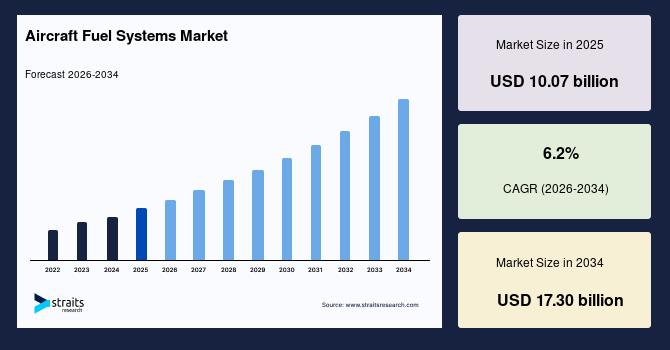
| Market Metric | Details & Data (2025-2034) |
|---|---|
| 2025 Market Valuation | USD 10.07 billion |
| Estimated 2026 Value | USD 10.69 billion |
| Projected 2034 Value | USD 17.30 billion |
| CAGR (2026-2034) | 6.2% |
| Dominant Region | North America |
| Fastest Growing Region | Asia Pacific |
| Key Market Players | Honeywell International Inc., Parker Hannifin Corporation, Eaton Corporation plc, Safran S.A., Collins Aerospace |
Download Free Sample Report to Get Detailed Insights.
Emerging Trends in Aircraft Fuel System Market Shift toward Sustainable Aviation Fuel Compatibility in Aircraft Fuel SystemsAircraft fuel systems are undergoing structural and material modifications to support the increasing use of sustainable aviation fuel blends. These fuels differ in chemical composition and require compatibility with seals, pumps, and fuel lines to ensure safe operation. Certification bodies have approved blended usage within defined limits, prompting OEMs to align system architectures with these requirements. Airlines are adopting SAF to meet emission reduction targets, increasing the need for adaptable fuel handling systems. Fuel system manufacturers are focusing on corrosion resistance and material durability to handle varying fuel properties. This shift is influencing both new aircraft designs and retrofit programs across existing fleets.
Rising Deployment of Fuel Tank Inerting Systems across Commercial AircraftFuel tank inerting systems are witnessing increased deployment due to regulatory emphasis on minimizing flammability risks within aircraft fuel tanks. These systems reduce oxygen concentration, lowering the probability of ignition under extreme operating conditions. Aviation authorities have mandated such technologies in commercial aircraft following safety assessments and incident analyses. Aircraft manufacturers are incorporating onboard inert gas generation systems as a standard safety feature in new models. Retrofit programs are also integrating inerting systems into older aircraft to comply with updated safety frameworks. The focus on passenger safety and risk mitigation is driving adoption across global fleets.
Aircraft Fuel System Market Drivers Expansion of Multi-engine Aircraft and Need for Precision Fuel Delivery Requirements Drives MarketThe expansion of multi-engine and high-performance aircraft is driving demand for advanced fuel systems that ensure balanced fuel flow, cross-feed capability, and redundancy for safe operation. These systems add engineering complexity and value due to their role in managing higher fuel loads and longer ranges in wide-body aircraft and military jets. Manufacturers are focusing on precision control and reliability, increasing demand across OEM production and fleet upgrades.
Precise fuel metering in turbine engines is also a key driver, as turbofan and turbojet systems require accurate fuel delivery for efficient combustion and stable thrust. Fuel systems must operate under extreme pressure and temperature while maintaining exact flow rates to avoid performance losses. Rising focus on fuel efficiency and emissions is accelerating adoption of advanced metering technologies, especially in commercial aviation where efficiency impacts operating costs.
Aircraft Fuel System Market Restraints Thermal Constraints in High-altitude Operations and Engine-specific Design Dependencies Restrain Aircraft Fuel System MarketThermal management challenges at high altitudes restrain the aircraft fuel system market due to extreme low-temperature effects on fuel behavior. Freezing conditions impact fuel viscosity, flow stability, and overall system performance during cruise phases. To mitigate this, systems require heating units, insulation, and circulation controls, increasing design complexity and weight. These added requirements also raise testing needs, extend development timelines, and increase manufacturing costs, while maintaining consistent fuel performance across diverse climatic conditions remains a persistent challenge.
Dependence on engine-specific fuel system configurations limits standardization in the market, as each propulsion system requires unique pressure, flow, and control specifications. This reduces interchangeability across aircraft platforms and restricts economies of scale for manufacturers. Customized engineering is required for different OEM engine architectures, increasing integration complexity and validation efforts. As a result, development cycles are longer and modular, scalable fuel system designs remain constrained.
Aircraft Fuel System Market Opportunities Advancements in Fuel Jettison Systems and Integrated Wing Tank Technologies Create Growth Opportunities for Market PlayersInnovation in fuel jettison and emergency fuel management systems is creating new growth opportunities due to regulatory requirements for controlled fuel dumping in large aircraft. These systems ensure safe landing weight management during emergencies and must deliver high precision and reliability. Modern aircraft are adopting automated jettison controls that improve safety, responsiveness, and reduce pilot workload. Manufacturers are enhancing discharge efficiency, system control, and environmental compliance during fuel release operations. Rising long-haul and wide-body aircraft deployment is further driving demand for advanced fuel dumping and control technologies.
Growth in integrated wing fuel tank technologies is creating opportunities as aircraft increasingly use wet-wing configurations for structural fuel storage. These systems improve space utilization and aircraft efficiency by using wing structures as fuel tanks. They require advanced sealing, structural integrity management, and precise fuel distribution systems to ensure safety and durability. Manufacturers are investing in improved materials and inspection technologies to reduce leakage risks and enhance maintenance efficiency. The shift toward lightweight aircraft designs is accelerating the adoption of integrated fuel storage and advanced fuel system monitoring solutions.
Regional Insights North America: Market Leadership through Advanced Aircraft Production Ecosystem and High-value Aerospace Manufacturing BaseNorth America dominated the aircraft fuel system market with the largest share of 36.16% in 2025, supported by its highly developed aerospace manufacturing ecosystem and strong presence of major aircraft OEMs and system integrators. The region benefits from large-scale aircraft production programs led by companies such as Boeing, which drives continuous demand for integrated fuel system components across commercial and defense platforms. According to the FAA Aerospace Forecast 2025–2045, the United States aviation sector is experiencing sustained recovery and long-term growth in aircraft utilization, supporting ongoing demand for advanced onboard systems, including fuel management and delivery technologies. The presence of established supply chains, high-value component manufacturing, and continuous innovation in propulsion-linked systems reinforces North America's leading position. Increasing focus on next-generation aircraft programs and production scalability is further strengthening regional market leadership.
The US aircraft fuel system market is expanding due to its position as the world's largest aerospace manufacturing hub, supported by strong commercial and defense aviation production. Fuel systems are critical to aircraft performance and safety compliance within highly integrated aviation platforms. Programs such as Boeing's MQ-25 unmanned aerial refueling system highlight increasing sophistication in fuel system applications. Strong MRO infrastructure, high fleet utilization, and continuous upgrades sustain demand, while leading OEM presence and government-backed aviation initiatives reinforce US dominance in North America.
The Canada aircraft fuel system market is supported by its specialized aerospace manufacturing base and strong participation in business jet and regional aircraft production. Programs led by manufacturers such as Bombardier require advanced, lightweight fuel system integration for high-performance aircraft platforms. The country remains a key global aerospace producer with a focus on high-value system engineering and precision manufacturing. Growing emphasis on sustainable aviation technologies is supporting next-generation fuel system development. Canada's export-oriented supply chain and collaboration with global OEMs strengthen its role in North America's aerospace ecosystem.
Asia Pacific: Fastest Growth Driven by Expanding Aircraft Manufacturing Programs and Regional Aviation Infrastructure DevelopmentThe Asia Pacific aircraft fuel system market is expected to be the fastest-growing region during the forecast period, registering a CAGR of 6.7%, supported by expanding aircraft manufacturing capacity and continued investment in aviation infrastructure across key economies. Countries across the region are advancing domestic aerospace capabilities through indigenous aircraft programs and localized supply chains. According to the International Civil Aviation Organization (ICAO) Asia-Pacific outlook, air traffic and fleet deployment across the region are projected to increase consistently, creating sustained demand for onboard systems such as fuel storage, transfer, and monitoring solutions. Governments are advancing airport expansion programs, regional connectivity initiatives, and aerospace industrial policies to strengthen aviation ecosystems. This evolving landscape is creating long-term demand for advanced aircraft fuel system integration across both commercial and defense aviation segments.
The China aircraft fuel system market is expanding due to large-scale indigenous aircraft programs and increasing aerospace self-reliance initiatives. Programs such as COMAC's C919 and CR929 are driving demand for domestically developed fuel management and delivery systems. According to the Civil Aviation Administration of China (CAAC), the country continues to scale aircraft production and aviation infrastructure to meet rising air transport demand. Strong investment in vertically integrated aerospace supply chains is accelerating local manufacturing of fuel system components, strengthening China's position in regional market growth.
The India aircraft fuel system market is growing due to rising defense aviation investments and indigenous aircraft development programs. Initiatives led by Hindustan Aeronautics Limited, including the Tejas fighter jet and the Advanced Medium Combat Aircraft program, are driving demand for advanced fuel system technologies. According to the Ministry of Civil Aviation, India is expanding its aviation ecosystem through policy support and infrastructure development. The“Make in India” initiative is further promoting domestic aerospace manufacturing, including fuel system components, while defense modernization and civil aviation growth are reinforcing India's role in the Asia Pacific market.
By ComponentThe fuel pumps segment held a 24.3% share in 2025 in the aircraft fuel system market, driven by its essential role in ensuring continuous and stable fuel flow from tanks to aircraft engines. Demand is supported by rising aircraft production and fleet expansion across commercial and defense aviation. Advancements in lightweight materials and improved pump reliability are enhancing efficiency and durability. These systems remain critical for maintaining optimal engine performance in modern aircraft.
The fuel inerting systems segment is projected to grow at a 7.2% CAGR due to increasing focus on aircraft safety and regulatory compliance. These systems reduce explosion risk by maintaining inert gas conditions within fuel tanks. Adoption is rising in both new aircraft and retrofit programs for aging fleets. Technological improvements in onboard inert gas generation are improving efficiency while reducing system weight.
By Aircraft TypeThe commercial aircraft segment held a 46.8% market share in 2025, driven by high production rates and continuous fleet expansion by global airlines. Fuel systems are widely used in both narrow-body and wide-body aircraft to support short-haul and long-haul operations. Growth is supported by rising air passenger traffic and investments in fuel-efficient aircraft platforms. Modern aircraft increasingly integrate lightweight materials and digital fuel monitoring systems to improve efficiency and reliability.
The UAV segment is expected to grow at a 8.4% CAGR due to increasing use in defense, surveillance, and commercial applications. Fuel systems are designed for compactness, high efficiency, and extended flight endurance. Rising defense procurement and adoption of UAVs for tactical missions are driving demand for advanced fuel system technologies. Commercial applications such as logistics, agriculture, and mapping are further supporting market expansion.
By Engine TypeThe turbofan engine segment held a 52.6% market share in 2025 and is projected to grow at a 6.4% CAGR, driven by its widespread use in commercial and long-haul aircraft. These engines require advanced fuel systems to manage high fuel flow and ensure efficient combustion. Rising production of narrow-body and wide-body aircraft is sustaining demand for compatible fuel system components. Integration of precise fuel metering and digital monitoring technologies is enhancing fuel efficiency and emissions control.
The turboprop engine segment accounted for a 18.9% market share in 2025, supported by strong adoption in regional and short-haul aviation. These engines are widely used in smaller aircraft where fuel efficiency over short distances is critical. Fuel systems are designed for simplicity, reliability, and cost efficiency. Growth is driven by increasing regional connectivity and fleet modernization in underserved routes.
By TechnologyThe conventional fuel systems segment held a 48.2% market share in 2025, supported by widespread use across legacy aircraft fleets. These systems rely on established mechanical and hydraulic architectures with proven operational reliability. Their lower integration complexity and compatibility with older platforms sustain demand. A large installed base of aging aircraft continues to depend on these systems for stable and cost-effective operation.
The smart fuel monitoring systems segment is expected to grow at an 8.2% CAGR due to increasing adoption of digital aircraft technologies. These systems enable real-time fuel tracking, predictive analytics, and enhanced operational efficiency. Growth is driven by rising focus on fuel optimization and emissions reduction in modern aircraft. Integration with advanced avionics and connected aircraft systems is improving decision-making and fleet management capabilities.
Competitive LandscapeThe global aircraft fuel system market is moderately fragmented, with a mix of large multinational aerospace suppliers and specialized component manufacturers operating across different tiers of the value chain. Established players dominate through long-term contracts with aircraft OEMs, proven engineering capabilities, global supply networks, and compliance with stringent aviation certification standards. Their competition is primarily based on reliability, system integration expertise, product lifecycle support, and the ability to deliver across high-volume production programs. In contrast, emerging players and niche suppliers compete by focusing on specialized components, cost optimization, faster customization, and innovation in targeted subsystems such as monitoring technologies or lightweight materials. Smaller firms often leverage agility and technical specialization to enter supplier ecosystems through partnerships or subcontracting models.
List of Key and Emerging Players in Aircraft Fuel Systems Market Honeywell International Inc. Parker Hannifin Corporation Eaton Corporation plc Safran S.A. Collins Aerospace Woodward, Inc. Triumph Group, Inc. Crane Aerospace and Electronics GKN Aerospace Meggitt PLC Liebherr Group Senior plc Zodiac Aerospace Marshall Aerospace AeroControlex Group Recent Developments-
In November 2025, ENOC Aviation signed an MoU with flydubai to expand and deepen an existing aviation fuel supply agreement, strengthening jet fuel logistics and aircraft fueling infrastructure support across fleet operations.
In November 2025, XCF Global signed an MoU with Impact Jets to supply Sustainable Aviation Fuel (SAF) to private aviation operators, including logistics and traceable fuel delivery systems integrated into aircraft fueling operations.
In August 2025, Air India signed a Memorandum of Understanding with Indian Oil to supply Sustainable Aviation Fuel (SAF), strengthening aircraft fuel supply integration and supporting fuel system compatibility upgrades in commercial aircraft operations.
In Jun2 2025, Honeywell signed an MoU with NTPC Green to evaluate production of SAF using carbon capture and hydrogen-based feedstocks, directly linked to future aviation fuel system supply chains.
| Report Metric | Details |
|---|---|
| Market Size in 2025 | USD 10.07 billion |
| Market Size in 2026 | USD 10.69 billion |
| Market Size in 2034 | USD 17.30 billion |
| CAGR | 6.2% (2026-2034) |
| Base Year for Estimation | 2025 |
| Historical Data | 2022-2024 |
| Forecast Period | 2026-2034 |
| Report Coverage | Revenue Forecast, Competitive Landscape, Growth Factors, Environment & Regulatory Landscape and Trends |
| Segments Covered | By Component, By Aircraft Type, By Engine Type, By Technology |
| Geographies Covered | North America, Europe, APAC, Middle East and Africa, LATAM |
| Countries Covered | US, Canada, UK, Germany, France, Spain, Italy, Russia, Nordic, Benelux, China, Korea, Japan, India, Australia, Taiwan, South East Asia, UAE, Turkey, Saudi Arabia, South Africa, Egypt, Nigeria, Brazil, Mexico, Argentina, Chile, Colombia |
Download Free Sample Report to Get Detailed Insights.
Aircraft Fuel Systems Market Segments By Component-
Fuel Pumps
Fuel Valves
Fuel Tanks
Fuel Gauging Systems
Fuel Inerting Systems
Fuel Filters
Fuel Lines
-
Commercial Aircraft
Military Aircraft
Business Jets
General Aviation Aircraft
Unmanned Aerial Vehicles
-
Turbofan Engines
Turboprop Engines
Turbojet Engines
Piston Engines
-
Conventional Fuel Systems
Digital Fuel Management Systems
Fuel Inerting Systems
Smart Fuel Monitoring Systems
-
North America
Europe
APAC
Middle East and Africa
LATAM

Legal Disclaimer:
MENAFN provides the
information “as is” without warranty of any kind. We do not accept any
responsibility or liability for the accuracy, content, images, videos,
licenses, completeness, legality, or reliability of the information
contained in this article. If you have any complaints or copyright issues
related to this article, kindly contact the provider above.
Comments
No comment