

Acne Treatment Market Size, Share & Growth Graph By 2034


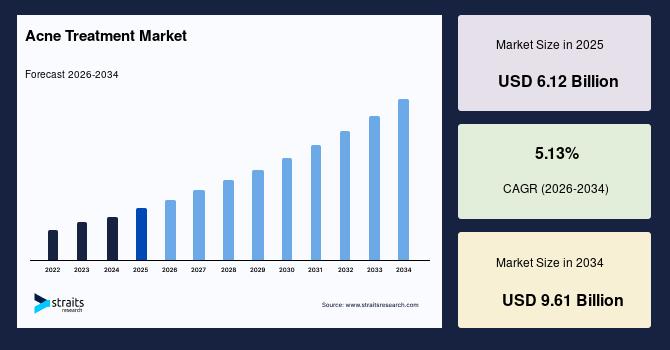
| Market Metric | Details & Data (2025-2034) |
|---|---|
| 2025 Market Valuation | USD 6.12 Billion |
| Estimated 2026 Value | USD 6.44 Billion |
| Projected 2034 Value | USD 9.61 Billion |
| CAGR (2026-2034) | 5.13% |
| Dominant Region | North America |
| Fastest Growing Region | Europe |
| Key Market Players | GlaxoSmithKline Plc, Almirall S.A, Galderma Laboratories L.P, Hoffman La Roche Ltd, Bausch Health Companies Inc |
Download Free Sample Report to Get Detailed Insights.
Emerging Trends in Acne Treatment Market Shift Toward Preventive and Early-Stage Acne CareThe market reflects a strong shift toward preventive and early-stage care, supported by epidemiological evidence. According to a study published on the National Center for Biotechnology Information platform, acne affects approximately 9.4% of the global population, with an average treatment age of around 20 years. This indicates that individuals begin managing skin conditions at a relatively young age. The growing adoption of skincare routines among adolescents further reinforces early intervention behavior. As a result, demand is increasing for mild, preventive solutions, positioning early-stage skincare as a key growth segment within the acne treatment market.
Growth of Clinic-based Aesthetic and Non-invasive ProceduresThe market is increasingly aligned with the global rise in clinic-based and minimally invasive aesthetic procedures. According to the International Society of Aesthetic Plastic Surgery Global Survey, nearly 38 million aesthetic procedures were performed worldwide, of which over 20.5 million were non-surgical treatments such as chemical peels and skin therapies. This segment has grown by more than 40% since 2020, reflecting strong consumer preference for low-downtime, clinically administered solutions. The increasing adoption of such procedures highlights a shift toward professional, technology-driven acne management, strengthening the role of dermatology clinics in the overall treatment ecosystem.
Acne Treatment Market Drivers Booming E-commerce Channels and Rising Adoption of Digital Consultations Drives MarketThe expansion of e-commerce in healthcare is supported by government-backed insights highlighting increased digital adoption and access. According to Invest India, more than 45% of new e-pharmacy users in India come from non-metro regions, indicating strong demand expansion beyond urban centers. This shift improves accessibility and convenience for consumers, particularly in underserved areas with limited physical pharmacy access. As a result, consumers increasingly rely on online platforms for over-the-counter acne treatments, driving higher purchase frequency and supporting broader market penetration through digital distribution channels.
The growing integration of digital dermatology platforms is enhancing access to acne treatment services and driving demand for professional care solutions. Evidence from a tele-dermatology study indicates that more than 16,800 users enrolled on a virtual platform, resulting in over 3,300 completed consultations, which reflects strong adoption of remote care models. Notably, approximately 75% of these interactions were first-time visits, highlighting the platform's role in attracting new patients into the treatment ecosystem. This trend supports improved diagnosis, ongoing patient management, and greater utilization of clinical therapies, ultimately strengthening demand for dermatologist-led acne treatment services.
Acne Treatment Market Restraints Rising Treatment Costs and Short Product Lifecycles Restrain Market GrowthFrequent shifts in skincare trends and consumer preferences significantly shorten the lifecycle of acne treatment products. Rapid changes in ingredient popularity, formulation expectations, and influencer-driven demand require companies to continuously update their product portfolios. This creates sustained pressure on research, development, and marketing functions to remain competitive. As a result, businesses incur higher operational and promotional costs to maintain relevance in the market. The need for constant innovation also increases the risk of product obsolescence, limiting long-term revenue stability and impacting overall profitability within the acne treatment segment.
The high cost associated with advanced acne treatments, including laser therapies and clinic-based procedures, remains a major barrier to market growth. These treatments often require specialized equipment and professional expertise, leading to premium pricing that is unaffordable for a large segment of price-sensitive consumers. This cost disparity restricts widespread adoption, particularly in developing and rural markets. Several consumers continue to rely on low-cost or over-the-counter alternatives, limiting the expansion of high-value clinical segments and slowing overall revenue growth in the acne treatment market.
Acne Treatment Market Opportunities Adoption of AI-Driven Personalization and Rising Male Grooming Awareness Creates Growth Opportunities for Market PlayersThe integration of AI-enabled skin analysis solutions is creating a transformative opportunity within the acne treatment market by enabling precision-led, personalized care delivery. Platforms such as GlowNowX demonstrate how a single selfie-based scan can generate a comprehensive skin diagnostic report within seconds, replacing traditional manual assessments that typically take significantly longer. These tools analyze multiple skin parameters, including acne severity, texture, and hydration, using machine learning models trained on diverse datasets, thereby improving diagnostic accuracy and treatment customization. This technological shift reduces clinical dependency on trial-and-error approaches, enhances consultation efficiency, and supports scalable, data-driven dermatology services, strengthening overall market demand for personalized acne solutions.
The growing focus on personal grooming among male consumers presents a significant expansion opportunity for the acne treatment market. Increasing awareness, social acceptance, and exposure to skincare education are driving higher product adoption among men. This shift is encouraging companies to develop gender-neutral and male-specific acne solutions tailored to different skin characteristics. As a result, the target consumer base is widening beyond traditional demographics. From a market standpoint, this supports incremental demand, enhances product diversification, and creates new revenue streams, particularly in emerging markets where male grooming is gaining rapid traction.
Regional Analysis North America: Market Dominance through High Dermatology Awareness, Preventive Skincare Adoption, and Advanced Treatment InfrastructureNorth America accounted for a share of 48.5% in 2025, supported by strong consumer awareness, advanced dermatology infrastructure, and high spending on skincare solutions. The region accounts for a significant share of global revenue, driven by widespread adoption of both over-the-counter and prescription treatments. Consumer behavior insights from Kenvue research presented at the American Academy of Dermatology Annual Meeting indicate that nearly 8 in 10 individuals actively use skincare for preventive purposes, while acne remains a primary concern among younger populations. This reflects a mature, prevention-focused market with consistent demand. The presence of well-established clinical services and continuous product innovation supports steady growth, positioning North America as a stable yet innovation-driven regional market.
The US market is supported by high clinical engagement and strong dermatology access. According to the American Academy of Dermatology, dermatologists manage more than 5.1 million acne-related consultations annually, reflecting a high level of treatment-seeking behavior. This consistent patient inflow drives demand for both prescription therapies and over-the-counter solutions. In addition, the availability of advanced treatment options and established clinical infrastructure supports effective disease management. The market continues to demonstrate stable growth, driven by early intervention practices and increasing adoption of professional dermatological care.
The Canada acne treatment market is supported by the high prevalence and early onset of the condition. According to the Canadian Dermatology Association, acne affects nearly 85% of individuals aged 12–24, indicating a strong and consistent patient base. The condition's persistence into adulthood further expands the treatment population, supporting stable market growth and continuous demand for dermatology services and skincare solutions.
Europe: Fastest Growth Driven by Advanced Dermatology Infrastructure and Innovations in Non-invasive Treatment TechnologiesEurope is expected to grow at a CAGR of 5.9% during the forecast period shaped by advancements in dermatological technologies, particularly in the area of non-invasive therapies. Innovations such as cold plasma technology, supported by European research and clinical development, are gaining traction for their ability to effectively target acne-causing bacteria while minimizing skin damage. Clinical evaluations within the region indicate measurable improvements in inflammation and lesion reduction, reinforcing the therapeutic potential of such solutions. This reflects Europe's strong focus on science-driven and regulated treatment approaches.
The UK acne treatment market is driven by strong primary care access and structured referral pathways for dermatology services. Increasing utilization of pharmacy-led consultations and over-the-counter treatments supports early-stage management. Rising digital health adoption is enabling remote consultations, improving treatment continuity and expanding access to acne care across diverse patient groups.
The German market benefits from a well-established healthcare system and high emphasis on clinical treatment standards. The presence of specialized dermatology practices and insurance-supported care encourages professional diagnosis and treatment. Growing demand for advanced topical formulations and therapeutic procedures is supporting steady market development and strengthening clinical adoption.
By Acne TypeThe moderate acne segment is expected to grow at a CAGR of 6.5% during the forecast period due to its high prevalence and requirement for multi-step treatment approaches. According to the Mayo Clinic, it typically involves combinations of topical retinoids, antibiotics, and sometimes oral medications, indicating higher treatment intensity. With 4–8 weeks needed for visible improvement and frequent transition from OTC to prescription therapies, it generates higher per-patient spending and sustained product usage.
The mild acne segment is the fastest-growing category due to its widespread occurrence and early-stage treatment adoption. The American Academy of Dermatology reports high prevalence among adolescents and young adults, with most cases classified as mild. Increasing awareness of daily skincare and proactive early intervention is accelerating demand, supporting steady segment expansion.
By Product TypeThe topical treatments segment dominated the market with a share of 62.35% in 2025 due to its widespread use and strong efficacy in mild to moderate cases. Agents like benzoyl peroxide and retinoids form the foundation of therapy, with benzoyl peroxide evaluated in 120 clinical trials involving over 29,000 participants. Topical retinoids are prescribed in nearly 58.8% of cases, supporting their central role through high adoption, ease of use, and proven outcomes.
The oral treatments segment is expected to grow at a CAGR of 4.3% during the forecast period due to its role in treating moderate to severe acne. Advancements such as denifanstat show strong clinical potential, with phase 3 trials reporting nearly 60% reduction in total lesion count and early improvement within four weeks. These therapies act on sebum production and inflammation, strengthening their impact in severe acne management.
By Distribution ChannelThe drug stores and retail pharmacies segment held a 45.9% share due to wide accessibility and role as first points of care for acne treatment. FDA-approved OTC products such as benzoyl peroxide and salicylic acid enable easy availability through retail outlets. Pharmacist guidance and early-stage treatment access further reinforce consistent demand and consumer trust in this channel.
The online pharmacies segment is the fastest growing with a CAGR of 18.2% driven by rising digital adoption and changing consumer behavior. These platforms offer wider product selection, discreet purchasing, and convenient doorstep delivery. Subscription models, personalized recommendations, and user reviews further enhance engagement and are reshaping distribution dynamics.
Competitive LandscapeThe acne treatment market is moderately fragmented, with a mix of global pharmaceutical companies, dermatology-focused brands, cosmetic players, and emerging digital health startups competing across segments. Established players primarily compete on product efficacy, brand credibility, regulatory compliance, and extensive distribution networks, while also investing in clinical validation and innovation. In contrast, emerging players focus on niche positioning, clean-label formulations, affordability, and technology integration such as AI-driven personalization to differentiate themselves. The market remains highly competitive with low entry barriers in certain segments, especially topical skincare. The integration of technology and personalized treatment solutions is expected to shape the competitive dynamics of the market.
List of Key and Emerging Players in Acne Treatment Market GlaxoSmithKline Plc Almirall S.A Galderma Laboratories L.P Hoffman La Roche Ltd Bausch Health Companies Inc Leo Pharma A/S Johnson & Johnson Services Inc Teva Pharmaceutical Industries Ltd Candela Corporation VYNE Therapeutics Inc. Recent Development-
In October 2025, Dermata received USPTO acceptance of patent application for its Spongilla-based topical acne treatment platform (XYNGARI candidate), expanding proprietary dermatology treatment coverage.
In September 2025, MDalgorithms expanded its clinical imaging partnership network with dermatology clinics to deploy AI-based acne severity analysis systems, integrate dermatology imaging datasets into clinical workflows, and support remote acne treatment decision systems.
In May 2025, Biofrontera secured patent protection extension for Ameluz topical photodynamic therapy formulation, strengthening exclusivity for dermatology applications including acne vulgaris treatment pathways.
| Report Metric | Details |
|---|---|
| Market Size in 2025 | USD 6.12 Billion |
| Market Size in 2026 | USD 6.44 Billion |
| Market Size in 2034 | USD 9.61 Billion |
| CAGR | 5.13% (2026-2034) |
| Base Year for Estimation | 2025 |
| Historical Data | 2022-2024 |
| Forecast Period | 2026-2034 |
| Report Coverage | Revenue Forecast, Competitive Landscape, Growth Factors, Environment & Regulatory Landscape and Trends |
| Segments Covered | By Acne Type, By Product Type, By Distribution Channel |
| Geographies Covered | North America, Europe, APAC, Middle East and Africa, LATAM |
| Countries Covered | US, Canada, UK, Germany, France, Spain, Italy, Russia, Nordic, Benelux, China, Korea, Japan, India, Australia, Taiwan, South East Asia, UAE, Turkey, Saudi Arabia, South Africa, Egypt, Nigeria, Brazil, Mexico, Argentina, Chile, Colombia |
Download Free Sample Report to Get Detailed Insights.
Acne Treatment Market Segments By Acne Type-
Moderate Acne
Mild Acne
Moderate to Severe Acid
-
Topical Treatments
Retinoids
Benzoyl Peroxide Products
Salicylic Acid Formulations
Antibiotic Creams
Other Treatments
Oral Treatments
Oral Antibiotics
Isotretinoin
Hormonal Therapy
Other Products
-
Hospital Pharmacies
Drug Stores & Retail Pharmacies
Online Pharmacies
Others
-
North America
Europe
APAC
Middle East and Africa
LATAM

Legal Disclaimer:
MENAFN provides the
information “as is” without warranty of any kind. We do not accept any
responsibility or liability for the accuracy, content, images, videos,
licenses, completeness, legality, or reliability of the information
contained in this article. If you have any complaints or copyright issues
related to this article, kindly contact the provider above.
Comments
No comment