

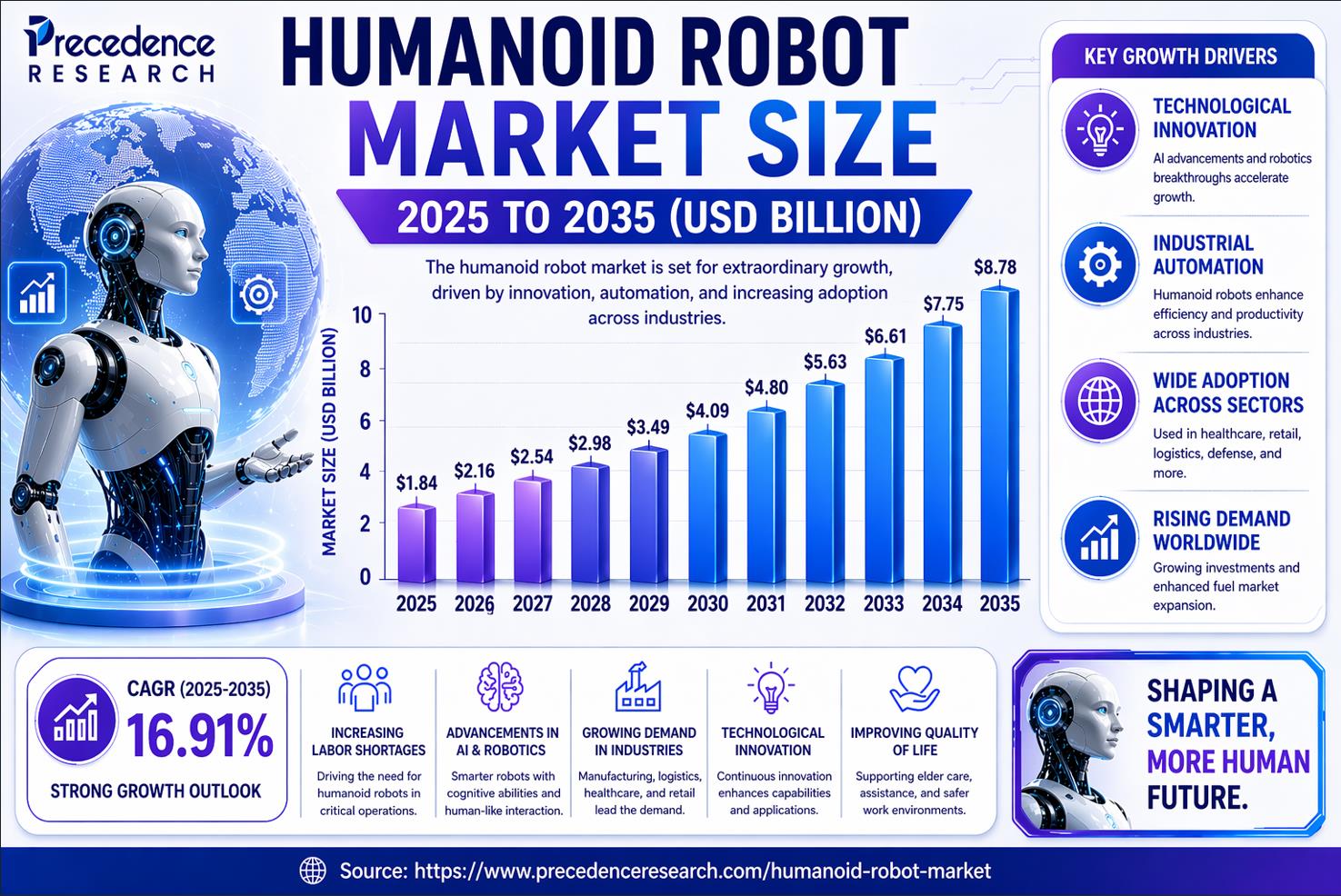
Humanoid Robot Market Size Worth USD 8.78 Billion By 2035 Driven By AI Advancements And Expanding Industrial And Consumer Applications


| Robot Name | ASIMO | NAO | iCub | REEM | Sophia |
| Height | 130 cm | 57 cm | 100 cm | 170 cm | 182 cm |
| Weight | 54 kg | 27 kg | 36.5 kg | 60 kg | 40 kg |
| Degrees of Freedom | 34 | 25 | 53 | 22 | 22 |
| Speed | 9 km/h | 1.2 km/h | N/A | 1.4 km/h | N/A |
| Processor | Mobile | ATOM Z530 1.6 GHz | PC104 | NVIDIA | JetsonTM TX2 |
| Unit | Pentium III-M 1.2 GHz | 1/2/4/8 GB RAM | Motherboard PB-945+ | Intel | JetsonTM TX2 |
Get Critical Insights Before Your Competitors Do
Trends Shaping the Market
- Increasing integration of generative AI in robotics: Generative AI is enabling humanoid robots
- Rise of robot-as-a-service (RaaS) models: Robot as a service
- Growing investments from venture capital firms: Venture capital funding is accelerating innovation by supporting startups focused on advanced robotics
- Expansion into consumer-facing applications: Humanoid robots are increasingly being deployed in retail, hospitality, and personal assistance roles, enhancing customer experience and everyday convenience.
➡️ Become a valued research partner with us
Major Products in Humanoid Robot Market & Their Study:
- Boston Dynamics brings four decades of DARPA-funded locomotion research to the commercial market, and its Hyundai Motor Group partnership provides a captive automotive deployment channel that validates the electric Atlas under some of the most demanding real-world manufacturing conditions before broader enterprise sales begin.
- Figure AI has constructed a differentiated AI stack through its partnership with OpenAI, enabling natural language task instruction at a level of fluency that separates it from mechanically capable but cognitively limited competitors, positioning it favorably for enterprise environments where worker-robot collaboration is the operating model.
- Unitree Robotics disrupted the entire market's pricing architecture with the G1 at USD 16,000, effectively forcing every premium-positioned competitor to articulate a more precise value premium to enterprise procurement teams confronting budget constraints.
Have questions or ready to move forward? Contact our experts today @ ... | +1 804 441 9344
Market Dynamics: Drivers, Restraints & Opportunities in the Industry
What Is Pulling the Market Forward: Forces That Cannot Be Switched Off
The single most powerful demand driver for humanoid robots is not technological ambition. It is arithmetic. The United States alone is projected to face a shortage of 8.5 million workers by 2030, concentrated in manufacturing, warehousing, and elder care sectors, while Germany's industrial employers report that unfilled positions are costing the economy an estimated EUR 49 billion annually in lost output. These are structural deficits that labor market policy cannot reverse within enterprise planning horizons, and humanoid robots are not competing with willing workers but filling a vacuum that willing workers no longer exist to fill.
The Friction in the Gears: Why the Market Will Not Scale at Full Speed
Despite the compelling growth narrative, the humanoid robot market carries a set of structural friction points that will moderate the pace of scaling for any operator assuming a frictionless ramp.
Cost remains the most immediate barrier: even at the lower end of the current commercial range, total first-year deployment costs including hardware, software licensing, integration, workforce training, and ongoing maintenance easily exceed USD 100,000 per unit for enterprise-grade platforms, a figure that places humanoid procurement outside the practical reach of SMEs and mid-market operators whose labor cost problem is often most acute.
Where the Next Wave of Value Gets Created: Opportunities That Have Not Yet Been Priced In
Three white spaces stand out as commercially material opportunities that current market valuations have not fully priced in. The first and largest is the domestic household market, which every major humanoid robot company has deliberately deferred in favor of faster-moving industrial and commercial procurement channels.
Industry projections suggest that 10% of households in advanced economies could own a personal humanoid robot by 2050, a penetration trajectory comparable to the early diffusion of personal computers, and the demographic and lifestyle convergence creating that demand, aging populations living independently longer, dual-income households with acute time scarcity, and a consumer generation already habituated to AI assistants, is strengthening rather than weakening.
Get informed with deep-dive intelligence on AI's market impact
Humanoid Robot Market Report Scope
| Report Coverage | Details |
| Market Size in 2025 | USD 1.84 Billion |
| Market Size in 2026 | USD 1.79 Billion |
| Market Size by 2035 | USD 8.78 Billion |
| Growth Rate (2026–2035) | CAGR of 16.91% |
| Largest Market (2025) | North America – due to strong AI and robotics infrastructure, increased healthcare & education deployment, and high R&D investment |
| Fastest Growing Market | Asia Pacific – rapid adoption in China, Japan, and South Korea driven by robotics innovation hubs and automation demand |
| Base Year | 2025 |
| Forecast Period | 2026 to 2035 |
| Segments Covered | Motion Type, Component, Application, and Region |
| Regions Covered | North America, Europe, Asia-Pacific, Latin America, and the Middle East & Africa |
| Leading Motion Type Segment | Wheel drive expected to hold the majority share due to industrial & defense uses |
| Dominant Component Segment | Software is projected to command the highest growth due to AI integration for autonomy and perception capabilities |
| Key Application Driver | Personal Assistance & Caregiving – demand rising due to aging population and unmet healthcare needs |
| Technology & Innovation Trends | Strong focus on AI, machine learning, and sensor-fusion capabilities to improve autonomy, safety, and task efficiency |
| Emerging Opportunities | Integration of humanoid robots in retail, logistics, elder care, and entertainment sectors; rising venture investments in mass-production and scalable designs |
| Industry Challenges | High deployment costs, energy and power limitations, and unpredictable performance in unstructured environments |
Instant Access. Zero Waiting. Buy the Premium Market Research Report Now
Segmental Analysis: Where the Revenue Is and Where It Is Going
Motion Type: Wheels Hold the Ground, Legs Claim the Future
Wheel-drive humanoid robots dominated the market in 2025, capturing the largest revenue share in the motion type segment. Wheeled platforms offer superior stability, lower manufacturing complexity, and faster deployment readiness for structured environments such as retail floors, hospital corridors, and warehouse aisles. SoftBank's Pepper, one of the most commercially deployed humanoid robots globally, operates on a wheeled base and has been installed across thousands of enterprise locations.
The biped segment is where the structural growth story resides and is expected to grow rapidly. Bipedal robots are designed to navigate environments built for humans: climbing stairs, handling tools, and working in spaces that wheeled systems simply cannot access. Tesla's Optimus, Boston Dynamics' electric Atlas, and Figure AI's Figure 02 are all bipedal platforms. Industry forecasts project annual shipments to reach 115,000 units by 2027, with bipedal designs accounting for a growing share of that volume.
Component Analysis: Software Commands Today, Hardware Builds Tomorrow
The software segment held the dominant share in 2025. Buyers increasingly evaluate humanoid robots on the sophistication of their operating software rather than raw mechanical specifications. Companies delivering natural language control interfaces, adaptive task learning, and over-the-air capability updates command premium pricing and secure high-margin recurring service contracts.
Hardware is the fastest-growing component segment. As production scales from thousands to tens of thousands of units, demand for precision actuators, force-torque sensors, dense battery packs, and dexterous end-effectors grows in direct proportion. The actuator and sensor subsector is positioned for outsized returns as production volumes from Tesla, AgiBot, and Agility Robotics accelerate through 2027 and 2028, creating supply chain constraints that early investors in component manufacturers stand to benefit from substantially.
Application Analysis: Caregiving Anchors Demand, Entertainment Breaks Out
Personal assistance and caregiving was the dominant application segment in 2025. The global population aged 65 and over is projected to reach 1.6 billion by 2050, with developed economies facing acute shortfalls in trained caregiving personnel. Humanoid robots capable of medication reminders, mobility assistance, fall detection, and companionship interactions are addressing a gap that neither immigration policy nor workforce training programs can close quickly enough. Institutions across Japan, the US, and Germany have moved from evaluation to active procurement in this segment.
Entertainment is the fastest-growing application segment, registering the highest CAGR within the application taxonomy. Theme parks, experiential retail, and hospitality venues represent buyers willing to absorb higher per-unit costs in exchange for customer engagement differentiation.
Research and space exploration commands the highest technical specification requirements, with NASA and private space ventures developing robots for zero-gravity and radiation-intensive environments where human presence is cost-prohibitive or impossible. Security and surveillance applications are gaining traction in facilities management, border monitoring, and industrial hazard inspection, where humanoid form factors allow deployment within existing human-designed infrastructure without facility modification.
Funding in the Humanoid Robot Market
The humanoid robot sector attracted USD 1.71 billion across 16 funding rounds through September 2025, an 81.5% increase over 2024 levels. Leading investment bank projections place the market at USD 38 billion by 2035, while longer-range estimates put the addressable market at USD 5 trillion by 2050 assuming one billion units in global circulation.
For market participants, the strategic question is not whether humanoid robots will achieve commercial scale. The evidence that they will is now compelling. The operative question is which segment, geography, and technology stack captures disproportionate value as the market transitions from its current formation stage to its growth phase. That is a question demanding rigorous, ongoing intelligence rather than a single point-in-time forecast.
Regional Analysis: The Two Arenas That Define the Competitive Map
North America: The Capital and Capability Engine
North America held the largest share of the global humanoid robot market in 2025. The region's dominance rests on the concentration of frontier AI research and talent, access to deep private capital markets, and the presence of large industrial and logistics operators willing to absorb early-stage deployment risk in exchange for operational advantage.
Tesla's Optimus program, targeting 50,000 to 100,000 units by 2026, represents the single largest production commitment in the market. Figure AI has secured over USD 750 million in funding, with enterprise pilots running across warehouse and manufacturing environments. Industry analysis attributes North America's leadership to a 59.8% share of the humanoid robot market, propelled by chronic labor shortages and sustained innovation investment. Long-range projections suggest that 10% of US households could own a humanoid robot by 2050, implying a domestic consumer market of extraordinary long-term scale.
What is the current market size of the U.S. humanoid robot market?
The U.S. humanoid robot market size is estimated at USD 801.36 million in 2026, with an expected growth to USD 3,322.43 million by 2035. This growth represents a CAGR of 17.15% from 2026 to 2035, driven by the increasing adoption of humanoid robots in industries such as healthcare, entertainment, and customer service.
Asia Pacific: The Production Powerhouse and Volume Leader
Asia Pacific is expected to grow at the fastest rate during the forecast period. Chinese companies alone accounted for four of the top five positions in global installation rankings, reflecting government-directed investment, deep manufacturing supply chain advantages, and willingness to deploy at commercial scale before Western competitors had fully exited pilot stages.
China is executing on humanoid robotics with the same industrial-policy intensity it previously applied to electric vehicles and solar panels. The sector recorded 610 investment deals totaling 50 billion yuan (approximately USD 7 billion) in the first nine months of 2025 alone, a 250% increase year-over-year. AgiBot leads global installations with approximately 31% market share by units, followed by Unitree at 27%.
UBTECH secured a USD 1 billion strategic financing facility. Chinese startup Galbot completed a USD 300 million funding round in December 2025 to scale industrial and commercial deployment. The government's stated objective is market dominance by 2027, a target that current investment and production trajectories make credible rather than aspirational.
Japan Humanoid Robot Market Trends:
Japan occupies a distinctive position, combining decades of robotics heritage with one of the world's most acute demographic challenges. With a median age above 48 and a declining workforce, Japan has both the technical capability and the economic urgency to accelerate humanoid adoption in caregiving, manufacturing, and public services.
SoftBank Robotics' Pepper and NAO platforms, deployed across thousands of enterprise locations worldwide, give Japan the most commercially proven humanoid platform operator in the global market. Toyota and Honda's sustained humanoid research programs reflect the automotive sector's strategic interest in robotic labor as a long-term hedge against workforce constraints.
✚ Related Topics You May Find Useful:
➡️ Humanoid Robots in Construction Market ➡️ Artificial Intelligence Robots Market ➡️ Robot Operating System Market ➡️ Household Robots Market ➡️ Autonomous Mobile Robots Market ➡️ Airport Robots Market ➡️ Medical Robots MarketHumanoid Robot Market Key Players:
- Samsung Electronics DST Robot Co. Ltd. Qihan Technology Co. Kawada Robotics Toshiba Robo Garage Co. Honda Motor Co. Ltd. Engineered Arts Instituto Italiano Di Technologia WowWee Group Toyota Motor Corporation ROBOTICS Ubtech Robotics Pal Robotics SoftBank Corporation Hanson Robotics
Competitive Landscape: The Companies Constructing the Machine Workforce
| Product Name | Company | Form Factor | Primary Application | Commercial Status |
| Optimus Gen 2 | Tesla | Biped | Manufacturing, Logistics | Production Scale-Up |
| Atlas (Electric) | Boston Dynamics | Biped | Industrial, Automotive | Commercial Pilots |
| Figure 02 | Figure AI | Biped | Warehouse, Caregiving | Enterprise Pilots |
| Pepper | SoftBank Robotics | Wheel Drive | Retail, Healthcare, Education | Mass Commercial |
| G1 | Unitree Robotics | Biped | Research, Light Industry | Commercial Available |
| Apollo | Apptronik | Biped | Manufacturing, Logistics | Commercial Pilots |
| Digit | Agility Robotics | Biped | Warehouse, Logistics | Commercial Deployed |
| Phoenix | Sanctuary AI | Biped | General Purpose, Industrial | Early Commercial |
| Ameca | Engineered Arts | Wheel Drive | Entertainment, R&D | Commercial Available |
| GR-1 | Fourier Intelligence | Biped | Healthcare, Research | Commercial Available |
Recent Developments in the Humanoid Robot Market
- The Toyota January 2026 entry now covers why Toyota's institutional credibility matters specifically to healthcare procurement committees, the supply chain and manufacturing discipline it brings, and what its formal commitment signals about the caregiving segment's maturity
The AgiBot March 2026 entry now explains the systems integration challenge behind 10,000 units, the 5,000-unit quarter velocity, the USD 7 billion China investment context, and positions the milestone as the benchmark against which all Western producers are now being measured
You can place an order or ask any questions, please feel free to contact at ... | +1 804 441 9344
Humanoid Robot Market Segmentation
By Motion Type
- Wheel Drive Biped
By Component
- Software Hardware
By Application
- Research & Space Exploration Education Entertainment Security and Surveillance Personal Assistance and Caregiving Others
By Region
- North America Europe Asia-Pacific Latin America The Middle East and Africa
Thank you for reading. You can also get individual chapter-wise sections or region-wise report versions, such as North America, Europe, or Asia Pacific.
Immediate Delivery Available | Buy This Premium Research Report@About Us
Precedence Research is a worldwide market research and consulting organization. We give an unmatched nature of offering to our customers present all around the globe across industry verticals. Precedence Research has expertise in giving deep-dive market insight along with market intelligence to our customers spread crosswise over various undertakings. We are obliged to serve our different client base present over the enterprises of medicinal services, healthcare, innovation, next-gen technologies, semi-conductors, chemicals, automotive, and aerospace & defense, among different ventures present globally.
Web:Our Trusted Data Partners:
Towards Healthcare | Towards Packaging | Towards Chem and Materials | Towards FnB | Nova One Advisor Market Stats InsightGet Recent News:
/newsFor the Latest Update Follow Us:
LinkedIn | Medium | Facebook | Twitter✚ Explore More Market Intelligence from Precedence Research:
➡️ Saudi Arabia Enterprise Resource Planning Software Market ➡️ Europe Anime Market ➡️ Europe IT Services Market ➡️ Middle East Nanocomposites Market ➡️ Middle East Gaming Market ➡️ U.S. Limestone Market ➡️ U.S. Nanomaterials Market ➡️ Middle East Countertops Market ➡️ Middle East Decks Market ➡️ U.S. Plywood Market ➡️ Middle East Sandstone Market ➡️ North America Decks Market ➡️ U.S. Windows Market
Legal Disclaimer:
MENAFN provides the
information “as is” without warranty of any kind. We do not accept any
responsibility or liability for the accuracy, content, images, videos,
licenses, completeness, legality, or reliability of the information
contained in this article. If you have any complaints or copyright issues
related to this article, kindly contact the provider above.
Comments
No comment