




403
Sorry!!
Error! We're sorry, but the page you were looking for doesn't exist.
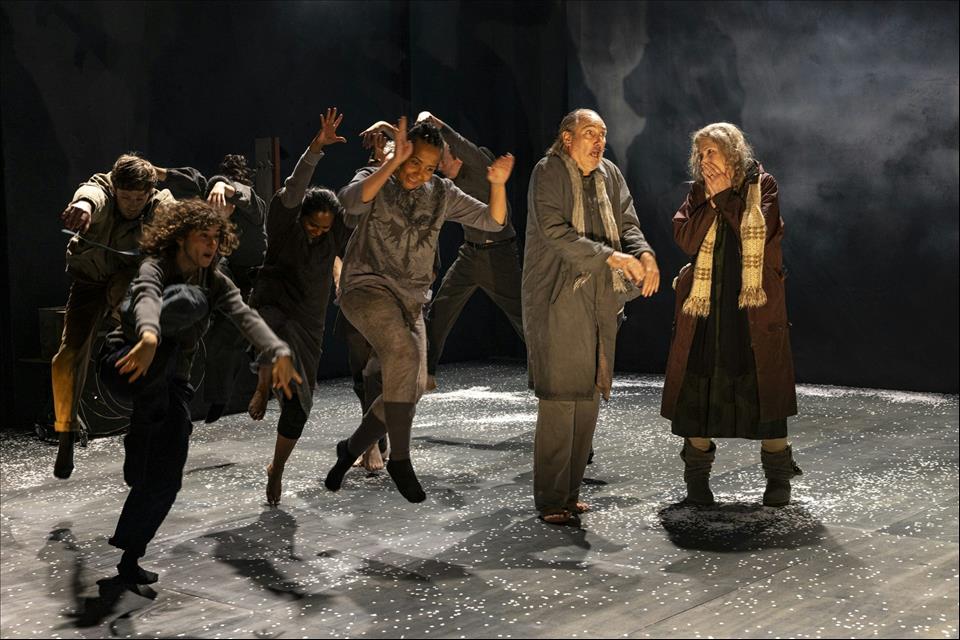
A Stage Adaptation Of Drive Your Plow Over The Bones Of The Dead Is Truly Singular, And Genuinely Memorable
Author: Alexander Howard
(MENAFN- The Conversation) Like all true visionaries, the English poet William Blake was light-years ahead of his time: a fierce critic of industrial modernity and a thinker deeply suspicious of any mindset that might turn the world into something to be dominated. His work also treats non-human life as morally significant, with abuse of innocent animals registering as an augur of apocalypse.

We get an inkling of this in The Marriage of Heaven and Hell (1790–93), where, in an aphoristic turn, he insists:
I begin here because Blake's vision of the natural world is a key to understanding Olga Tokarczuk's 2009 novel Drive Your Plow Over the Bones of the Dead, which takes its title from a line in Blake's book.
Now, Tokarczuk's novel has been adapted for the stage by director Eamon Flack, who says the title:
By the same token, Flack emphasises how the title“belies [...] the very wonky, joyful, slightly madcap, gorgeous and eccentric nature of the story”.
Flack's bravura production seizes on this doubleness. An anarchic energy runs through the show, full of remarkably striking imagery and theatrical invention, in keeping with the novel's restless blending of modes and moods: the cosmological and the procedural, the comic and the horrific.
'An ecofeminist fable'Drive Your Plow is best described as anti-authoritarian ecofeminist fable moonlighting as an Agatha Christie-esque murder mystery.
Published in Polish in 2009 and translated into English by Antonia Lloyd-Jones in 2018, Tokarczuk's genre-bending book is set in a rural Polish village near the Czech border, a liminal space where the social order feels simultaneously rigid and strangely permeable.
Tokarczuk's narrator is Janina Duszejko, an opinionated and talkative older woman. A former teacher and keen amateur astrologer, she is at once an outsider and an obsessive interpreter of the world around her, given to discerning patterns where others see only sheer coincidence.
Not long after the novel starts, Duszejko's equally unconventional friend Oddball arrives at her door with the news that another neighbour, Bigfoot, has been found dead in his home.
It is the first of a series of unexplained deaths in the community, each circling back, in different ways, to questions of patriarchal authority, institutional violence and the human claim to mastery over the natural world.
Disgusted by the unthinking behaviour of the“neurotic egoists” that surround her, Duszejko becomes convinced that the region's animals are rightfully“taking revenge on people”.
Capturing the novel's emotionsFlack's adaptation is faithful, but by no means deferential. Featuring a rotating cast of characters and making excellent use of Belvoir's revolving stage, it embraces physical movement, metatheatrical gestures and variations in narrative pace. This renders the novel's oscillating shifts in emotion and genre into something visually arresting and affectively charged.
At the heart of the production stands Pamela Rabe, a mesmeric Duszejko. On stage for pretty much the entire running time, she anchors the production with an exceptional display, by turns acerbic, droll and extremely moving.
It confirms Rabe is one of the finest actors working in Australia today.
But the production's merits extend well beyond its central performance. One of its most impressive features is its unwavering commitment to the ensemble of 11 actors.
As Rabe told The Australian, Flack remains
Flack has an equal commitment to duration. He is a director who allows scenes, images and rhythms to unfold at their own pace. This is not a production in a hurry.
As with his 2023 adaptation of Mikhail Bulgakov's The Master and Margarita, Drive Your Plow stretches towards the outer limits of what contemporary theatre audiences are typically asked to sit with, clocking in at something close to three and a half hours in length.
As The Conversation's Arts and Culture Editor Jane Howard has recently argued, such run times can be risky:
To be sure, Flack's production occasionally brushes up against this threshold. And yet, its expansiveness also feels integral to its internal logic. It asks its audiences to dwell – to sit with its eccentricities and moments of drift – until something truly singular and genuinely memorable comes into view.
Drive Your Plow Over the Bones of the Dead is at Belvoir, Sydney, until May 10.
Institution:University of Sydney

Legal Disclaimer:
MENAFN provides the
information “as is” without warranty of any kind. We do not accept
any responsibility or liability for the accuracy, content, images,
videos, licenses, completeness, legality, or reliability of the information
contained in this article. If you have any complaints or copyright
issues related to this article, kindly contact the provider above.
Most popular stories
Market Research

More Story







Comments
No comment