


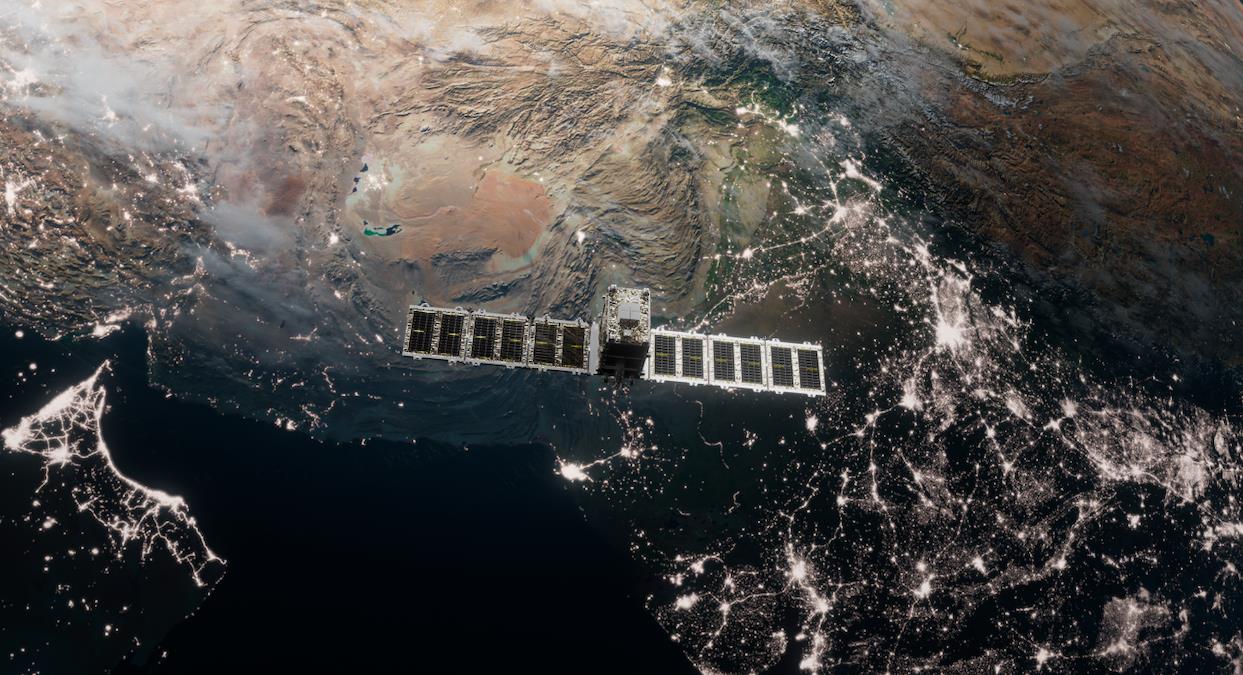
Japan's 'Owl' Spy Satellites In Orbit


A special-purpose company established to implement the project by Mitsubishi Electric, Mitsui & Co. and SKY Perfect JSAT is expected to sign a 5-year contract with the ministry this month. Mitsui Bussan Aerospace, Axelspace and Institute for Q-shu Pioneers of Space (QPS ) will also participate as partner companies.
The project will employ a Private Finance Initiative (PFI) to build a satellite constellation operated by private companies, aiming to provide consistent and timely satellite imaging intelligence to strengthen the defense ministry's space situational awareness, reconnaissance and stand-off defense capabilities. According to SKY Perfect JSAT,“Existing commercial satellite imagery services may not consistently deliver images when required.”
SAR, as explained by NASA, is a type of active data collection in which an instrument sends out a pulse of energy and then records the amount of that energy reflected back after it has interacted with Earth. Unlike optical imagery, which is a passive data collection technique based on emitted energy, SAR imagery is created from the reaction of an emitted pulse of energy with physical structures and conditions – regardless of darkness, cloud cover, or state of matter (e.g. tracking oil spills).
The Japanese government's PFI leverages private sector capital and expertise to improve the quality and lower the cost of national defense and other social infrastructure projects.
Synspective was founded in 2018 as an outgrowth of the ImPACT (Impulsing Paradigm Change through Disruptive Technologies) program, a Japanese government-led R&D initiative started four years earlier to promote high-risk, high-impact scientific and technological innovation.
Structured as a venture company, Synspective was listed on the Tokyo Stock Exchange Growth Market in December 2024.
ImPACT developed the core technology for Synspective's small SAR satellites. In 2020, Synspective's first SAR satellite, StriX-a, was put into a Sun Synchronous Orbit at an altitude of 500km by an Electron rocket launched by Rocket Lab from its Mahia Peninsula spaceport in New Zealand.

Legal Disclaimer:
MENAFN provides the
information “as is” without warranty of any kind. We do not accept
any responsibility or liability for the accuracy, content, images,
videos, licenses, completeness, legality, or reliability of the information
contained in this article. If you have any complaints or copyright
issues related to this article, kindly contact the provider above.


Comments
No comment