


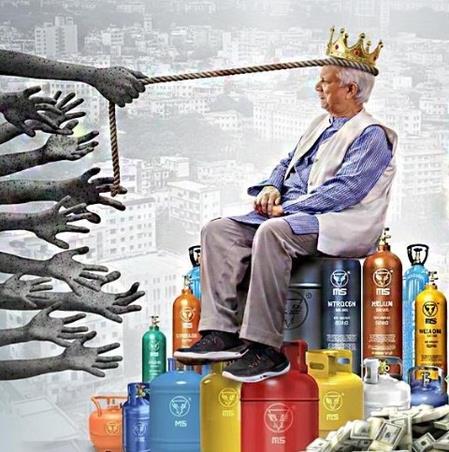
Gas Crisis Across Bangladesh Direct Outcome Of State Neglect, Says Awami League


According to the party, the current crisis in Bangladesh is not a sudden shock, an unavoidable global spillover, or a supply issue, but an "undeniable failure of governance" and yet another example of "misrule" under the Yunus regime.
"This crisis did not emerge overnight. Bangladesh has faced far worse global energy disruptions in recent years and still managed to prevent a system-wide collapse. Today, however, gas shortages persist even when consumers are willing to pay, LPG cylinders vanish from markets despite ongoing imports, and supply chains remain visibly unmanaged. These are not symptoms of scarcity; they are symptoms of administrative paralysis," the Awami League stated.
At its core, the party said this is not a resource failure but a failure of leadership. Under the former Prime Minister Sheikh Hasina-led Awami League government, it noted that scarcity was anticipated and managed through LNG imports, continuous LPG and CNG, subsidies, and active state intervention; however, execution under the Yunus regime has been abandoned.
"While the government continues to speak loudly about reform, it has failed at the most basic task of governance: keeping the country running. The result is a deepening gas crisis that exposes how a manageable challenge was turned into a national emergency, one that did not have to happen," the Awami League emphasised.
"The gas crisis has moved beyond short-term disruption and entered a phase of systemic failure. Despite existing infrastructure and import channels, the Yunus administration has failed to manage supply, regulate markets, or ensure continuity, turning energy access into daily uncertainty," it further added.
The Awami League stressed that since taking office in 2024, the Yunus-led interim government has introduced no concrete reform in gas procurement, no restructuring of LNG financing, no stabilisation mechanism for LPG and CNG markets, and no initiative to expand domestic gas exploration.
It added that supply planning remained ad hoc, storage buffers were neglected, and market oversight weakened -- precisely as demand and vulnerability increased.
"In practice, 'reform' became a slogan used to mask delay. While the government spoke of long-term transformation, it failed at the immediate task of governance: securing energy, managing risk, and preventing system breakdown. The current gas crisis is not a transition cost of reform; it is the cost of having none," the party noted.

Legal Disclaimer:
MENAFN provides the
information “as is” without warranty of any kind. We do not accept any
responsibility or liability for the accuracy, content, images, videos,
licenses, completeness, legality, or reliability of the information
contained in this article. If you have any complaints or copyright issues
related to this article, kindly contact the provider above.


Comments
No comment