


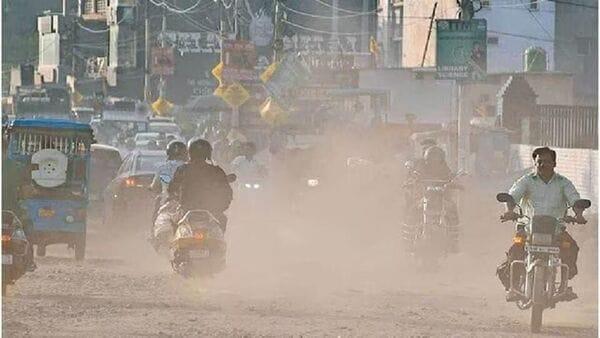
Delhi AQI Likely To Turn 'Severe' - When Can Air Quality Be Expected To Improve?


Officials told news agency PTI that dense fog is likely to worsen Delhi's air quality over the weekend, despite the implementation of stringent pollution-control measures.
As per the CPCB classification, an AQI between 0 and 50 is considered 'good', 51–100 'satisfactory', 101–200 'moderate', 201–300 'poor', 301–400 'very poor' and 401–500 'severe'.
Meanwhile, the India Meteorological Department (IMD) issued a yellow alert for fog, predicting dense fog on Saturday, December 20. Weather officials said foggy conditions are likely to persist during early mornings in the coming days as winter intensifies.
When is Delhi AQI expected to improve?Shambhavi Shukla, Programme Manager at Centre for Science and Environment, New Delhi, told Mint that the air quality in Delhi is likely to improve from February and March onwards.
"The air quality is not good, but better than what is happening right now," she said, adding that, as the year passes by, the monsoon comes from July-end and August onwards, "then you can see the best air quality."
View full ImageAQI trend from January 1, 2025, to November 30, 2025.
(SAFAR)What leads to improved air quality?
Shambhavi Shukla explained that when it rains, all the particles settle down. She said that, as of now, there is fog (water droplets and moisture in the air) and particulate matter (PM 10 and PM 2.5).
Especially during the monsoon, when there is rain, these particulate matter settle down and "you can see less dust/particles, and it washes off the pollution from the air," Shukla said.
Air pollution, foggy conditions during winterSevere air pollution and foggy conditions during winter are persistent challenges, pose significant health hazards, and disrupt daily routines worldwide.
A study, titled 'Role of meteorology and air pollution on fog conditions over Delhi during the peak winter 2024', investigated the conditions favouring the prolonged fog events in Delhi during January 2024 using observations, back trajectories, and reanalysis datasets.
Analysis of visibility observations revealed that foggy conditions persisted in Delhi for 46 percent of the time during the study period.
The existence of three-four days of cold wave to severe cold wave conditions and the lack of passage of strong western disturbances across north and northwest India also favoured the prolonged fog formation.
Besides, high relative humidity, shallow boundary layer, stable weather conditions such as the absence of significant surface winds, the existence of cold wave to severe cold wave, temperature inversion (up to 4 °C), poor ventilation, and presence of high particulate matter (PM10 and PM2.5) facilitated the fog formation.

Legal Disclaimer:
MENAFN provides the
information “as is” without warranty of any kind. We do not accept
any responsibility or liability for the accuracy, content, images,
videos, licenses, completeness, legality, or reliability of the information
contained in this article. If you have any complaints or copyright
issues related to this article, kindly contact the provider above.


Comments
No comment