


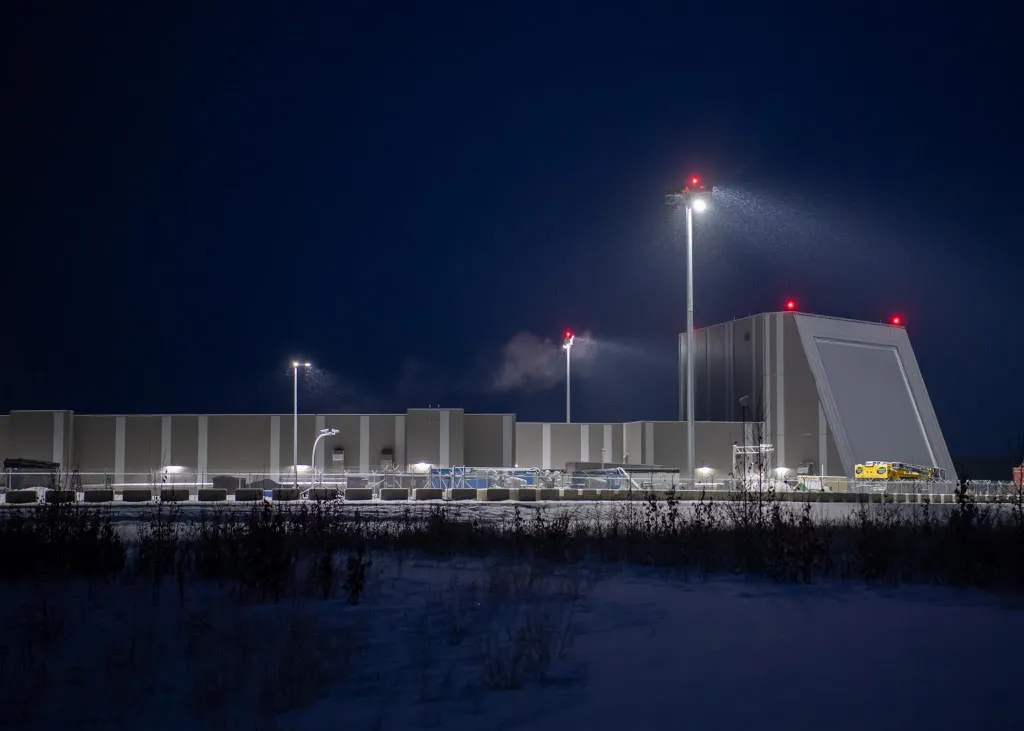
U.S. Space Force Accepts LRDR, Strengthening National Defense


(MENAFN- Mid-East Info) In a significant development for missile defense, the U.S. Space Force has formally accepted Lockheed Martin's Long Range Discrimination Radar (LRDR) at Clear Space Force Station in Alaska after completion of Missile Defense Agency (MDA) testing. The decision strengthens the U.S. national missile warning and tracking architecture at a time of rising long-range threat activity.
As reported by the U.S. Space Force, the radar is now formally integrated into the U.S. missile warning, tracking and targeting mission set, marking a decisive step in strengthening national defense. Lockheed Martin confirmed the completion of DD250 final acceptance and system handover to MDA, underscoring the maturity of the radar program and its readiness to support national missile defense missions. LRDR: A Game-Changer in Missile Defense for the Middle East The Middle East has long stood at the crossroads of global trade, technology, and defense strategy. As the region modernizes and strengthens its security posture, it faces an increasingly complex missile threat environment-defined by rapid technological innovation, evolving tactics, and new domains of warfare. From short- and medium-range ballistic missiles to emerging hypersonic systems and precision cruise weapons, the character of the threat has changed dramatically. What remains constant is the need for uninterrupted situational awareness-a defense network that can detect, track, and respond before a missile ever enters regional airspace. That is where Lockheed Martin's Long-Range Discrimination Radar (LRDR) comes in. Seeing Farther, Responding Faster: At its core, LRDR is a high-performance, S-band radar built with advanced solid-state gallium-nitride (GaN) technology. It combines wide-area search with high-resolution tracking and discrimination, enabling operators to detect, track, and distinguish real warheads from decoys, debris, and countermeasures in particularly challenging environments for continuous operation-even during maintenance-LRDR ensures round-the-clock readiness. Its modular, software-defined architecture supports rapid updates and seamless integration with other defense systems, ensuring enduring relevance as threats evolve. More than just a sensor, LRDR provides the intelligence behind decision advantage-empowering commanders to see farther, decide faster, and respond more effectively. ·Early and persistent tracking from launch through midcourse supplies critical reaction time and situational clarity. ·High-fidelity discrimination ensures interceptors are used only against verified threats, conserving resources and improving efficiency. ·Open architecture enables future upgrades, new system integrations, and continuous evolution to meet emerging challenges. ·Simultaneous Multi-Mission: No time lost transitioning a threat from a surveillance to fire control asset. Discrimination, Deterrence and Defense: Traditional radars can detect a missile launch. LRDR goes much further. Its greatest strength lies in discrimination-the ability to determine which objects within a complex cloud of debris or deception represent genuine threats missiles often deploy decoys or separate into multiple stages designed to overwhelm conventional sensors. LRDR's precision algorithms and advanced signal processing cut through that noise, delivering the clarity essential to modern missile defense.
This capability delivers three decisive advantages:
As reported by the U.S. Space Force, the radar is now formally integrated into the U.S. missile warning, tracking and targeting mission set, marking a decisive step in strengthening national defense. Lockheed Martin confirmed the completion of DD250 final acceptance and system handover to MDA, underscoring the maturity of the radar program and its readiness to support national missile defense missions. LRDR: A Game-Changer in Missile Defense for the Middle East The Middle East has long stood at the crossroads of global trade, technology, and defense strategy. As the region modernizes and strengthens its security posture, it faces an increasingly complex missile threat environment-defined by rapid technological innovation, evolving tactics, and new domains of warfare. From short- and medium-range ballistic missiles to emerging hypersonic systems and precision cruise weapons, the character of the threat has changed dramatically. What remains constant is the need for uninterrupted situational awareness-a defense network that can detect, track, and respond before a missile ever enters regional airspace. That is where Lockheed Martin's Long-Range Discrimination Radar (LRDR) comes in. Seeing Farther, Responding Faster: At its core, LRDR is a high-performance, S-band radar built with advanced solid-state gallium-nitride (GaN) technology. It combines wide-area search with high-resolution tracking and discrimination, enabling operators to detect, track, and distinguish real warheads from decoys, debris, and countermeasures in particularly challenging environments for continuous operation-even during maintenance-LRDR ensures round-the-clock readiness. Its modular, software-defined architecture supports rapid updates and seamless integration with other defense systems, ensuring enduring relevance as threats evolve. More than just a sensor, LRDR provides the intelligence behind decision advantage-empowering commanders to see farther, decide faster, and respond more effectively. ·Early and persistent tracking from launch through midcourse supplies critical reaction time and situational clarity. ·High-fidelity discrimination ensures interceptors are used only against verified threats, conserving resources and improving efficiency. ·Open architecture enables future upgrades, new system integrations, and continuous evolution to meet emerging challenges. ·Simultaneous Multi-Mission: No time lost transitioning a threat from a surveillance to fire control asset. Discrimination, Deterrence and Defense: Traditional radars can detect a missile launch. LRDR goes much further. Its greatest strength lies in discrimination-the ability to determine which objects within a complex cloud of debris or deception represent genuine threats missiles often deploy decoys or separate into multiple stages designed to overwhelm conventional sensors. LRDR's precision algorithms and advanced signal processing cut through that noise, delivering the clarity essential to modern missile defense.
This capability delivers three decisive advantages:
-
Resource efficiency: By engaging only verified threats, LRDR reduces unnecessary interceptor launches, conserving inventory and lowering operational costs.
Operational confidence: High-accuracy discrimination enables faster, more informed decisions, reducing the risk of false alarms.
Stronger deterrence: Knowing that their warheads will be detected and tracked with precision, adversaries are less likely to attempt missile strikes.

Legal Disclaimer:
MENAFN provides the
information “as is” without warranty of any kind. We do not accept
any responsibility or liability for the accuracy, content, images,
videos, licenses, completeness, legality, or reliability of the information
contained in this article. If you have any complaints or copyright
issues related to this article, kindly contact the provider above.


Comments
No comment