



403
Sorry!!
Error! We're sorry, but the page you were looking for doesn't exist.
'Yes' To God, But 'No' To Church What Religious Change Looks Like For Many Latin Americans
Author: Matthew Blanton
(MENAFN- The Conversation) In a region known for its tumultuous change, one idea remained remarkably consistent for centuries: Latin America is Catholic.![Three women in white robes and caps stand outdoors at nighttime by a large wooden cross.]()
Women known as 'animeras,' who pray for the souls of the deceased, walk to a church for Day of the Dead festivities in Telembi, Ecuador. AP Photo/Carlos Noriega Religious decline![A spotlight shines on a zigzag row of people wearing jackets, with the rest of the crowd hidden in the dark.]()
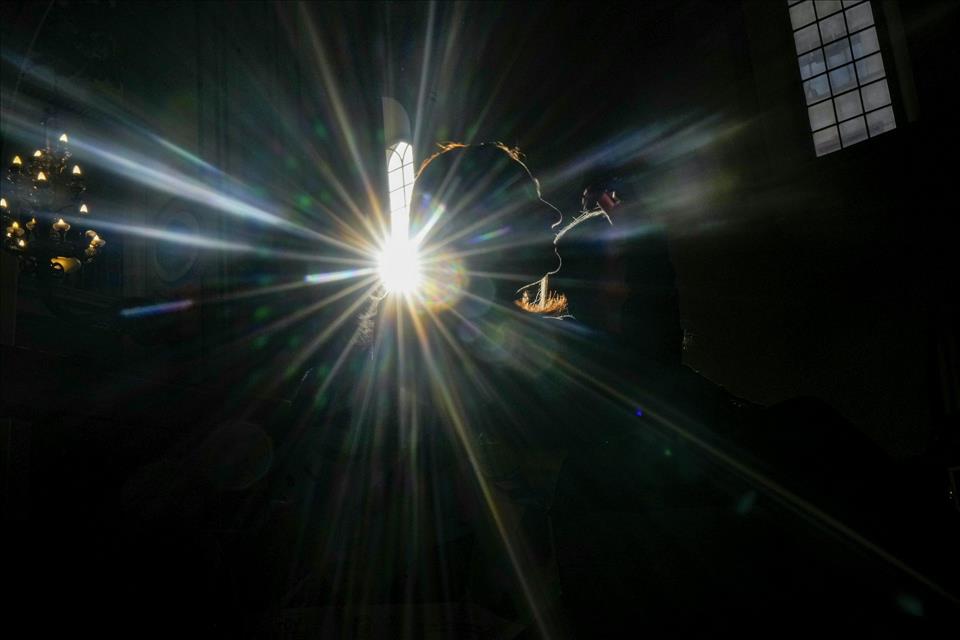
People attend a Mass marking the International Day against Drug Abuse and Illicit Trafficking in Buenos Aires, Argentina, on June 26, 2024. AP Photo/Rodrigo Abd![A man in a colorful knit hat and bright sweater or jacket holds up a small doll in a white robe that is surrounded by wisps of smoke.]()
An Aymara Indigenous spiritual guide blesses a statue of baby Jesus with incense after an Epiphany Mass at a Catholic church in La Paz, Bolivia, on Jan. 6, 2025. AP Photo/Juan Karita

The region's 500-year transformation into a Catholic stronghold seemed capped in 2013, when Jorge Mario Bergoglio of Argentina was elected as the first Latin American pope. Once a missionary outpost, Latin America is now the heart of the Catholic Church. It is home to over 575 million adherents – over 40% of all Catholics worldwide. The next-largest regions are Europe and Africa, each home to 20% of the world's Catholics.
Yet beneath this Catholic dominance, the region's religious landscape is changing.
First, Protestant and Pentecostal groups have experienced dramatic growth. In 1970, only 4% of Latin Americans identified as Protestant; by 2014, the share had climbed to almost 20%.
But even as Protestant ranks swelled, another trend was quietly gaining ground: a growing share of Latin Americans abandoning institutional faith altogether. And, as my research shows, the region's religious decline shows a surprising difference from patterns elsewhere. While fewer Latin Americans are identifying with a religion or attending services, personal faith remains strong.
Women known as 'animeras,' who pray for the souls of the deceased, walk to a church for Day of the Dead festivities in Telembi, Ecuador. AP Photo/Carlos Noriega Religious decline
In 2014, 8% of Latin Americans claimed no religion at all. This number is twice as high as the percentage of people who were raised without a religion, indicating that the growth is recent, coming from people who left the church as adults.
However, there had been no comprehensive study of religious change in Latin America since then. My new research, published in September 2025, draws on two decades of survey data from over 220,000 respondents in 17 Latin American countries. This data comes from the AmericasBarometer, a large, region-wide survey conducted every two years by Vanderbilt University that focuses on democracy, governance and other social issues. Because it asks the same religion questions across countries and over time, it offers an unusually clear view of changing patterns.
Overall, the number of Latin Americans reporting no religious affiliation surged from 7% in 2004 to over 18% in 2023. The share of people who say they are religiously unaffiliated grew in 15 of the 17 countries, and more than doubled in seven.
On average, 21% of people in South America say they do not have a religious affiliation, compared with 13% in Mexico and Central America. Uruguay, Chile and Argentina are the three least religious countries in the region. Guatemala, Peru and Paraguay are the most traditionally religious, with fewer than 9% who identify as unaffiliated.
Another question scholars typically use to measure religious decline is how often people go to church. From 2008 to 2023, the share of Latin Americans attending church at least once a month decreased from 67% to 60%. The percentage who never attend, meanwhile, grew from 18% to 25%.
The generational pattern is stark. Among people born in the 1940s, just over half say they attend church regularly. Each subsequent generation shows a steeper decline, dropping to just 35% for those born in the 1990s. Religious affiliation shows a similar trajectory – each generation is less affiliated than the one before.
Personal religiosityHowever, in my study, I also examined a lesser-used measure of religiosity – one that tells a different story.
That measure is“religious importance”: how important people say that religion is in their daily lives. We might think of this as“personal” religiosity, as opposed to the“institutional” religiosity tied to formal congregations and denominations.
People attend a Mass marking the International Day against Drug Abuse and Illicit Trafficking in Buenos Aires, Argentina, on June 26, 2024. AP Photo/Rodrigo Abd
Like church attendance, overall religious importance is high in Latin America. In 2010, roughly 85% of Latin Americans in the 17 countries whose data I analyzed said religion was important in their daily lives. Sixty percent said“very,” and 25% said“somewhat.”
By 2023, the“somewhat important” group declined to 19%, while the“very important” group grew to 64%. Personal religious importance was growing, even as affiliation and church attendance were falling.
Religious importance shows the same generational pattern as affiliation and attendance: Older people tend to report higher levels than younger ones. In 2023, 68% of people born in the 1970s said religion was“very important,” compared with 60% of those born in the 1990s.
Yet when you compare people at the same age, the pattern reverses. At age 30, 55% of those born in the 1970s rated religion as very important. Compare that with 59% among Latin Americans born in the 1980s, and 62% among those born in the 1990s. If this trend continues, younger generations could eventually show greater personal religious commitment than their elders.
Affiliation vs. beliefWhat we are seeing in Latin America, I'd argue, is a fragmented pattern of religious decline. The authority of religious institutions is waning – fewer people claim a faith; fewer attend services. But personal belief isn't eroding. Religious importance is holding steady, even growing.
This pattern is quite different from Europe and the United States, where institutional decline and personal belief tend to move together.
Eighty-six percent of unaffiliated people in Latin America say they believe in God or a higher power. That compares with only 30% in Europe and 69% in the United States.
Sizable proportions of unaffiliated Latin Americans also believe in angels, miracles and even that Jesus will return to Earth in their lifetime.
In other words, for many Latin Americans, leaving behind a religious label or skipping church does not mean leaving faith behind.
An Aymara Indigenous spiritual guide blesses a statue of baby Jesus with incense after an Epiphany Mass at a Catholic church in La Paz, Bolivia, on Jan. 6, 2025. AP Photo/Juan Karita
This distinctive pattern reflects Latin America's unique history and culture. Since the colonial period, the region has been shaped by a mix of religious traditions. People often combine elements of Indigenous beliefs, Catholic practices and newer Protestant movements, creating personal forms of faith that don't always fit neatly into any one church or institution.
Because priests were often scarce in rural areas, Catholicism developed in many communities with little direct oversight from the church. Home rituals, local saints' festivals and lay leaders helped shape religious life in more independent ways.
This reality challenges how scholars typically measure religious change. Traditional frameworks for measuring religious decline, developed from Western European data, rely heavily on religious affiliation and church attendance. But this approach overlooks vibrant religiosity outside formal structures – and can lead scholars to mistaken conclusions.
In short, Latin America reminds us that faith can thrive even as institutions fade.
Institution:The University of Texas at Austin

Legal Disclaimer:
MENAFN provides the
information “as is” without warranty of any kind. We do not accept
any responsibility or liability for the accuracy, content, images,
videos, licenses, completeness, legality, or reliability of the information
contained in this article. If you have any complaints or copyright
issues related to this article, kindly contact the provider above.
Most popular stories
Market Research

More Story







Comments
No comment