


Inside Dubai's Skyrocketing 'Mall Economy' - And What's Fueling It


Mudon resident Monica Prasad, a marketing professional and mother of two, loves her biweekly visits to Dubai Hills Mall - her one-stop destination for everything, be it shopping for the family, watching a movie or a special dinner with friends. “Dubai doesn't have much street shopping, so malls are the only places to go whether you need a shoe or a pen!” she laughs. “What I like about Dubai Hills is that it isn't overwhelming in size, has good brands and restaurants, and draws a chic crowd.” Her visits usually last at least four hours - part shopping, part socialising and part weekend routine.
For Prasad, as for many in Dubai, a mall is less a shopping venue and more a space for connection, convenience and recreation.
Recommended For You 62% women screened for breast cancer in UAE first-timers, healthcare group saysNow, mall-goers like her have more reasons to rejoice. The city's mall-scape is undergoing a massive change with new developments on the anvil even as existing ones get an ambitious facelift.
The effect on tourism, real estate, retail and the economy aside, what makes the trend interesting is the contrast: while globally, traditional malls are struggling to survive the onslaught of e-commerce, in the UAE, the reverse is true: malls here are thriving, drawing in more crowds than ever and cementing its status as a business and tourist destination.
What to look forward to
So, 2025 has indeed been the year of mall announcements, refurbishments and expansions. Here's a quick lowdown on the key headliners:
The iconic Dubai Fountains, adjoining the Dubai Mall, reopened last month after its first phase of renovation. Phase 2 will have more innovative, tech-led features promising to elevate the world's largest dancing fountains.
Earlier this year, Dubai Mall developer Emaar unveiled The District, a Dh1.5 billion expansion with a curated selection of 279 new outlets.
The Majid Al Futtaim (MAF) group's ambitious Dh5 billion investment to transform Mall of the Emirates by 2027 boasts of 20,000 sq m of additional retail space, an advanced IMAX experience, an indoor-outdoor dining precinct, a wellness club and (the recently launched) New Covent Garden Theatre and Pineapple Dubai.
MAF will also launch a mall in the Ghaf Woods community - a forest-integrated place where you can shop, dine and have fun amid lush natural landscapes.
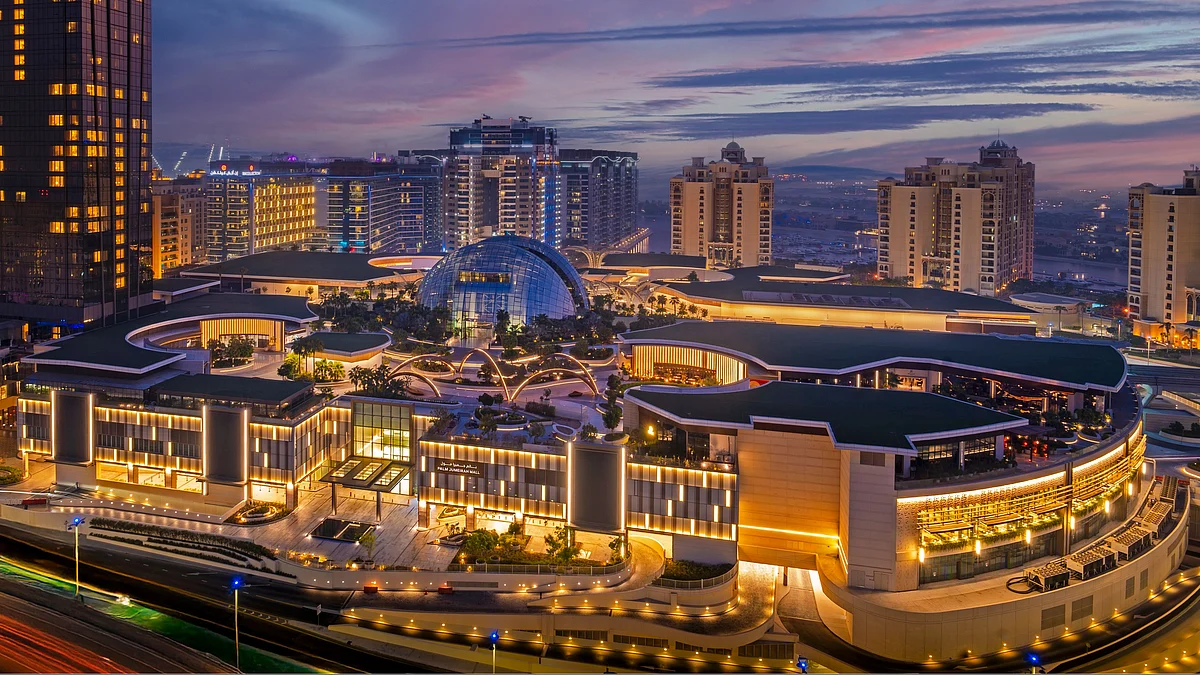
On the Palm, Nakheel Mall rebranded itself as Palm Jumeirah Mall with the redeveloped section bringing a new line of international and homegrown fashion and dining brands for a more sophisticated experience.
The revamped malls also boast of new much-awaited international brands - Haribo at Dubai Festival City Mall, Kim Kardashian's SKIMS and American beauty giant Ulta Beauty at Mall of the Emirates and Primark at Dubai Mall, City Centre Mirdif and MoE.
In summer this year, Dubai top malls hosted 'mallathons', turning these arenas into indoor walking and jogging tracks.
In Abu Dhabi, Yas Mall has expanded along with Yas Bay and Etihad Arena while Sharjah's City Centre Al Zahia, is now the largest mall in the Northern Emirates.
Even Al Ain has seen the development of Remal Mall. Who said secondary cities didn't demand large-scale retail?
Significance of the Mall Economy
Malls have long been part of the economic and social fabric of the UAE. As Joerg Meiser, Partner at Monitor Deloitte in the Middle East, puts it, they're not just commercial spaces but “strategic pillars in the city's visitor economy.”
But the big change now is their evolved role, being reimagined as immersive, multi-sensory destinations that blend fashion, food, leisure and culture. Analyst and Certified Board Director and Board Advisor, Niranjan Gidwani, calls this the natural evolution of a maturing market. “Such large-scale projects re-establish Dubai's stature as a global retail and lifestyle hub,” he says, noting that these expansions reflect strong retail demand and a shift towards integrated-lifestyle experiences.
It is no surprise then that malls contribute significantly to tourism and the wider economy. In 2024, the UAE welcomed more than 28 million international visitors, with Dubai accounting for 18.72 million overnight stays. And tourists in the UAE - more than any other destinations - spend on retail activities. According to Department of Economy and Tourism (DET) data, an astounding 99 per cent of visitors in 2024 made a stop at Dubai Mall alone. Dubai Mall's prominence is well documented; it is, after all, the most visited place on earth for two consecutive years (2023-2024), with 111 million visitors in 2024.
Beyond shopping, the economic ripple effect runs deep. “Malls also anchor real estate, boost hospitality and create jobs,” Meiser says. “This multiplier effect explains why investments in malls are often treated as investments in the city's broader economic flywheel.”
For consumers, malls have become a modern urban lifestyle statement in themselves. Studies show that six in 10 UAE residents visit a mall at least once a week, with most spending between Dh100–Dh500 per trip. Dining, in particular, is a major magnet. With food and beverage as a key draw, malls have been transformed, as Gidwani says, “into living extensions of communities - places that fulfil social, recreational, and experiential needs.”
The Anchor for Festivals and Tourism
With malls serving as accessible, all-in-one spaces offering multi-dimentional experiences, they've become the perfect partners for Dubai's tourism authorities.
Mohamad Feras, AVP Retail & Strategic Alliances at Dubai Festivals and Retail Establishment (DFRE), explains how the department's partnerships with malls go far beyond retail. “Malls are a cornerstone of Dubai's tourism appeal; they are iconic landmarks that shape how visitors experience the city. For many travellers, a visit to Dubai isn't complete without spending time at our malls, which offer everything from luxury fashion and global dining to indoor ski slopes, aquariums, art installations, and seasonal experiences. So they're central to how we shape Dubai's identity as a global shopping and lifestyle destination,” he says.
These collaborations are meticulously structured - from joint planning sessions to thematic alignment and promotional rollouts - ensuring every campaign delivers a citywide buzz. So whether it's exclusive deals during Dubai Shopping Festival (DSF) and Dubai Summer Surprises (DSS), 12-hour flash sales, Ramadan-themed activations or prize-led promotions, the synergy between DFRE and the malls is what brings Dubai's retail calendar to life. The impact, says Feras, is two-fold. “We support the retail economy by driving consistent footfall and sales uplift, while also strengthening Dubai's positioning as a dynamic hotspot where something exciting is always happening.”
According to the 2024 DET Annual Visitor Survey, 77per cent of travellers came for leisure, with average stays of 10 days and strong bucket-list motivations. Developers are therefore integrating immersive anchors, curated dining, live events and seamless digital experiences. “The result is higher dwell time, higher cross-category spend, and a durable rationale for multi-year expansion,” says Meiser. “Seasonal campaigns like DSF and DSS further boost consumption and traffic. These expansions, therefore, are less about capacity and more about reinforcing the role of malls as full-day destinations that integrate retail, events, technology and lifestyle in one journey.”
The results speak for themselves. The last DSS saw a 110 per cent increase in average consumer spending between June 27 and August 31. Over 1,200 winners took home prizes worth more than Dh20 million through raffles and retail promotions with over 1,050 brands at 3,800 retailers participating in the campaign.
The Rise of Community Malls
While size does matter, the scene also offers a quieter revolution closer to home - the rise of community malls.
The big players focus on large-scale expansions but it's the smaller neighbourhood malls that are transforming the areas they serve. As Gidwani points out, “Smaller malls like Nad Al Sheba and City Centre Shindagha are increasingly impactful in boosting the real estate appeal and community living of their surrounding areas.”
Nad Al Sheba mall - a 500,000 sq ft mixed-use destination with over 100 stores, wellness facilities, padel courts, restaurants and supermarkets - is a prime example. Along with The Square in Nad Al Sheba Gardens and DxBike in Meydan, it has not only enhanced real estate values but also made the neighbourhood self-sufficient.
For residents, such community malls bring daily convenience closer to home. Monika Prasad, for instance, often heads to Ranches Souk 2 near her house in Mudon. “The restaurants are great and it has all the basics that serve my needs,” she says.
Developers are taking note. Projects like the Dh210 million Sobha Hartland Community Mall are designed around the idea of local connection and quality of life. Co-chairman of Sobha Group, Ravi Menon, states that the goal is to create “community-focused integrated spaces”.
How Dubai Ducks the E-commerce Wave
All these efforts have had an unexpected global impact. While it was assumed - quite rightly - that e-commerce would wipe out brick-and-mortar establishments, Dubai has proved otherwise. Globally, e-commerce accounted for just over 20 per cent of retail sales but the reason why the city's malls ducked the trend lies in their “differentiated value proposition.” “Malls do not see online channels as a threat but rather, as an enabler,” says Meiser. “Many retailers operate on a 'Showrooming model'. Visitors experience the product in store, but delivery happens via e‐commerce, so shopping integrates seamlessly into a day out. Events like DSF and DSS amplify traffic, creating further spikes in retail activity that online alone cannot replicate. For residents, malls provide a climate‐controlled 'third place' for socialising, while tourists include mall visits into their travel itineraries,” he says.
Gidwani agrees, arguing that strategic investments in world-class infrastructure and retail innovation has created an ecosystem where the physical and digital exist harmoniously. “The city's seamless logistics, digital payments, and hybrid shopping models (like click-and-collect) enhance convenience while preserving the appeal of physical spaces. This allows malls to remain vital hubs even amid the e-commerce growth,” he says. Meiser adds that the threat from e-commerce does not apply to malls in Dubai because here the malls have moved up the value chain. “From places to buy, they are places to be!” he says.
The Risks and Challenges
By all means, the mall economy appears to be booming but sustaining this growth is no easy task. Developers have to continuously innovate to keep driving footfalls. Then there is the other side of the glam: managing the high energy consumption and water use, addressing the environmental impact and ensuring effective waste management to meet Dubai's zero landfill targets. “While developers are beginning to integrate smart energy-efficient systems, green building designs, and circular waste practices, balancing technological innovation with sustainable operations and having an effective plan to handle slowdown phases, need to be in place,” warns Gidwani.
For Meiser, the key challenge is how malls manage the end-to-end victory in three stages - pre-visit, in-visit and post-visit. In the first stage, the risk is that of indivisibility where most retailers identify only 15-27 per cent of their visitors. “This makes true personalisation impossible,” he says.
Orchestration is the challenge in the in-visit stage where parking, wayfinding, tenant coordination and F&B all add up to the quality of the visit. Finally, the risk in the post-visit stage is that of disconnection. “Too often, the relationship ends when the visitor leaves. Deloitte's 'Future of Shopping Malls' study shows that malls which establish Visitor Experience Centres or hubs that manage feedback, loyalty, and digital engagement achieve 20-40 per cent higher dwell times and 25-35 per cent increases in repeat visits,” says Meiser. His prediction: The next phase of growth will be determined not by the size of a mall, but by how effectively it orchestrates Visitor Experience. “For example, Deloitte Visitor Experience Framework suggests leveraging data enabled by AI to analyse VX across all the touchpoints to understand satisfaction, identify pain points and recommend solutions. Those who get this right will turn malls into ecosystems people actively choose and return to.”
The Mall of the Future
Gidwani, on the other hand, looks at the larger picture. The Mall of the Future in Dubai, he says, will be an immersive, multi-sensory lifestyle destination that blends retail, dining, wellness, culture and entertainment with cutting-edge technology. “These will be malls that integrate AI-powered personalisation, AR for immersive shopping experiences, smart IoT enabled environments, contactless payments and safety along with robotics and digital concierges. Hybrid “phygital” shopping models will blur the lines between online and offline retail,” he predicts.
Going by the developments, we might just be a few years into this future.

Legal Disclaimer:
MENAFN provides the
information “as is” without warranty of any kind. We do not accept
any responsibility or liability for the accuracy, content, images,
videos, licenses, completeness, legality, or reliability of the information
contained in this article. If you have any complaints or copyright
issues related to this article, kindly contact the provider above.


Comments
No comment