




403
Sorry!!
Error! We're sorry, but the page you were looking for doesn't exist.
Provokeglobal:“PR Is The Fast-Twitch Muscle In Any Organisation”:
(MENAFN- PRovoke)
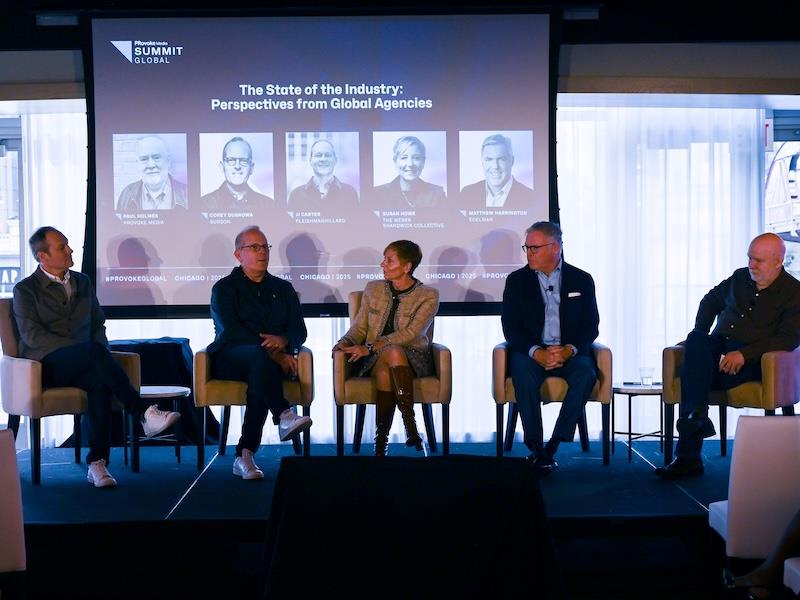
CHICAGO - At the PRovoke Global Summit in Chicago today, leaders from Edelman, Burson, FleishmanHillard and The Weber Shandwick Collective explored how communications is adapting to political turbulence, cultural fragmentation and AI-driven transformation, and why agility remains the defining advantage of the industry.
The conversation, moderated by PRovoke Media founder and CEO Paul Holmes, brought together four of the world's top agency heads – Matthew Harrington, executive vice chairman of Edelman; Corey duBrowa, global CEO of Burson; JJ Carter, global president and CEO of FleishmanHillard; and Susan Howe, CEO of the Weber Shandwick Collective – for an unflinching discussion on global challenges, client expectations and the future of the business.
Navigating the new normal
The agency leaders reflected on a turbulent year that has tested both their people and the boundaries of what communications can do. Harrington described 2025 as“a rollercoaster, whether geopolitics, polarisation, a world trying to navigate uncertainty and significant transformation.”
He noted:“Our industry is at the centre of so much of that, so the rollercoaster also has pendulum swings, socially and politically. I'm coming to the close of 2025 with a fair sense of optimism that we are getting our footing and clients are leaning into the sense of this being the new normal.”
For Howe, the period has been“a stress test for our values, and for our people.” She continued:“I'm optimistic, so I see the potential and the many opportunities that lie ahead of us. It's been a seismic shift in terms of the value of communications. What used to be binary – protect and promote – has become blended, which creates opportunity for clients and people – but not without a lot of challenges.”
The sense of conflicting forces was echoed by duBrowa, who said he could not remember a year with“such a mosaic of headwinds that have presented themselves to our clients. In this new US administration, the spectre of political violence [has] never been more prevalent, plus there's what AI is doing, not just to our industry but more widely.”
DuBrowa said had just returned from China, where he found“a lot of talk about the emergence of China and the US as the two global power centres – it was profound to come away from the trip feeling that's the truth of the way the world is going.” He noted“a sharp decline in trust in earned media, but at the same time 85% of citations on LLMs are from earned media. 2025 is the year that two things can be true – there are opposing forces and polarisation, and it's the responsibility and privilege of our industry to help our people and clients to navigate those confusing signals.”
Carter saw that same duality inside agencies themselves.“Two things can be true inside our companies as well,” he said.“Our people are facing uncertainty and anxiety about what the future holds, but they are also incredibly ambitious for change.
“Folks have built careers based on being experienced and seasoned on the front line of client problem solving, now they have a huge new toolset and can extend messaging to audiences that wasn't possible before. There's so much ambition and hunger – the comms landscape is in very good hands.”
Blurring the lines between 'promote' and 'protect'
Holmes asked whether the industry's focus had shifted from storytelling to protection, to avoid missteps that might put brands at risk. Howe responded that the two are now inseparable.“We're not seeing that,” she said.“It has become blended – clients need us to develop campaigns that pierce culture, break through [and] add meaning to story to fuel LLMs, but also to be the places where consumer brands are believed in public.
“We're seeing a lot of brand building work with cultural fluency and creativity at its core, and preparedness for risk goes side by side. Clients are expecting us to continue to invent new ways to provide solutions that work on both sides. Advisory is thriving, but we're also seeing a lot of clients needing us to build brands and businesses.”
Harrington pointed to the renewed energy around in-person experiences.“There has been a resurgence of experiential, and brands getting into marketplaces where consumers are,” he said.“It brings storytelling to life and enables them to connect in a tangible way.”
DuBrowa noted that the pursuit of“brand safety” can sometimes be counterproductive.“Brand safety is a strange term – sometimes safety equals silence which equals irrelevance,” he warned.“We talk about protecting brands, and living in culture is important there – we can't escape the spectre of what's happening in DC and a different engagement model with this president. The ground beneath our feet has shifted.”
Carter added that risk is now quantifiable, which is changing how clients approach decisions.“I expect more clients to have the downside risk modelled out before they act. We can now put a monetary value on risk, which we didn't have until this year,” he said.“It has built courage and stamina, plus messages in different markets need to be more nuanced. That fidelity is shaping the way advice is landing.”
The speed of decision-making is also reshaping counsel.“It's not that legislation doesn't matter anymore, but the window in which things occur has shrunk,” said duBrowa.“Clients need to feel they have efficacy, and people don't have time or patience to wait. The counsel we're offering is back to the 'two things can be true' idea – you need to have broader strategy to find out where [a] company fits in the policy landscape, but there is also urgency. We need to do both things in a fluid way.”
That urgency is particularly visible in Washington.“The dynamics of DC are so fast-moving, strategy is not just making a deal but also being on the front foot, and that's one of the things we've seen companies striving to do,” said Harrington.“For instance, Tim Cook at Apple has spent an inordinate time in DC this year, presumably in consideration of the whole stakeholder set.”
Howe said the same principle applies internally.“You may have an employee base that is following action at the federal level, and seeing other behaviours in the company, so it's about how we bring employees along with us.”
And the regulatory picture extends well beyond the US, Carter pointed out.“Brussels is as important as DC – the cascade of regulation out of Brussels is changing supply chains for clients that will have a significant financial impact, so we have to make sure we're not overcorrecting for DC.”
Diverging values and regional realities
The conversation turned to the widening gap between regions on issues such as ESG and DEI. Carter observed that motivations now vary widely:“If you were and are using ESG as a reputational shield, it's of diminishing effectiveness today. If you're using it as a guiding mechanism for the long-term future of the business, you should carry forward with that, and it's up to you when you lift the curtain to talk about sustainable energy or supply chains, but using it as a veneer to mask other challenges in the business isn't as effective today.”
DuBrowa reflected on how the global picture is fragmenting.“The environment has been a big focus in Europe for so long, but it's difficult to understand what's happening on the ground unless you're in these places,” he said.
“What I learned in China is that the government shift to EV has had a profound impact. I don't see a wildly different picture of the importance of environment, but it is implemented differently on a local level. My plea to you if you work in a global business it to actually get out and see what's happening globally. I fear some of the denigration of our media properties has resulted in skewed reporting.”
Momentum, however, is building in new parts of the world.“I'm very excited about the Middle East, the Emirates and Saudi Arabia – even ADNOC is looking at renewables and understanding their energy mix is going to need to change – even the centre of the oil industry recognises the transition, and with that comes diversification of the economy,” said Harrington.
Howe agreed that innovation was emerging everywhere.“Some markets are embracing innovation in interesting ways and that will continue to drive growth. We're looking at capabilities, and seeing experiential and digital experiences as a huge centre of growth, as well as the emergence of more and more agentic work.”
For Carter, that diversity of models is reshaping competition.“There's a whole host of clients who are being serviced by agencies in their domestic market, and are happy at a different price point than global firms,” he said.“We've also seen the value of bringing in elite consultants to lead business and be forward-leaning as advisors to navigate complex moments.”
DuBrowa added that Asia's growth trajectory is impossible to ignore.“Four of the five biggest markets in the world, GDP wise, will be in Asia by 2035. Domestic companies going global from those markets need public and corporate affairs support, and there's also need for more branding – not just product and service help, but corporate branding, and licence to operate in markets around the world where they have ambition.”
Cultural fluency replaces purpose
Holmes noted that at the Cannes Lions festival this year,“cultural fluency” had overtaken purpose as the industry's holy grail. Howe agreed immediately.“Cultural fluency is our superpower as an organisation and a profession – we are best suited because of our agility,” she said.
“What differentiates us from the rest of marketing services is the speed with which we can plug into culture and be fast to market. It's incredibly energising today because we're able to look at so much more data because of what AI enables.”
Carter said this is precisely why PR is well-positioned to lead in an era of creators and fragmented platforms.“So much content lives on digital platforms where you can track a message to a converted sale,” he said.“The reason PR writ large has the opportunity to lead is because we're accustomed to multi-audience and multi-platform comms and weaving a complex story through those platforms in a way that is not suited to the blunt instrument of paid.”
DuBrowa brought the discussion back to agility, which he sees as PR's core strength.“Leaders are asking us to give them a steer on where things are headed – companies only use 30–40% of their own data. Burson has started work on cognitive AI tools, assuming that agility is the new stability. It's PR's superpower – we're the fast-twitch muscle in any organisation.”
The AI evolution
Technology, all agreed, is both reshaping and accelerating communications. Harrington called it“a merger of agility and data,” explaining that Edelman has created“more than 500 custom GPTs, driving speed, efficiency and far better insight... Real-time synthetic focus groups [are helping] clients get insights into how the stakeholder and customer base might be thinking and feeling.”
AI, said Howe, is proving a powerful motivator.“The ability to invent agentic solutions on behalf of clients is what it does to our people: the humans in the loop are energised and inventing, coming up with solutions even before the client is asking for it.”
Carter was dismissive of fears that critical thinking will be lost.“I'm not worried about that,” he said.“These tools will be fundamental to how we live our lives. Our interns are prepared to come in as analysts on day one and make sense of data, rather than just scraping it... The energy and optimism I see in the workforce is like nothing I've seen in 25 years.”
DuBrowa added that this new generation is redefining agency culture itself.“The exchange rate is changing with people new to the industry,” he said.“We used to operate on an apprenticeship model... but that has been swapped out for things that have more impact. This cohort coming out of university now will have skills that will dwarf the capabilities of the people in our building today.”
When the discussion turned to technology strategy, the consensus was clear: agencies cannot afford to wait.“No-one in this room should be waiting – it's all about our tech stack and partnerships,” said Howe.“Anyone who's waiting is in trouble.”
DuBrowa agreed that tech platforms alone would not set the pace.“The big tech companies say here's the platform, now go build on top of it,” he said.“They aren't thinking about specific applications or business problems like Burson's Reputation Capital, for example, which is trying to speak to impact.”
Carter added:“We don't want to be beholden to a single platform as a global company – being able to integrate them in a seamless way is the next challenge.”
All four leaders expressed optimism about the months ahead.“The appetite for change is as high as it's ever been,” said Carter.“After a difficult year we've created a framework and a playbook for change.”
DuBrowa said what excites him most is“storytelling around innovation,” while Howe pointed to“the convergence of creativity and critical advisory.” Harrington agreed:“Leaning into transformation – we are coming to terms with the need for speed, and clients are also leaning into it.”
The conversation, moderated by PRovoke Media founder and CEO Paul Holmes, brought together four of the world's top agency heads – Matthew Harrington, executive vice chairman of Edelman; Corey duBrowa, global CEO of Burson; JJ Carter, global president and CEO of FleishmanHillard; and Susan Howe, CEO of the Weber Shandwick Collective – for an unflinching discussion on global challenges, client expectations and the future of the business.
Navigating the new normal
The agency leaders reflected on a turbulent year that has tested both their people and the boundaries of what communications can do. Harrington described 2025 as“a rollercoaster, whether geopolitics, polarisation, a world trying to navigate uncertainty and significant transformation.”
He noted:“Our industry is at the centre of so much of that, so the rollercoaster also has pendulum swings, socially and politically. I'm coming to the close of 2025 with a fair sense of optimism that we are getting our footing and clients are leaning into the sense of this being the new normal.”
For Howe, the period has been“a stress test for our values, and for our people.” She continued:“I'm optimistic, so I see the potential and the many opportunities that lie ahead of us. It's been a seismic shift in terms of the value of communications. What used to be binary – protect and promote – has become blended, which creates opportunity for clients and people – but not without a lot of challenges.”
The sense of conflicting forces was echoed by duBrowa, who said he could not remember a year with“such a mosaic of headwinds that have presented themselves to our clients. In this new US administration, the spectre of political violence [has] never been more prevalent, plus there's what AI is doing, not just to our industry but more widely.”
DuBrowa said had just returned from China, where he found“a lot of talk about the emergence of China and the US as the two global power centres – it was profound to come away from the trip feeling that's the truth of the way the world is going.” He noted“a sharp decline in trust in earned media, but at the same time 85% of citations on LLMs are from earned media. 2025 is the year that two things can be true – there are opposing forces and polarisation, and it's the responsibility and privilege of our industry to help our people and clients to navigate those confusing signals.”
Carter saw that same duality inside agencies themselves.“Two things can be true inside our companies as well,” he said.“Our people are facing uncertainty and anxiety about what the future holds, but they are also incredibly ambitious for change.
“Folks have built careers based on being experienced and seasoned on the front line of client problem solving, now they have a huge new toolset and can extend messaging to audiences that wasn't possible before. There's so much ambition and hunger – the comms landscape is in very good hands.”
Blurring the lines between 'promote' and 'protect'
Holmes asked whether the industry's focus had shifted from storytelling to protection, to avoid missteps that might put brands at risk. Howe responded that the two are now inseparable.“We're not seeing that,” she said.“It has become blended – clients need us to develop campaigns that pierce culture, break through [and] add meaning to story to fuel LLMs, but also to be the places where consumer brands are believed in public.
“We're seeing a lot of brand building work with cultural fluency and creativity at its core, and preparedness for risk goes side by side. Clients are expecting us to continue to invent new ways to provide solutions that work on both sides. Advisory is thriving, but we're also seeing a lot of clients needing us to build brands and businesses.”
Harrington pointed to the renewed energy around in-person experiences.“There has been a resurgence of experiential, and brands getting into marketplaces where consumers are,” he said.“It brings storytelling to life and enables them to connect in a tangible way.”
DuBrowa noted that the pursuit of“brand safety” can sometimes be counterproductive.“Brand safety is a strange term – sometimes safety equals silence which equals irrelevance,” he warned.“We talk about protecting brands, and living in culture is important there – we can't escape the spectre of what's happening in DC and a different engagement model with this president. The ground beneath our feet has shifted.”
Carter added that risk is now quantifiable, which is changing how clients approach decisions.“I expect more clients to have the downside risk modelled out before they act. We can now put a monetary value on risk, which we didn't have until this year,” he said.“It has built courage and stamina, plus messages in different markets need to be more nuanced. That fidelity is shaping the way advice is landing.”
The speed of decision-making is also reshaping counsel.“It's not that legislation doesn't matter anymore, but the window in which things occur has shrunk,” said duBrowa.“Clients need to feel they have efficacy, and people don't have time or patience to wait. The counsel we're offering is back to the 'two things can be true' idea – you need to have broader strategy to find out where [a] company fits in the policy landscape, but there is also urgency. We need to do both things in a fluid way.”
That urgency is particularly visible in Washington.“The dynamics of DC are so fast-moving, strategy is not just making a deal but also being on the front foot, and that's one of the things we've seen companies striving to do,” said Harrington.“For instance, Tim Cook at Apple has spent an inordinate time in DC this year, presumably in consideration of the whole stakeholder set.”
Howe said the same principle applies internally.“You may have an employee base that is following action at the federal level, and seeing other behaviours in the company, so it's about how we bring employees along with us.”
And the regulatory picture extends well beyond the US, Carter pointed out.“Brussels is as important as DC – the cascade of regulation out of Brussels is changing supply chains for clients that will have a significant financial impact, so we have to make sure we're not overcorrecting for DC.”
Diverging values and regional realities
The conversation turned to the widening gap between regions on issues such as ESG and DEI. Carter observed that motivations now vary widely:“If you were and are using ESG as a reputational shield, it's of diminishing effectiveness today. If you're using it as a guiding mechanism for the long-term future of the business, you should carry forward with that, and it's up to you when you lift the curtain to talk about sustainable energy or supply chains, but using it as a veneer to mask other challenges in the business isn't as effective today.”
DuBrowa reflected on how the global picture is fragmenting.“The environment has been a big focus in Europe for so long, but it's difficult to understand what's happening on the ground unless you're in these places,” he said.
“What I learned in China is that the government shift to EV has had a profound impact. I don't see a wildly different picture of the importance of environment, but it is implemented differently on a local level. My plea to you if you work in a global business it to actually get out and see what's happening globally. I fear some of the denigration of our media properties has resulted in skewed reporting.”
Momentum, however, is building in new parts of the world.“I'm very excited about the Middle East, the Emirates and Saudi Arabia – even ADNOC is looking at renewables and understanding their energy mix is going to need to change – even the centre of the oil industry recognises the transition, and with that comes diversification of the economy,” said Harrington.
Howe agreed that innovation was emerging everywhere.“Some markets are embracing innovation in interesting ways and that will continue to drive growth. We're looking at capabilities, and seeing experiential and digital experiences as a huge centre of growth, as well as the emergence of more and more agentic work.”
For Carter, that diversity of models is reshaping competition.“There's a whole host of clients who are being serviced by agencies in their domestic market, and are happy at a different price point than global firms,” he said.“We've also seen the value of bringing in elite consultants to lead business and be forward-leaning as advisors to navigate complex moments.”
DuBrowa added that Asia's growth trajectory is impossible to ignore.“Four of the five biggest markets in the world, GDP wise, will be in Asia by 2035. Domestic companies going global from those markets need public and corporate affairs support, and there's also need for more branding – not just product and service help, but corporate branding, and licence to operate in markets around the world where they have ambition.”
Cultural fluency replaces purpose
Holmes noted that at the Cannes Lions festival this year,“cultural fluency” had overtaken purpose as the industry's holy grail. Howe agreed immediately.“Cultural fluency is our superpower as an organisation and a profession – we are best suited because of our agility,” she said.
“What differentiates us from the rest of marketing services is the speed with which we can plug into culture and be fast to market. It's incredibly energising today because we're able to look at so much more data because of what AI enables.”
Carter said this is precisely why PR is well-positioned to lead in an era of creators and fragmented platforms.“So much content lives on digital platforms where you can track a message to a converted sale,” he said.“The reason PR writ large has the opportunity to lead is because we're accustomed to multi-audience and multi-platform comms and weaving a complex story through those platforms in a way that is not suited to the blunt instrument of paid.”
DuBrowa brought the discussion back to agility, which he sees as PR's core strength.“Leaders are asking us to give them a steer on where things are headed – companies only use 30–40% of their own data. Burson has started work on cognitive AI tools, assuming that agility is the new stability. It's PR's superpower – we're the fast-twitch muscle in any organisation.”
The AI evolution
Technology, all agreed, is both reshaping and accelerating communications. Harrington called it“a merger of agility and data,” explaining that Edelman has created“more than 500 custom GPTs, driving speed, efficiency and far better insight... Real-time synthetic focus groups [are helping] clients get insights into how the stakeholder and customer base might be thinking and feeling.”
AI, said Howe, is proving a powerful motivator.“The ability to invent agentic solutions on behalf of clients is what it does to our people: the humans in the loop are energised and inventing, coming up with solutions even before the client is asking for it.”
Carter was dismissive of fears that critical thinking will be lost.“I'm not worried about that,” he said.“These tools will be fundamental to how we live our lives. Our interns are prepared to come in as analysts on day one and make sense of data, rather than just scraping it... The energy and optimism I see in the workforce is like nothing I've seen in 25 years.”
DuBrowa added that this new generation is redefining agency culture itself.“The exchange rate is changing with people new to the industry,” he said.“We used to operate on an apprenticeship model... but that has been swapped out for things that have more impact. This cohort coming out of university now will have skills that will dwarf the capabilities of the people in our building today.”
When the discussion turned to technology strategy, the consensus was clear: agencies cannot afford to wait.“No-one in this room should be waiting – it's all about our tech stack and partnerships,” said Howe.“Anyone who's waiting is in trouble.”
DuBrowa agreed that tech platforms alone would not set the pace.“The big tech companies say here's the platform, now go build on top of it,” he said.“They aren't thinking about specific applications or business problems like Burson's Reputation Capital, for example, which is trying to speak to impact.”
Carter added:“We don't want to be beholden to a single platform as a global company – being able to integrate them in a seamless way is the next challenge.”
All four leaders expressed optimism about the months ahead.“The appetite for change is as high as it's ever been,” said Carter.“After a difficult year we've created a framework and a playbook for change.”
DuBrowa said what excites him most is“storytelling around innovation,” while Howe pointed to“the convergence of creativity and critical advisory.” Harrington agreed:“Leaning into transformation – we are coming to terms with the need for speed, and clients are also leaning into it.”

Legal Disclaimer:
MENAFN provides the
information “as is” without warranty of any kind. We do not accept
any responsibility or liability for the accuracy, content, images,
videos, licenses, completeness, legality, or reliability of the information
contained in this article. If you have any complaints or copyright
issues related to this article, kindly contact the provider above.
Most popular stories
Market Research

More Story








Comments
No comment