



403
Sorry!!
Error! We're sorry, but the page you were looking for doesn't exist.
What Belfast's Changing Murals Can Tell Us About Peace
Author: Dylan O'Driscoll
(MENAFN- The Conversation) The walls of Belfast in Northern Ireland are more than just brick and mortar. They are canvases for public communication, reflecting the city's history of conflict and its ongoing journey towards peace.![A map of Belfast showing points from the database]()
A map of the research sites that form our database. Author provided, CC BY-SA![Three photos of the same mural over time celebrating soldiers, then the buildings, then the people]()
The gateway to Shankill in 1999, 2009 and 2022. Left and middle Extra Mural Activity, right author's own photograph.![Four photos of the same mural over time showing the invasion of Afghanistan, then Gerry Adams, then Celebrating the NHS, then Bobby Sands and the Irish flag]()
International Wall, Divis Street. (Clockwise L-R) in 2002, 2014, 2020 and 2022. Extra Mural Activity/ibid/Google Maps/Author's own photo![Three murals, showing soldiers]()
Freedom Corner Mural. (Clockwise L-R) 2016, 2022 and again, 2022. Authors' own photo/ibid/Extramural Activity![]()

From large murals depicting significant events to subtle markings, these visual messages offer a unique lens into the evolving sentiments and politics within local communities. They also reveal the unity and divisions that exist across communities in a society in transition.
Our research shows that by systematically tracking changes in murals over time and across different locations – what we call“spatio-temporal analysis” – we can gain profound insights into the dynamics of peace and conflict. The walls themselves provide messages that can be inviting or excluding, or even communicate shifts within a community's own identity. For instance, if a mural with paramilitary associations is replaced by one featuring a symbol of peace, it sends a powerful message that attitudes are changing.
To understand these visual shifts, we built a unique dataset of murals from Belfast, spanning from 1998 to 2022. This period is particularly significant as it began with the signing of the Good Friday Agreement, a pivotal moment for peace in Northern Ireland. Our approach leveraged open-access digital archives and Google Street View. This allowed us to track changes over time.
A map of the research sites that form our database. Author provided, CC BY-SA
A broad trend emerged. Over the years, there was a significant move away from murals that glorify violence, weaponry and paramilitaries. For example, in the Unionist Shankill area, the murals we mapped showed a 75% decrease in depictions of paramilitaries and violence since 1998. They have largely been replaced by artwork honouring culture, heritage and community.
However, this shift is not necessarily a move towards reconciliation between communities. Instead, it often signifies a solidification of distinct identities.
In Unionist areas, new murals frequently portray Protestants as hardworking, alongside symbols of the monarchy and union jacks. Meanwhile, Nationalist areas show strong connections to socialism, resistance movements, Gaelic traditions and the Irish flag. While less violent, these murals still maintain a sense of“othering” (creating us and them). This contributes to the ongoing process of separate nation-building within each community.
Reading wallsThe murals on Peter's Hill, marking the entry to the Unionist Shankill Road, clearly demarcate territory. In 1999, a mural honoured Loyalist paramilitary groups such as the Ulster Defence Association (UDA). In the 2009 and 2021 versions, depictions of weapons and paramilitary groups were gone.
The gateway to Shankill in 1999, 2009 and 2022. Left and middle Extra Mural Activity, right author's own photograph.
The 2009 mural explicitly claimed Shankill as“original Belfast”. The“i” was dotted with a crown in a nod to the monarchy. The 2021 version, while retaining this claim, shifted to celebrating community work. It depicted local community workers and young people. This showed a move away from glorifying violence, yet still reinforced a distinct Unionist cultural identity.
The Falls Road International Wall is a key stop for Belfast's conflict tourism. It is used by the Nationalist community to express solidarity with globally oppressed groups, linking their struggle to international revolutionary movements.
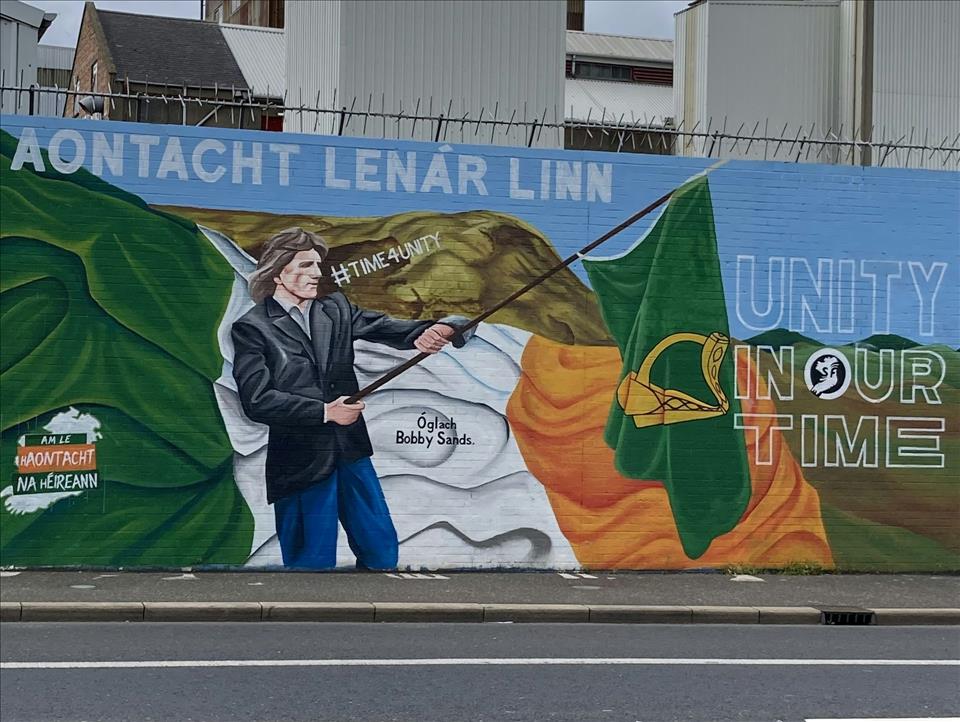
Our analysis shows how dynamic this wall is, often changing in response to local and global events. A 2001 mural depicted Nationalists as victims of state violence. By 2002, it featured anti-war messaging after the invasion of Afghanistan. The wall has since shown strong affinity with the Palestinian cause, honoured Gerry Adams and even featured a mural for the National Health Service (NHS) during COVID. However, by 2022, it shifted back to strong Irish Republican ideologies, featuring figures like Bobby Sands and calls for a united Ireland.
International Wall, Divis Street. (Clockwise L-R) in 2002, 2014, 2020 and 2022. Extra Mural Activity/ibid/Google Maps/Author's own photo
On Whiterock Road in west Belfast, outside the main tourist routes, a mural set holds deep historical significance. The current mural, appearing during the Ballymurphy inquest (2018-2021), commemorates the 1971 Ballymurphy Massacre. It depicts the 11 victims and a scene from the event. Earlier murals in this spot memorialised the 1916 Easter Rising. The timing of these changes highlights how this site is used to remember and memorialise specific historical periods, reflecting the community's ongoing engagement with its past.
The large mural network on Newtownards Road, known locally as“Freedom Corner”, has been a long-standing symbol of paramilitary territorial claim-making for the Ulster Defence Association (UDA). While it was refreshed in 2015 after damage, its message and style remained largely unchanged from the Good Friday Agreement to 2022.
In 2022 the murals were whitewashed and new ones commissioned without consulting the community. While the art style changed, the substance continued to link Northern Ireland to the British union and promote paramilitary activity. Interestingly, the new mural also includes the role of women, indicating a desire to break the perception of male-dominated Unionism.
Freedom Corner Mural. (Clockwise L-R) 2016, 2022 and again, 2022. Authors' own photo/ibid/Extramural Activity
Our research demonstrates that murals are far more than just art, they are a powerful, dynamic communication method. Murals offer invaluable insights into local perceptions of peace and conflict, societal transformation, and community positioning.
By systematically analysing these visual changes over time and space, we can better understand how communities express themselves, maintain their identities, and navigate the complex path of post-conflict evolution. This foundational method opens doors for further research, helping us ask deeper questions about the decision-making behind these murals, their funding, community buy-in and their true impact on local dynamics.
The walls of Belfast continue to tell a story, and by reading them we can learn a great deal about the complex journey towards peace.
Looking for something good? Cut through the noise with a carefully curated selection of the latest releases, live events and exhibitions, straight to your inbox every fortnight, on Fridays. Sign up here.
Institution:Coventry University

Legal Disclaimer:
MENAFN provides the
information “as is” without warranty of any kind. We do not accept
any responsibility or liability for the accuracy, content, images,
videos, licenses, completeness, legality, or reliability of the information
contained in this article. If you have any complaints or copyright
issues related to this article, kindly contact the provider above.
Most popular stories
Market Research

More Story


Comments
No comment