


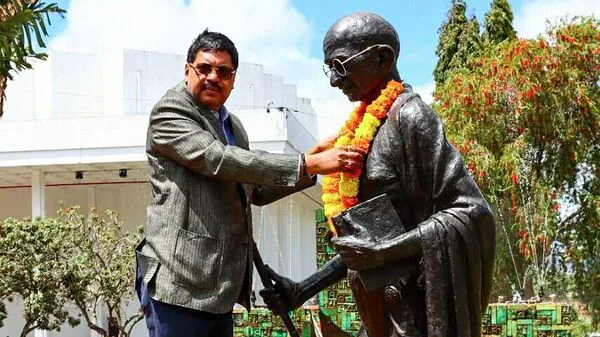
Indian Judiciary Stands For Rule Of Law, Not Bulldozer Justice, Says CJI BR Gavai In Mauritius Cites His Own Judgement


Delivering the inaugural Sir Maurice Rault Memorial Lecture 2025 in Mauritius on 'Rule of Law in the Largest Democracy', CJI Gavai referred to his own verdict deprecating 'bulldozer justice '.
Also Read | Won't attend RSS event due to health reasons: CJI Gavai's motherSir Maurice Rault, a noted jurist, was the Chief Justice of Mauritius from 1978 to 1982.
Highlighting the principle of rule of law and its expansive interpretation by the Supreme Court of India , Justice Gavai, who was on a three-day official visit to the island nation, said, "The judgment sent a clear message that the Indian legal system is governed by the rule of law, not by the rule of the bulldozer."
What was CJI judgement in the 'bulldozer justice' case?In the November 2024 judgement in the 'bulldozer justice' case, the Supreme Court court held that demolition of houses of accused in response to alleged offenses bypasses legal processes, violates the rule of law and infringes upon the fundamental right to shelter under Article 21.
"It was further held that the executive cannot assume the roles of judge, jury, and executioner simultaneously," the CJI said.
Justive Gavai delivered the lecture in the presence of President of Mauritius Dharambeer Gokhool, Prime Minister Navinchandra Ramgoolam and Chief Justice Rehana Mungly Gulbul among others.
In his address, the CJI referred to various landmark judgements of the apex court including the 1973 Kesavananda Bharati verdict that had brought the basic structure doctrine and clipped the powers of Parliament to amend every bit of the Constitution.
Also Read | CJI Gavai clarifies 'ask Lord Vishnu' remark, says 'I respect all religions'"Over the past 75 years since the adoption of the Indian Constitution, the concept of the Rule of Law has evolved far beyond legal texts, permeating social, political, and constitutional discourse alike," he said.
'Laws enacted to redress historical injustices'Justice Gavai said in social sphere, laws have been enacted to redress historical injustices and marginalized communities have frequently invoked them, and the very language of rule of law to assert their rights against entrenched systems of oppression.
"In the political arena, the rule of law serves as a benchmark of good governance and societal progress, standing in stark contrast to misgovernance and lawlessness, where institutions and public officials might otherwise evade accountability," he said.
'Rule of Law is not a mere set of rules'Referring to the contributions of Mahatma Gandhi and BR Ambedkar, Justice Gavai said their vision demonstrated that in India "the Rule of Law is not a mere set of rules".
"It is an ethical and moral framework designed to uphold equality, protect human dignity, and guide governance in a diverse and complex society," he said.
The CJI referred to recent notable verdicts including the one which abolished the practice of instant triple talaq among Muslims.
He also highlighted the judgements in the case challenging the law on adultery and the electoral bond scheme.
Also Read | 'Will look into it': CJI BR Gavai on removal of stray dogs from streets of Delhi"Taken together, these four judgments demonstrate how the Supreme Court has developed the rule of law as a substantive principle, using it to strike down laws that are manifestly arbitrary or unjust," he said.
'Right to privacy as a fundamental right'Justice Gavai also emphasised the importance of the judgement which held right to privacy as a fundamental right.
The Indian legal system is governed by the rule of law, not by the rule of the bulldozer."This articulation underscores that, when understood as a core principle of constitutionalism, the rule of law operates on both procedural and substantive levels: it restrains arbitrary action by the State , guarantees equality before the law, and embeds democratic accountability across all branches and levels of governance," he said.
(With agency inputs)

Legal Disclaimer:
MENAFN provides the
information “as is” without warranty of any kind. We do not accept
any responsibility or liability for the accuracy, content, images,
videos, licenses, completeness, legality, or reliability of the information
contained in this article. If you have any complaints or copyright
issues related to this article, kindly contact the provider above.


Comments
No comment