


Ferromanganese Market Size, Share And Growth Forecast By 2033


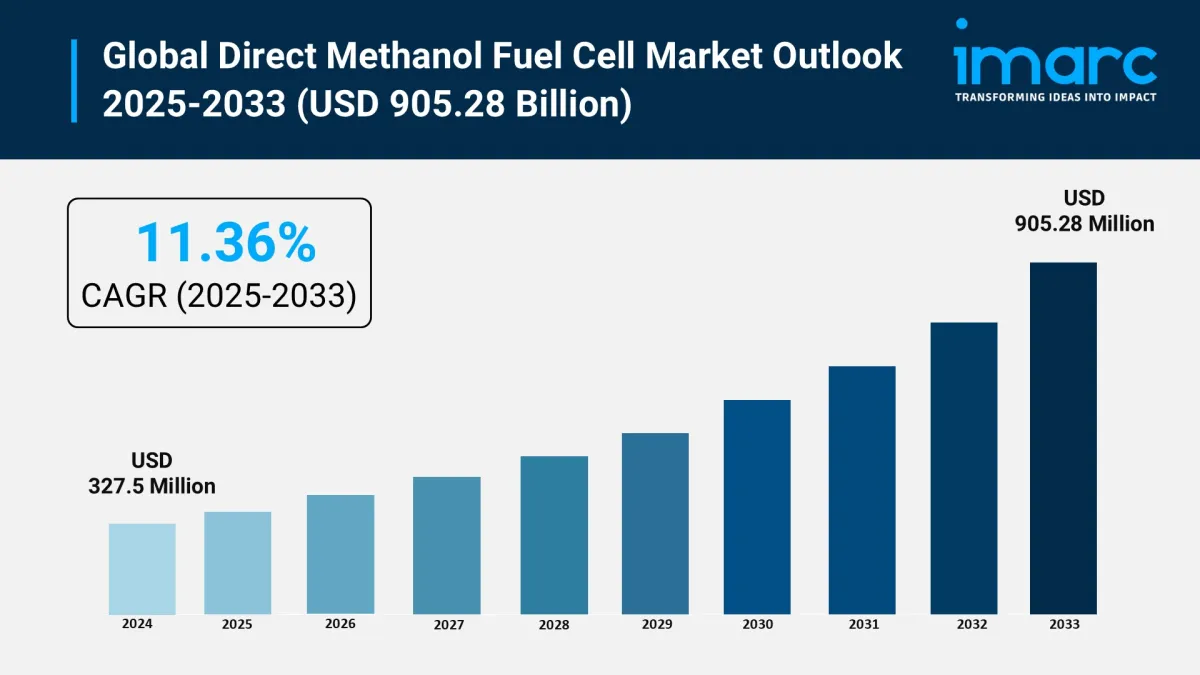
The direct methanol fuel cell market is experiencing remarkable expansion, driven by increasing demand for clean energy solutions, growing adoption in portable electronics, and significant technological breakthroughs in fuel cell efficiency. According to IMARC Group's comprehensive research publication, “Direct Methanol Fuel Cell Market: Global Industry Trends, Share, Size, Growth, Opportunity and Forecast 2025-2033” , the global direct methanol fuel cell market size reached USD 327.50 Million in 2024. Looking forward, IMARC Group expects the market to reach USD 905.28 Million by 2033, exhibiting a growth rate (CAGR) of 11.36% during 2025-2033.
This comprehensive analysis covers market dynamics, technological innovations, competitive landscape, and regional insights. The report integrates extensive research findings, industry assessments, and data from multiple sources to provide stakeholders with actionable insights. It examines key market drivers, challenges, and opportunities while highlighting technological breakthroughs, application developments, and regulatory frameworks shaping the industry's trajectory.
Grab a sample PDF of this report: https://www.imarcgroup.com/direct-methanol-fuel-cell-market/requestsample
Our report includes:
-
Market Dynamics and Growth Drivers
Technology Innovation and Development Analysis
Competitive Landscape Assessment
Detailed Industry Segmentation
Strategic Business Recommendations
Growth Factors in the Direct Methanol Fuel Cell Market
-
Surging Demand for Portable Power Solutions
The growing need for reliable, long-lasting power in portable applications is driving unprecedented growth in the DMFC market. Modern consumers and industries require power solutions that go beyond traditional battery limitations, especially in remote locations where grid power is unavailable. Military applications represent a particularly strong growth area, with defense organizations worldwide adopting DMFC systems for field communications and surveillance equipment. These systems can operate continuously for 72 hours on a single methanol cartridge, compared to just 8-12 hours with conventional batteries. Emergency response teams have increasingly adopted DMFC technology for disaster relief operations, where reliable power can be life-critical. The telecommunications industry has also embraced DMFC systems for powering remote cell towers and communication infrastructure, with major operators reporting 60% reduction in maintenance visits compared to diesel generators.
-
Clean Energy Transition and Environmental Imperatives
Governments worldwide are implementing aggressive clean energy policies that directly benefit fuel cell technologies like DMFCs. The European Union's Green Deal has allocated substantial funding for hydrogen and fuel cell development, with direct methanol systems receiving special attention for their simplicity and immediate deployability. Japan's Strategic Innovation Program continues supporting DMFC commercialization through research grants and deployment incentives, recognizing the technology's potential for energy security. Corporate sustainability initiatives are creating new market opportunities as companies seek carbon-neutral alternatives to diesel generators and traditional backup power systems. Major technology companies have begun integrating DMFC systems into their sustainability strategies, with data centers and remote facilities leading adoption efforts. The technology's ability to operate without producing harmful emissions makes it particularly attractive for indoor applications and environmentally sensitive locations.
-
Technological Breakthroughs and Performance Improvements
Recent advances in catalyst materials and membrane technologies have dramatically improved DMFC performance while reducing costs. New platinum-ruthenium catalyst formulations enable operation at ambient temperatures with 40% higher power density than previous generations. Membrane electrode assemblies now achieve durability exceeding 5,000 operating hours, making commercial applications economically viable for the first time. Manufacturing improvements by companies like SFC Energy and Samsung SDI have reduced system costs by approximately 30% through economies of scale and design optimization. Advanced methanol-tolerant cathode catalysts have eliminated crossover issues that previously limited efficiency, while new bipolar plate designs reduce system weight by 25% without compromising performance. These technological advances are enabling DMFC deployment in applications previously dominated by conventional power sources.
How AI is Reshaping the Future of Direct Methanol Fuel Cells
Artificial intelligence is fundamentally transforming DMFC development through accelerated materials discovery and intelligent system optimization. Machine learning algorithms now predict catalyst performance characteristics before physical synthesis, reducing development cycles from months to weeks and enabling rapid innovation in membrane materials. AI-powered fuel cell management systems continuously optimize methanol flow rates, temperature control, and power output based on real-time demand patterns, improving overall system efficiency by 15-20% while extending component lifespan.
Smart grid integration represents a revolutionary application where AI enhances DMFC deployment in distributed energy systems. Intelligent power management algorithms predict energy demand fluctuations and automatically adjust fuel cell output accordingly, maximizing system efficiency while minimizing methanol consumption. These systems can seamlessly integrate with renewable energy sources and battery storage, creating hybrid power solutions that provide uninterrupted electricity supply even during grid outages.
Manufacturing quality control has been revolutionized through AI implementation, with computer vision systems inspecting membrane electrode assemblies for defects with 99.5% accuracy. Machine learning algorithms optimize production parameters in real-time, maximizing manufacturing yield while ensuring consistent product quality. Predictive maintenance systems analyze performance data to identify potential component failures before they occur, reducing operational downtime by up to 40% and significantly lowering maintenance costs for end users.
Key Trends in the Direct Methanol Fuel Cell Market
-
Miniaturization and Consumer Electronics Integration
The industry is experiencing rapid progress in DMFC miniaturization, enabling integration into increasingly compact consumer devices and portable applications. Micro-fuel cells with power outputs ranging from 1-50 watts are now available in form factors smaller than traditional laptop batteries, opening new market segments in wearable technology and Internet of Things devices. Advanced microfabrication techniques allow fuel cell stacks to be manufactured with sub-millimeter precision, creating opportunities in medical devices, wireless sensors, and portable communication equipment. Flexible DMFC designs using polymer substrates enable integration into curved surfaces and non-traditional form factors, expanding application possibilities in automotive, aerospace, and consumer electronics sectors.
-
Hybrid System Development and Multi-Application Platforms
Modern DMFC systems increasingly incorporate hybrid architectures that combine fuel cells with batteries or supercapacitors to optimize performance across varying load conditions. These hybrid configurations provide instant power response through energy storage components while maintaining extended operating time through continuous fuel cell operation. Multi-fuel capability is becoming standard in advanced systems, with DMFCs capable of operating on methanol, ethanol, or formic acid depending on availability and cost considerations. This flexibility proves particularly valuable in military and remote applications where fuel supply chains may be unpredictable or expensive to maintain.
-
Industry Standardization and Safety Protocol Development
Comprehensive standardization efforts are accelerating market adoption by establishing consistent safety protocols and performance benchmarks across the industry. International standards organizations have developed testing procedures specifically for DMFC systems, enabling reliable performance comparisons and facilitating regulatory approvals in different markets. Safety regulations for methanol handling and transportation continue evolving to support commercial deployment, with simplified procedures for fuel cartridge shipping and storage reducing operational complexity for end users. These standardization initiatives are lowering market entry barriers for new manufacturers while improving consumer confidence in fuel cell reliability and safety.
Recent News and Developments
-
Breakthrough Technology Announcements and Performance Improvements
SFC Energy continues leading DMFC innovation, having shaped fuel cell development since 2000 with their EFOY and EFOY Pro systems. The company recently announced new fuel cell systems achieving 45% electrical efficiency, representing a significant improvement over previous generations. These advanced systems demonstrate continuous operation exceeding 6,000 hours, surpassing commercial viability thresholds for stationary and mobile applications. The technology improvements include enhanced catalyst formulations and optimized system designs that reduce maintenance requirements while improving power output consistency.
-
Strategic Partnerships and Manufacturing Expansion
Major technology companies are forming strategic alliances to accelerate DMFC commercialization and expand manufacturing capabilities. Samsung SDI has announced partnerships with automotive manufacturers to develop fuel cell auxiliary power units for electric vehicles, recognizing the growing need for extended range capabilities. Manufacturing capacity expansions are underway at multiple facilities, with production increases of 150% planned to meet growing demand from telecommunications, military, and industrial customers. These expansions include new automated production lines that improve quality consistency while reducing manufacturing costs.
-
Government Investment and Policy Support
National governments continue increasing investment in fuel cell research and deployment programs, with DMFC technology receiving particular attention for its immediate commercial viability. The Japanese government has allocated additional funding for DMFC commercialization through expanded Strategic Innovation Programs, while European Union Horizon initiatives support large-scale demonstration projects across member countries. Military organizations worldwide are expanding DMFC procurement for field applications, recognizing the strategic advantages of fuel-based power systems over battery-dependent alternatives. These government investments are accelerating technology maturation while creating stable demand for commercial production.
Ask analyst for customized report: https://www.imarcgroup.com/request?type=report&id=7267&flag=E
Leading Companies Operating in the Global Direct Methanol Fuel Cell Market Industry:
-
SFC Energy AG
Samsung SDI Co., Ltd.
Toshiba Corporation
Panasonic Corporation
Oorja Protonics
Antig Technology Co., Ltd.
Neah Power Systems, Inc.
UltraCell Corporation
CMR Fuel Cells Plc
DTI Energy
Direct Methanol Fuel Cell Market Report Segmentation:
Breakup by Component:
-
Membrane Electrode Assembly
Current Collectors
Bipolar Plates
Others
Breakup by Application:
-
Portable
Stationary
Transportation
Breakup by End User:
-
Electronics
Automotive
Military & Defense
Telecommunications
Others
Breakup by Power Range:
-
Below 1W
1W to 5W
5W to 100W
Above 100W
Breakup by Distribution Channel:
-
Direct Sales
Distributors
Online Channels
Regional Insights:
-
North America (United States, Canada)
Asia Pacific (China, Japan, India, South Korea, Australia, Indonesia, Others)
Europe (Germany, France, United Kingdom, Italy, Spain, Russia, Others)
Latin America (Brazil, Mexico, Others)
Middle East and Africa
Research Methodology:
The report employs a comprehensive research methodology, combining primary and secondary data sources to validate findings. It includes market assessments, industry expert interviews, consumer surveys, and advanced data triangulation techniques to ensure accuracy and reliability. Our research approach incorporates real-time market monitoring, competitive intelligence gathering, and trend analysis to provide stakeholders with actionable insights for strategic decision-making.
Note: If you require specific details, data, or insights that are not currently included in the scope of this report, we are happy to accommodate your request. As part of our customization service, we will gather and provide the additional information you need, tailored to your specific requirements. Please let us know your exact needs, and we will ensure the report is updated accordingly to meet your expectations.
About Us:
IMARC Group is a global management consulting firm that helps the world's most ambitious changemakers to create a lasting impact. The company provides a comprehensive suite of market entry and expansion services. IMARC offerings include thorough market assessment, feasibility studies, company incorporation assistance, factory setup support, regulatory approvals and licensing navigation, branding, marketing and sales strategies, competitive landscape and benchmarking analyses, pricing and cost research, and procurement research.
Contact Us:
IMARC Group 134 N 4th St. Brooklyn, NY 11249, USA
Email: sales[@]imarcgroup.com
Tel No:(D) +91-120-433-0800
United States: +1-201-971-6302

Legal Disclaimer:
MENAFN provides the
information “as is” without warranty of any kind. We do not accept any
responsibility or liability for the accuracy, content, images, videos,
licenses, completeness, legality, or reliability of the information
contained in this article. If you have any complaints or copyright issues
related to this article, kindly contact the provider above.


Comments
No comment