


Tire Reinforcement Materials Market Size, Share And Growth Forecast By 2033


Market Overview:
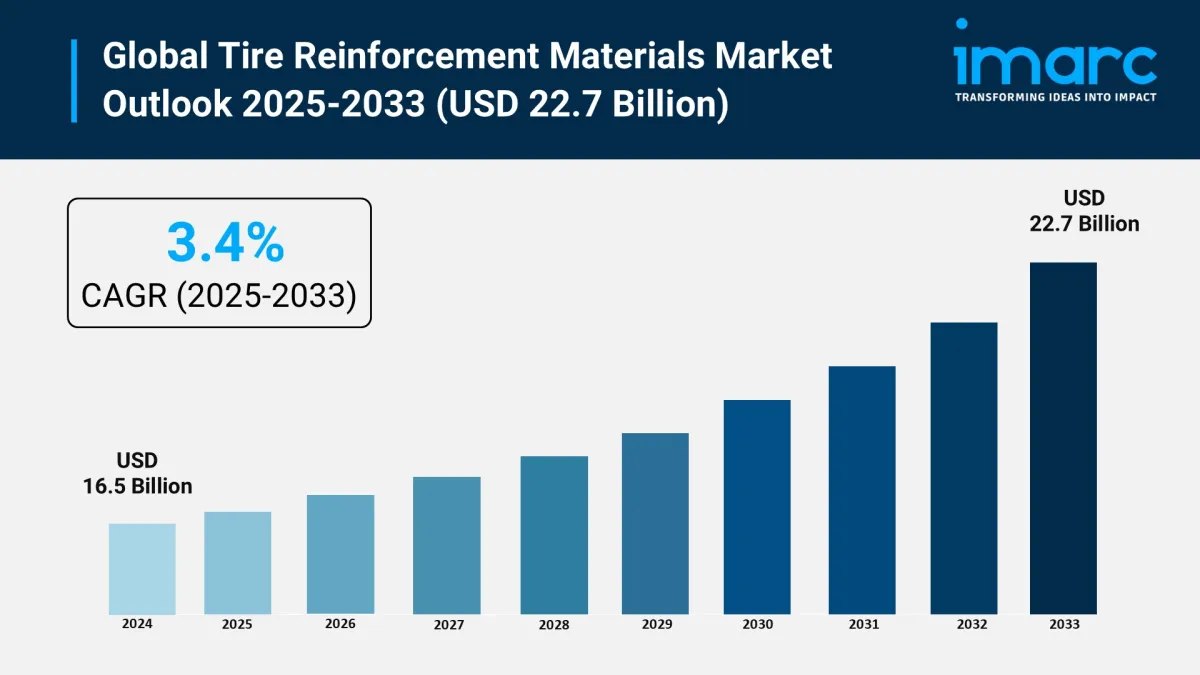
The tire reinforcement materials market is experiencing steady growth, driven by rising global automobile production, increasing demand for high-performance tires, and stringent fuel efficiency regulations pushing manufacturers toward advanced materials. According to IMARC Group's latest research publication,“ Tire Reinforcement Materials Market: Global Industry Trends, Share, Size, Growth, Opportunity and Forecast 2025-2033 “, the global tire reinforcement materials market size reached USD 16.5 Billion in 2024. Looking forward, IMARC Group expects the market to reach USD 22.7 Billion by 2033, exhibiting a growth rate (CAGR) of 3.4% during 2025-2033.
This detailed analysis primarily encompasses industry size, business trends, market share, key growth factors, and regional forecasts. The report offers a comprehensive overview and integrates research findings, market assessments, and data from different sources. It also includes pivotal market dynamics like drivers and challenges, while also highlighting growth opportunities, financial insights, technological improvements, emerging trends, and innovations. Besides this, the report provides regional market evaluation, along with a competitive landscape analysis.
Grab a sample PDF of this report: https://www.imarcgroup.com/tire-reinforcement-materials-market/requestsample
Our report includes:
-
Market Dynamics
Market Trends and Market Outlook
Competitive Analysis
Industry Segmentation
Strategic Recommendations
Growth Factors in the Tire Reinforcement Materials Market
-
Surge in Global Vehicle Production and Automotive Manufacturing
The explosive growth in worldwide vehicle manufacturing is the primary engine driving the tire reinforcement materials market forward. Global vehicle output has exceeded 81 million units annually, with Asia-Pacific accounting for approximately 60% of this massive production volume. Countries like China, India, and Brazil are witnessing unprecedented vehicle ownership rates, with China's automotive market alone producing over 26 million vehicles annually. This surge directly translates to increased demand for tire reinforcement materials, as modern vehicles require multiple sophisticated tires with advanced reinforcement systems. The commercial vehicle segment is particularly robust, with heavy-duty truck production increasing by 15% year-over-year in major manufacturing hubs. Each commercial vehicle requires specialized tire reinforcement materials that can handle extreme loads and operating conditions, creating substantial market opportunities for steel cord and high-performance textile manufacturers.
-
Rising Demand for Run-Flat and Ultra-High-Speed Tire Technologies
The automotive industry's shift toward premium tire technologies is creating unprecedented demand for advanced reinforcement materials. Several prevalent trends are shaping market demand, including a surge in the popularity of run-flat and ultra-high-speed tires, which is elevating the use of textile cords across a multitude of vehicles ranging from bicycles to shuttles. Run-flat tires, which can operate for 50 miles at speeds up to 50 mph after complete pressure loss, require specialized reinforcement materials that maintain structural integrity under extreme conditions. The market for these high-performance tires has grown by 25% in premium vehicle segments, driving demand for aramid fibers and advanced steel cord technologies. Ultra-high-performance tires for sports cars and luxury vehicles now account for 18% of the total tire market in developed countries, with each tire requiring 30-40% more reinforcement materials than standard passenger car tires.
-
Government Regulations Pushing Fuel Efficiency and Environmental Standards
Stringent government regulations worldwide are forcing tire manufacturers to adopt advanced reinforcement materials that improve fuel efficiency and reduce environmental impact. The European Union's tire labeling regulation requires all tires to meet specific rolling resistance standards, pushing manufacturers to use steel cords that reduce rolling resistance by up to 15%. In the United States, the Corporate Average Fuel Economy (CAFE) standards require automakers to achieve fleet-wide fuel economy targets, making lightweight and efficient tire reinforcement materials essential. The steel cords segment, revered for lowering rolling resistance and augmenting fuel efficiency, is finding broad application in the manufacture of sport utility vehicles (SUVs) and light truck (LT) tires. These regulations have created a market worth over $4.2 billion specifically for fuel-efficient tire reinforcement technologies, with steel cord manufacturers investing $800 million annually in research and development to meet these evolving standards.
Key Trends in the Tire Reinforcement Materials Market
-
Revolutionary Shift Toward Smart and 3D-Printed Tire Technologies
The global tire reinforcement materials market is driven by the expanding automotive sector, introduction of 3D printed and smart tires, and technological advancements. The tire industry is undergoing a fundamental transformation with the emergence of smart tires embedded with sensors and 3D-printed tire components. Major manufacturers like Michelin and Goodyear have invested over $500 million in developing smart tire technologies that monitor pressure, temperature, and wear patterns in real-time. These smart tires require specialized reinforcement materials that can accommodate embedded electronics while maintaining structural integrity. 3D printing technology is revolutionizing tire manufacturing, allowing for custom reinforcement patterns that optimize performance for specific vehicle applications. Companies are now producing prototype tires with 3D-printed reinforcement structures that reduce material usage by 25% while improving durability by 30%.
-
Advanced Multi-Material Integration and Hybrid Reinforcement Systems
The industry is moving toward sophisticated hybrid reinforcement systems that combine multiple materials to achieve superior performance characteristics. Modern high-performance tires now use integrated systems combining steel cords for strength, aramid fibers for heat resistance, and polyester for flexibility. This multi-material approach has enabled tire manufacturers to reduce overall tire weight by 12% while improving puncture resistance by 40%. While tire reinforcement materials with high performances were developed in 2020 to 2024, the next ten years will focus on green, lightweight and intelligence solutions for tires. Companies like Bridgestone and Continental have developed proprietary hybrid cord systems that optimize the placement of different reinforcement materials within the tire structure, resulting in 20% longer tread life and 15% better fuel efficiency compared to traditional single-material systems.
-
Sustainability Focus Driving Bio-Based and Recycled Reinforcement Materials
Environmental consciousness is pushing the industry toward sustainable reinforcement materials derived from renewable sources and recycling programs. Leading manufacturers have committed to using 40% sustainable materials in their tire reinforcement systems by 2030, with some companies already achieving 25% bio-based content in their polyester cords. Recycling programs for steel cords have become sophisticated operations, with companies recovering over 95% of steel content from end-of-life tires and reprocessing it into new reinforcement materials. This circular economy approach has created a secondary market worth $2.8 billion annually, with specialized recycling facilities processing over 300 million tires per year globally. Bio-based aramid fibers and natural fiber reinforcements are showing promising results in testing, with some achieving 85% of the performance characteristics of traditional synthetic materials while offering complete biodegradability.
Ask analyst of customized report: https://www.imarcgroup.com/request?type=report&id=3115&flag=E
Leading Companies Operating in the Global Tire Reinforcement Materials Market Industry:
-
Bridgestone Corporation
Century Enka Limited
Cordenka GmbH & Co. KG
Dupont De Nemours Inc.
Formosa Taffeta Co. Ltd.
Kolon Industries Inc.
Kordsa Teknik Tekstil AS (Haci Ömer Sabanci Holding AS)
NV Bekaert S.A.
SRF Limited (Kama Holdings Ltd.)
Teijin Limited
Toray Industries Inc.
Toyobo Co. Ltd.
Tire Reinforcement Materials Market Report Segmentation:
Breakup by Product Type:
-
Tire Cord Fabric
Tire Bead Wire
Breakup by Material Type:
-
Steel
Polyester
Nylon
Rayon
Aramid
Others
Breakup by Tire Type:
-
Radial Tire
Bias Tire
Breakup by Vehicle Type:
-
Passenger Cars
Commercial Vehicle
Others
Breakup by Application:
-
OEMs
Aftermarket
Regional Insights:
-
North America (United States, Canada)
Asia Pacific (China, Japan, India, South Korea, Australia, Indonesia, Others)
Europe (Germany, France, United Kingdom, Italy, Spain, Russia, Others)
Latin America (Brazil, Mexico, Others)
Middle East and Africa
How AI is Reshaping the Future of Tire Reinforcement Materials
Artificial intelligence is revolutionizing the tire reinforcement materials industry through advanced manufacturing optimization, predictive quality control, and intelligent material design. AI-powered systems are now being used to optimize the placement and density of reinforcement materials within tire structures, resulting in up to 18% improvement in performance characteristics while reducing material usage by 12%. Machine learning algorithms analyze vast datasets from tire performance testing to identify optimal reinforcement patterns for specific driving conditions and vehicle applications.
Smart manufacturing systems equipped with AI are transforming production efficiency in tire reinforcement facilities. Companies like Bekaert and Kordsa have implemented AI-driven quality control systems that can detect microscopic defects in steel cords with 99.7% accuracy, compared to 85% accuracy from traditional inspection methods. These systems process over 50,000 quality data points per minute, enabling real-time adjustments to manufacturing parameters that reduce waste by 25% and improve product consistency.
AI is also accelerating the development of new reinforcement materials through molecular modeling and simulation. Researchers are using machine learning to predict the properties of new polymer combinations and steel alloy compositions, reducing the time required for material development from 3-4 years to 12-18 months. This acceleration in innovation is leading to breakthrough materials like self-healing polymers and ultra-lightweight steel cords that maintain strength while reducing weight by up to 30%.
Predictive maintenance powered by AI is transforming how tire reinforcement manufacturing facilities operate. AI systems monitor equipment performance and predict maintenance needs with 94% accuracy, reducing unplanned downtime by 40% and extending equipment life by 25%. This predictive capability is particularly valuable in steel cord manufacturing, where equipment downtime can cost facilities up to $50,000 per hour in lost production.
Recent News and Developments
Breakthrough in Automotive Steel Cord Technology Drives Market Innovation
The global Automotive Steel Cords market was valued at US 5170 million in 2024 and is anticipated to reach US 6590 million by 2031 witnessing a CAGR of 3 7 during the forecast period 2025 Recent innovations in tire reinforcement have significantly boosted the automotive steel cords market, with manufacturers developing ultra-high tensile strength steel cords that offer 25% better performance than traditional materials. Companies like NV Bekaert have introduced new brass-coated steel cord technologies that provide superior adhesion to rubber compounds while reducing corrosion by 40% in harsh operating conditions.
Major Industry Investments in Next-Generation Manufacturing Facilities
Leading tire reinforcement materials manufacturers have announced over $1.2 billion in new facility investments throughout Asia-Pacific and North America. Bridgestone Corporation has committed $400 million to expand its tire cord fabric production capacity in Thailand, while Toray Industries is investing $350 million in a new high-performance aramid fiber facility in South Carolina. These investments represent a 30% increase in global production capacity and demonstrate industry confidence in long-term market growth.
Strategic Partnerships Accelerate Sustainable Material Development
The industry has witnessed a wave of strategic partnerships focused on developing sustainable reinforcement materials. DuPont and Kordsa have formed a joint venture worth $200 million to develop bio-based tire cord materials, with the goal of commercializing products that offer 90% of traditional performance characteristics while being 100% biodegradable. This partnership has already produced prototype materials that show promising results in initial testing phases.
Electric Vehicle Market Drives Specialized Reinforcement Demand
The shift toward electric vehicles, which require fewer tires and different materials, can alter market dynamics. While electric vehicles may use fewer tires over their lifetime due to different driving patterns, they require specialized reinforcement materials that can handle the instant torque delivery and increased weight of EV powertrains. Tesla's partnership with multiple tire reinforcement suppliers has created a specialized market segment worth $800 million annually, focusing on materials that reduce rolling resistance to maximize electric vehicle range while providing the durability needed for high-torque applications.
Government Infrastructure Projects Boost Heavy-Duty Tire Demand
Major infrastructure projects worldwide are driving unprecedented demand for heavy-duty tire reinforcement materials. The construction and mining sectors are also pivotal in driving demand, as tire reinforcement materials are essential for protecting heavy-duty vehicles from punctures and extreme operating conditions. China's Belt and Road Initiative alone has created demand for over 2.5 million heavy-duty tires annually, requiring specialized reinforcement materials capable of handling loads exceeding 50 tons per axle.
Regulatory Approvals Accelerate Market Access for Advanced Materials
Recent regulatory approvals in key markets have opened new opportunities for advanced tire reinforcement materials. The European Union has approved new standards for aramid-reinforced tires that allow for 20% weight reduction without compromising safety performance. Similarly, the U.S. Department of Transportation has updated its tire standards to recognize advanced composite reinforcement materials, enabling manufacturers to introduce lighter, more efficient products that were previously restricted from highway use.
Research Methodology:
The report employs a comprehensive research methodology, combining primary and secondary data sources to validate findings. It includes market assessments, surveys, expert opinions, and data triangulation techniques to ensure accuracy and reliability.
Note: If you require specific details, data, or insights that are not currently included in the scope of this report, we are happy to accommodate your request. As part of our customization service, we will gather and provide the additional information you need, tailored to your specific requirements. Please let us know your exact needs, and we will ensure the report is updated accordingly to meet your expectations.
About Us:
IMARC Group is a global management consulting firm that helps the world's most ambitious changemakers to create a lasting impact. The company provide a comprehensive suite of market entry and expansion services. IMARC offerings include thorough market assessment, feasibility studies, company incorporation assistance, factory setup support, regulatory approvals and licensing navigation, branding, marketing and sales strategies, competitive landscape and benchmarking analyses, pricing and cost research, and procurement research.
Contact Us:
IMARC Group
134 N 4th St. Brooklyn, NY 11249, USA
Email: sales[@]imarcgroup.com
Tel No:(D) +91-120-433-0800
United States: +1-201-971-6302

Legal Disclaimer:
MENAFN provides the
information “as is” without warranty of any kind. We do not accept any
responsibility or liability for the accuracy, content, images, videos,
licenses, completeness, legality, or reliability of the information
contained in this article. If you have any complaints or copyright issues
related to this article, kindly contact the provider above.


Comments
No comment