


Industrial Automation Services Market Size, Share And Growth Forecast By 2033


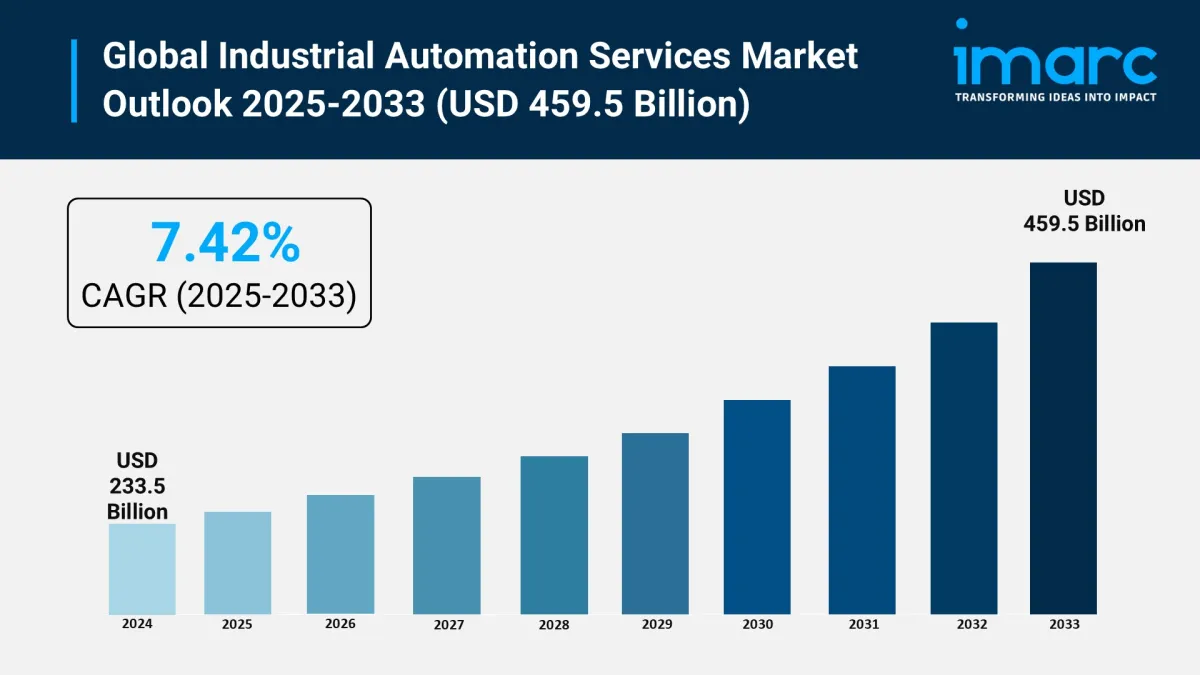
The industrial automation services market is experiencing remarkable expansion, driven by the widespread adoption of Industry 4.0 technologies, stringent regulatory compliance requirements, and the urgent need for operational efficiency across manufacturing sectors. According to IMARC Group's comprehensive research publication, “Industrial Automation Services Market: Global Industry Trends, Share, Size, Growth, Opportunity and Forecast 2025-2033” , the global industrial automation services market size reached USD 233.5 Billion in 2024. Looking forward, IMARC Group expects the market to reach USD 459.5 Billion by 2033, exhibiting a growth rate (CAGR) of 7.42% during 2025-2033.
This detailed analysis primarily encompasses industry size, business trends, market share, key growth factors, and regional forecasts. The report offers a comprehensive overview and integrates research findings, market assessments, and data from different sources. It also includes pivotal market dynamics like drivers and challenges, while also highlighting growth opportunities, financial insights, technological improvements, emerging trends, and innovations. Besides this, the report provides regional market evaluation, along with a competitive landscape analysis.
Grab a sample PDF of this report: https://www.imarcgroup.com/industrial-automation-services-market/requestsample
Our report includes:
-
Market Dynamics
Market Trends and Market Outlook
Competitive Analysis
Industry Segmentation
Strategic Recommendations
How AI is Reshaping the Future of Industrial Automation Services
Artificial Intelligence is fundamentally transforming industrial automation services, creating a new paradigm where machines don't just execute programmed tasks but learn, adapt, and make intelligent decisions in real-time. Rapidly accelerating digitization, fueled by technologies like AI, is enabling manufacturers to boost efficiency and address the skilled labor shortage, while Agentic AI has been transforming IT automation by allowing systems to operate independently, make real-time decisions, and execute tasks without human intervention.
The integration of AI-powered predictive maintenance capabilities is revolutionizing how industries approach equipment management. AI-enabled predictive maintenance reduces downtime by forecasting equipment failures before they occur, allowing companies to shift from reactive maintenance strategies to proactive ones. This transformation is particularly evident in process industries where unexpected equipment failures can result in millions of dollars in losses and safety risks.
Machine learning algorithms are now embedded in distributed control systems, enabling them to optimize production parameters automatically based on historical data patterns and real-time conditions. These intelligent systems can detect anomalies, suggest process improvements, and even implement corrective measures without human intervention. By 2040, the adoption of AI is projected to reach 34.8% across industries, indicating the massive potential for growth in AI-driven automation services.
The rise of digital twins – virtual replicas of physical systems powered by AI – is enabling manufacturers to simulate production scenarios, test optimization strategies, and predict outcomes before implementing changes in real-world operations. This technology is particularly valuable in complex process industries where experimentation with actual systems would be costly and risky.
Key Trends in the Industrial Automation Services Market
Surge in Smart Factory Implementations and Industry 4.0 Adoption
The transformation toward smart factories represents one of the most significant trends reshaping industrial automation services today. The shift towards smart factories, where machines and systems are intertwined and capable of facilitating normal decision making, is catalyzing the requirement for advanced automation services. Companies are investing heavily in IoT-enabled equipment that can communicate seamlessly with central control systems, creating interconnected production environments that respond dynamically to changing conditions.
European manufacturers are leading this transformation, with countries like Germany spearheading the Industry 4.0 movement. Schneider Electric opened a new smart factory in Hungary in 2024 to address the increased need for engineering-to-order products associated with energy transition and digitalization, demonstrating how major industrial players are committing resources to next-generation manufacturing capabilities.
The integration of advanced analytics platforms with existing automation infrastructure is enabling real-time performance monitoring and optimization. These systems can process vast amounts of data from sensors, machines, and production lines to identify bottlenecks, predict maintenance needs, and suggest efficiency improvements automatically.
Emphasis on Cybersecurity and Edge Computing Solutions
As industrial systems become more connected and data-driven, cybersecurity has emerged as a critical concern for automation service providers. The increasing sophistication of cyber threats targeting industrial control systems has prompted companies to invest in robust security frameworks that protect both operational technology and information technology networks.
Edge computing is gaining traction as a solution that brings data processing closer to the point of generation, reducing latency and improving system responsiveness while enhancing security by limiting data transmission to central servers. This approach is particularly valuable in time-critical applications where milliseconds can make the difference between optimal and suboptimal performance.
Sustainability and Energy Efficiency Integration
Environmental considerations are increasingly driving automation service requirements, with companies seeking solutions that not only improve productivity but also reduce energy consumption and carbon emissions. European companies are under pressure to minimize energy consumption and reduce carbon footprints, aligning with stringent environmental regulations and the EU's Green Deal objectives.
Automation services are now incorporating energy optimization algorithms that can adjust equipment operation based on energy costs, renewable energy availability, and production schedules. These systems can automatically shift energy-intensive processes to periods when renewable energy is abundant or electricity costs are lower.
Growth Factors in the Industrial Automation Services Market
Rising Demand for Regulatory Compliance and Quality Assurance
Industries across the globe are facing increasingly stringent regulatory requirements that demand precise documentation, consistent processes, and traceable quality controls. Industries are extremely regulated by strict regulatory policies focused on guaranteeing product quality, safety, and environmental sustainability, requiring careful documentation, a lot of testing, and strict steps to follow.
The pharmaceutical industry exemplifies this trend, where FDA regulations require comprehensive validation of automated systems and complete traceability of manufacturing processes. Similarly, food and beverage manufacturers must comply with HACCP standards and FDA food safety regulations, making automation services essential for maintaining consistent compliance across all production activities.
Process industries like chemical manufacturing face complex environmental regulations that require continuous monitoring of emissions, waste products, and energy consumption. Automated systems provide the precision and documentation capabilities necessary to meet these requirements while minimizing the risk of human error that could lead to compliance violations and significant financial penalties.
Accelerating Labor Shortages and Skills Gap Challenges
The manufacturing sector worldwide is grappling with significant labor shortages, particularly in skilled technical positions. Technologies like AI are enabling manufacturers to address the skilled labor shortage by automating complex tasks that previously required experienced operators.
Baby boomer retirements have created knowledge gaps in many industries, while younger workers often lack the specialized skills needed for complex manufacturing operations. Automation services help bridge this gap by capturing institutional knowledge in digital systems and reducing the skill requirements for routine operational tasks.
Companies are finding that investing in automation services not only addresses immediate labor shortages but also makes their operations more resilient to future workforce challenges. By automating repetitive and dangerous tasks, companies can redeploy human workers to higher-value activities that require creativity, problem-solving, and strategic thinking.
Increasing Focus on Operational Excellence and Competitive Advantage
Businesses across various sectors are continuously seeking ways to enhance their operational efficiency and productivity to remain competitive in the market. The pressure to reduce costs while improving quality and speed-to-market has made automation services essential for maintaining competitive positioning.
Automated systems can operate continuously without the need for breaks, thereby significantly increasing output and reducing lead times. This capability is particularly valuable in industries with high-volume production requirements or where market demand fluctuates significantly.
In 2023, WALTER Surface Technology launched an automation service to present robotic solutions for metalworking companies, demonstrating how specialized service providers are developing targeted solutions for specific industry needs.
Recent News and Developments
Strategic Partnerships and Technology Collaborations
The industrial automation services landscape has witnessed several significant partnerships and collaborations aimed at delivering comprehensive solutions to end-users. In 2024, SLB combined efforts with Nabors Industries to deploy the use of fully automated drilling solutions for the oil and gas operators as well as drilling contractors, highlighting how industry leaders are joining forces to tackle complex automation challenges in demanding environments.
Technology companies are increasingly forming strategic alliances to combine their complementary capabilities. These partnerships often bring together hardware manufacturers, software developers, and service providers to create integrated solutions that can address the full spectrum of customer needs from initial system design through long-term maintenance and optimization.
Major Facility Expansions and Investment Announcements
Leading automation service providers are making substantial investments in expanding their capabilities and geographic reach. The establishment of new smart factories and service centers reflects the industry's confidence in continued growth and the need to be closer to customers in key markets.
These facility expansions often incorporate the latest automation technologies, serving as demonstration sites where customers can see advanced solutions in action and serving as testing grounds for new service offerings and technologies.
Regulatory and Standards Development
Government agencies and industry organizations are actively developing new standards and regulations that will shape the future of industrial automation services. These developments often focus on cybersecurity requirements, safety standards, and interoperability specifications that will influence how automation services are designed and delivered.
The ongoing development of Industry 4.0 standards by organizations like the Industrial Internet Consortium and the Platform Industrie 4.0 is creating frameworks that will guide the evolution of automation services and ensure compatibility between different vendors' solutions.
Ask analyst for customized report: https://www.imarcgroup.com/request?type=report&id=1300&flag=E
Leading Companies Operating in the Global Industrial Automation Services Market Industry:
-
Siemens AG
Honeywell International Inc.
General Electric Company
Mitsubishi Electric
Rockwell Automation
Johnson Controls Inc.
Schneider Electric
Yokogawa Electric Corporation
OMRON Corporation
Danaher Corporation
Industrial Automation Services Market Report Segmentation:
Breakup by Type of Service:
-
Project Engineering and Installation
Maintenance and Support Services
Consulting Services
Operational Services
Breakup by Product Type:
-
DCS
SCADA
PLC
MES
Others
Breakup by End User:
-
Discrete Industries
Process Industries
Regional Insights:
-
North America (United States, Canada)
Asia Pacific (China, Japan, India, South Korea, Australia, Indonesia, Others)
Europe (Germany, France, United Kingdom, Italy, Spain, Russia, Others)
Latin America (Brazil, Mexico, Others)
Middle East and Africa
Research Methodology:
The report employs a comprehensive research methodology, combining primary and secondary data sources to validate findings. It includes market assessments, surveys, expert opinions, and data triangulation techniques to ensure accuracy and reliability.
Note: If you require specific details, data, or insights that are not currently included in the scope of this report, we are happy to accommodate your request. As part of our customization service, we will gather and provide the additional information you need, tailored to your specific requirements. Please let us know your exact needs, and we will ensure the report is updated accordingly to meet your expectations.
About Us:
IMARC Group is a global management consulting firm that helps the world's most ambitious changemakers to create a lasting impact. The company provides a comprehensive suite of market entry and expansion services. IMARC offerings include thorough market assessment, feasibility studies, company incorporation assistance, factory setup support, regulatory approvals and licensing navigation, branding, marketing and sales strategies, competitive landscape and benchmarking analyses, pricing and cost research, and procurement research.
Contact Us:
IMARC Group
134 N 4th St. Brooklyn, NY 11249, USA
Email: sales[@]imarcgroup.com
Tel No:(D) +91-120-433-0800
United States: +1-201-971-6302

Legal Disclaimer:
MENAFN provides the
information “as is” without warranty of any kind. We do not accept any
responsibility or liability for the accuracy, content, images, videos,
licenses, completeness, legality, or reliability of the information
contained in this article. If you have any complaints or copyright issues
related to this article, kindly contact the provider above.


Comments
No comment