


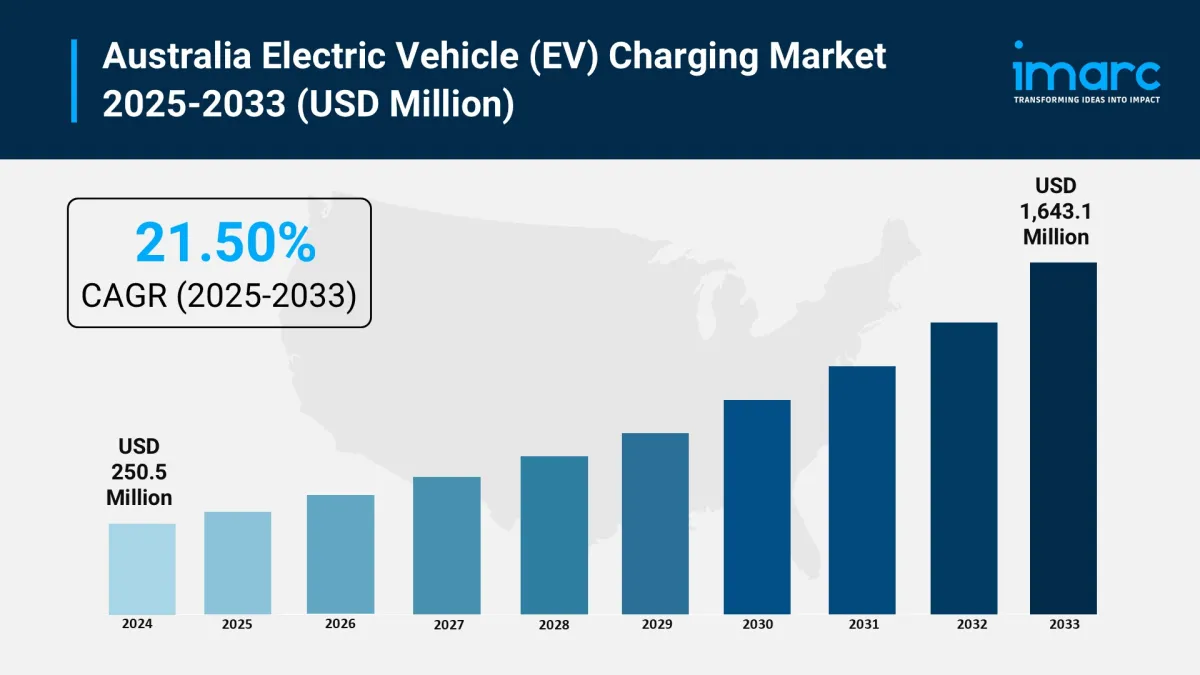
Australia Electric Vehicle (EV) Charging Market Size, Share And Trends By 2025-2033


Report Attributes:
· Base Year: 2024
· Forecast Years: 2025–2033
· Historical Years: 2019–2024
· Market Size in 2024: USD 250.5 Million
· Market Forecast in 2033: USD 1,643.1 Million
· Market Growth Rate 2025–2033: 21.50%
For an in-depth analysis, you can refer to a sample copy of the report:
https://www.imarcgroup.com/australia-electric-vehicle-charging-market/requestsample
How Is AI Transforming the EV Charging Market in Australia?
-
AI is optimizing charging station operations via real-time monitoring and smart scheduling to reduce wait times and energy costs.
Vehicle-to-grid (V2G) technologies enhance grid stability by enabling bidirectional energy flow between EVs and the electricity grid.
Intelligent IoT systems and digital platforms are managing dynamic pricing, interoperability, and session booking.
AI-driven predictive maintenance improves charger reliability and uptime.
Smart grid integration facilitates efficient energy use and renewables incorporation in charging networks.
Fleet electrification and commercial charging solutions leverage AI for performance optimization.
Government-supported pilot programs for AI-enabled bi-directional charging are shaping future infrastructure.
Australia EV Charging Market Overview
. The market is growing quickly because public and private companies are setting up charging stations in both cities and countryside areas.
. Governments are giving a lot of support through laws and financial help to make more EV charging stations and related systems.
. Smart charging methods like connecting electric vehicles to the power grid and using apps to manage charging are now common.
. Faster growth is happening because of teamwork between different levels of government and businesses investing in the EV industry.
. New kinds of charging stations, such as those powered by solar energy or a mix of energy sources, are being built in faraway places.
. Stores and online tools are helping people use EVs more easily and reach more customers
Key Features and Trends of Australia EV Charging Market
. Building more fast-charging stations helps reduce worries about running out of battery and makes it easier for people to use electric vehicles.
. Smart charging systems help manage electricity use across the grid and make better use of renewable energy sources.
. Special charging routes are being encouraged in different regions and tourist areas to help people travel by electric car in less populated places.
. More companies in delivery and government are switching to electric vehicles, which is leading to more charging stations being built for commercial use.
. New ways of working together between government and private companies, like charging-as-a-service, are starting to appear.
. Government policies are helping through things like money-back offers, funding for charging stations, and plans that involve different levels of government.
Growth Drivers of Australia EV Charging Market
More people are choosing electric vehicles because they care about the environment and technology has improved. Governments at the national and state levels are offering rewards to help install more charging stations. New technologies like smart charging and vehicle-to-grid systems are making it easier to manage energy use. There's a growing network of charging points in both busy cities and quieter countryside areas. Companies are also making promises to be more eco-friendly, which is leading to more charging setups at work and for company vehicle fleets.
Innovation & Market Demand of Australia EV Charging Market
-
Launch of solar-powered and battery-backed charging stations for off-grid locations.
Development of integrated digital platforms for charger booking, payment, and session management.
Increasing trials and adoption of bi-directional charging enabling EVs to provide grid services.
Expansion of commercial and depot charging solutions for fleet electrification.
Growing consumer demand for faster charging and improved network interoperability.
Australia EV Charging Market Opportunities
-
Regional destination charging grants supporting tourism-related EV infrastructure.
Scaling of V2G technology trials toward commercial deployment.
Expansion of retail partnerships for charger installations in national chains.
Rising demand for home charging solutions with government rebate support.
Increasing corporate adoption of charging-as-a-service business models.
Australia EV Charging Market Challenges
-
Geographic and infrastructure constraints in sparsely populated and remote regions.
Policy fragmentation and inconsistent regulations between states and territories.
Supply chain limitations and shortage of qualified workforce for charger installation and maintenance.
High cost of fast-charging infrastructure and grid upgrades.
Need for standardized payment systems and network interoperability to improve user convenience.
Australia EV Charging Market Analysis
-
Market is driven by government-led policies, growing EV registrations, and consumer acceptance.
Rapid expansion of public and private charging stations across metropolitan and regional areas.
Increasing incorporation of smart and bi-directional charging technologies.
Collaboration among governments, utilities, and private operators fueling growth and innovation.
Robust public-private investments supporting infrastructure resilience and coverage expansion.
Australia EV Charging Market Segmentation:
By Charging Station Type:-
AC Charging
DC Charging
-
Battery Electric Vehicle (BEV)
Plug-in Hybrid Electric Vehicle (PHEV)
Hybrid Electric Vehicle (HEV)
-
Portable Charger
Fixed Charger
-
Level 1
Level 2
Level 3
-
Combined Charging System (CCS)
CHAdeMO
Type-1 (SAE J1772)
Tesla Supercharger
Type-2 (IEC 62196-2)
Others
-
Residential
Commercial
-
Australia Capital Territory & New South Wales
Victoria & Tasmania
Queensland
Northern Territory & Southern Australia
Western Australia
Australia EV Charging Market News & Recent Developments:
-
June 2024: Volkswagen Australia partnered with Ampol to offer home EV charging services and discounts at public charging stations.
May 2024: Ampcontrol launched the MegaWatt Charger for faster EV charging in the mining industry, enhancing transition to electrification.
Australia EV Charging Market Key Players:
-
Siemens AG
ABB Ltd
Delta Electronics Inc.
Tesla Inc.
BYD Company Limited
Key Highlights of the Report:
Market Performance (2019–2024) Market Outlook (2025–2033) COVID-19 Impact on the Market Porter's Five Forces Analysis Strategic Recommendations Historical, Current and Future Market Trends Market Drivers and Success Factors SWOT Analysis Structure of the Market Value Chain Analysis Competitive Landscape and Company Profiles Note: If you need specific information that is not currently within the scope of the report, we can provide it to you as a part of the customization.
Ask analyst for your customized sample: https://www.imarcgroup.com/request?type=report&id=24693&flag=E
FAQs: Australia EV Charging Market
Q1: What is the current market size of the Australia EV charging market?
A: The market size was USD 250.5 Million in 2024.
Q2: What is the projected CAGR for the Australia EV charging market during 2025–2033?
A: The market is expected to grow at a CAGR of 21.50% during 2025–2033.
Q3: Which charging technologies are shaping the market?
A: AC and DC chargers, smart charging, and vehicle-to-grid (V2G) systems dominate.
Q4: What are key challenges for market growth?
A: Geographic constraints, regulatory fragmentation, supply chain issues, and high infrastructure costs.
Q5: Who are the major players in the Australia EV charging market?
A: Siemens AG, ABB Ltd, Delta Electronics, Tesla Inc., BYD Company Limited.
About Us
IMARC Group is a leading market research company that provides management strategy and market research worldwide. We partner with clients in all sectors and regions to identify their highest-value opportunities, address their most critical challenges, and transform their businesses. Our solutions include comprehensive market intelligence, custom consulting, and actionable insights to help organizations make informed decisions and achieve sustainable growth.
Contact Us
134 N 4th St. Brooklyn, NY 11249, USA
Email: sales[@]imarcgroup.com
Tel No: (D) +91 120 433 0800
United States: +1-201971-6302

Legal Disclaimer:
MENAFN provides the
information “as is” without warranty of any kind. We do not accept any
responsibility or liability for the accuracy, content, images, videos,
licenses, completeness, legality, or reliability of the information
contained in this article. If you have any complaints or copyright issues
related to this article, kindly contact the provider above.


Comments
No comment