


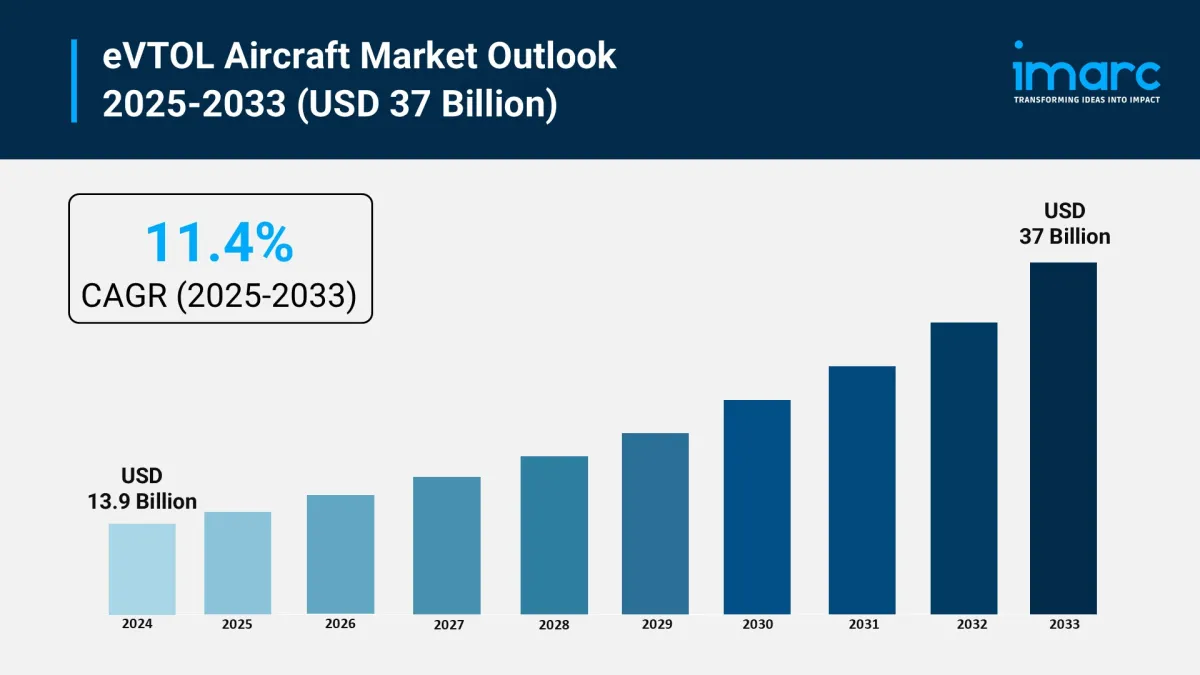
Evtol Aircraft Market Size To Hit USD 37 Billion In 2033 Grow CAGR By 11.4%


The eVTOL aircraft market is experiencing rapid growth, driven by advances in battery and propulsion technologies, government initiatives and regulatory support, and growing demand for sustainable and efficient urban mobility. According to IMARC Group's latest research publication, “eVTOL Aircraft Market Size, Share, Trends and Forecast by Lift Technology, Mode of Operation, Maximum Take Off Weight (MTOW), Range, Propulsion Type, Application, and Region, 2025-2033”, the global eVTOL aircraft market size was valued at USD 13.9 Billion in 2024. Looking forward, IMARC Group estimates the market to reach USD 37 Billion by 2033, exhibiting a CAGR of 11.4% from 2025-2033.
This detailed analysis primarily encompasses industry size, business trends, market share, key growth factors, and regional forecasts. The report offers a comprehensive overview and integrates research findings, market assessments, and data from different sources. It also includes pivotal market dynamics like drivers and challenges, while also highlighting growth opportunities, financial insights, technological improvements, emerging trends, and innovations. Besides this, the report provides regional market evaluation, along with a competitive landscape analysis.
Unlock Exclusive Insights: Receive Your Free“eVTOL Aircraft Market” Sample PDF
Our report includes:
-
Market Dynamics
Market Trends and Market Outlook
Competitive Analysis
Industry Segmentation
Strategic Recommendations
Growth Factors in the eVTOL Aircraft Market
-
Advancements in Battery and Electric Propulsion Technologies
One of the biggest drivers of the eVTOL aircraft market is how rapidly battery tech has improved. Lighter, faster-charging batteries with greater energy density allow eVTOLs to fly longer distances and reduce downtime. This makes electric vertical takeoff and landing aircraft practical for daily urban commutes and cargo delivery. For example, modern battery innovations have extended flight ranges significantly, enabling operators to envision efficient air taxi services as alternatives to congested city roads. Better propulsion systems also lower operational costs and reduce noise, attracting interest from urban planners and investors aiming for cleaner transport solutions.
-
Government Support and Regulatory Development
Governments worldwide are backing eVTOL development through initiatives and incentives. India's Confederation of Indian Industry, for instance, is pushing for extended Production Linked Incentive schemes to boost domestic eVTOL manufacturing, which supports startups and supply chain growth. Regulatory bodies like the DGCA in India have established guidelines for airworthiness and vertiport operations. Others in the US and Europe are fast-tracking frameworks for certification and safe integration into crowded airspaces. This government involvement reduces uncertainty, builds trust, and accelerates commercialization, making the industry more attractive to traditional aerospace players and investors.
-
Growing Urbanization and Demand for Faster, Cleaner Mobility
Urban population growth is creating gridlock and pollution, which push demand for quick, efficient alternatives like eVTOLs. These aircraft promise to cut travel times drastically, especially in megacities where road transport struggles. Customer interest and pre-orders show strong market excitement: AIR, a leading eVTOL manufacturer, has over 2,200 preorders for its personal air vehicle. Businesses also see the benefits for logistics and emergency services, needing fast cargo delivery in dense environments. As people and governments prioritize sustainability, eVTOLs' electric, low-emission profile dovetails perfectly with the push for green urban transport.
Key Trends in the eVTOL Aircraft Market
-
Hydrogen-Electric Hybrid Propulsion Exploration
A promising trend in eVTOLs is moving beyond pure battery power to hydrogen-electric hybrid systems, offering longer range and quicker refueling times. Horizon Aircraft and ZeroAvia's collaboration on a hydrogen-electric powertrain aims to unlock zero-emission regional air travel beyond urban centers. The partnership has backing from defense and regulatory agencies, showing the technology's serious potential. Hybrid systems could transform eVTOLs into more versatile vehicles able to serve broader markets, including regional travel and cargo transport, overcoming current battery limitations and expanding industry reach.
-
Modular and Scalable Aircraft Designs
Companies like AIR are innovating with modular eVTOL designs, such as the AIR ONE, which features adaptable cabins and folding wings for different uses. This flexibility allows operators to quickly switch between passenger and cargo variants or meet diverse transportation needs. For instance, AIR's unmanned cargo eVTOL offers 70 cubic feet of space for logistics, emergency stretchers, or standard pallets. Scalable designs enable faster production and customization while balancing performance with weight efficiency, helping manufacturers respond rapidly to customer demands in commercial and personal aviation segments.
-
Advances in Autonomous Flight and Safety Systems
Autonomous technologies are being integrated deeply into eVTOL systems to improve safety and operational efficiency. AI-driven navigation, sense-and-avoid sensors, and automated flight controls reduce human error risks and facilitate safe flights in complex urban airspaces. This trend is particularly important as regulators push for rigorous safety standards before commercial operations ramp up. Autonomous functions also promise lower operational costs by enabling pilotless flights in cargo or taxi services. The ongoing improvements in AI and machine learning are accelerating eVTOL readiness and public confidence, making autonomous flight a cornerstone of future urban air mobility.
Ask analyst of customized report: https://www.imarcgroup.com/request?type=report&id=6546&flag=E
Leading Companies Operating in the Global eVTOL Aircraft Industry:
-
Airbus SE
Archer Aviation Inc.
Beta Technologies
Guangzhou EHang Intelligent Technology Co. Ltd
Lift Aircraft Inc.
Lilium GmbH
Moog Inc.
Piasecki Aircraft Corporation
Pipistrel d.o.o Ajdovšcina
Vertical Aerospace Group Ltd.
Volocopter GmbH
Wisk Aero LLC
Xti Aircraft Company
eVTOL Aircraft Market Report Segmentation:
By Lift Technology:
-
Vectored Thrust
Multirotor
Lift Plus Cruise
Multirotor eVTOLs dominate the market due to their simplicity, cost-effectiveness, and suitability for urban operations.
By Mode of Operation:
-
Piloted
Autonomous
Semi-Autonomous
Semi-autonomous eVTOLs lead market demand at 38.9%, balancing automation with human oversight for enhanced safety and regulatory compliance.
By Maximum Take-off Weight (MTOW):
-
<250 Kg
250-500 Kg
500-1500 Kg
>1500 Kg
The <250 Kg segment holds 28.9% market share due to regulatory advantages and operational flexibility, making them ideal for various applications.
By Range:
-
0-200 Km
200-500 Km
The 200-500 Km range captures 58.0% market share, serving regional transport needs and benefiting from advancements in battery technology for longer flights.
By Propulsion Type:
-
Battery-Electric
Hybrid-Electric
Hydrogen-Electric
Battery-electric eVTOLs lead the market with zero emissions, lower costs, and regulatory favorability, supported by advancements in battery technology.
By Application:
-
Commercial
-
Air Taxi
Delivery Drones
-
Cargo Transport
Combat Mission
-
Air Ambulance
Medical Cargo Transport
The commercial application segment comprises 48.5% market share, driven by demand for air taxis and cargo transport in urban air mobility initiatives.
Regional Insights:
-
North America (United States, Canada)
Asia Pacific (China, Japan, India, South Korea, Australia, Indonesia, Others)
Europe (Germany, France, United Kingdom, Italy, Spain, Russia, Others)
Latin America (Brazil, Mexico, Others)
Middle East and Africa
North America leads with a 37.5% market share, fueled by technological innovation, regulatory support, and significant investments in eVTOL development.
Note: If you require specific details, data, or insights that are not currently included in the scope of this report, we are happy to accommodate your request. As part of our customization service, we will gather and provide the additional information you need, tailored to your specific requirements. Please let us know your exact needs, and we will ensure the report is updated accordingly to meet your expectations.
About Us:
IMARC Group is a global management consulting firm that helps the world's most ambitious changemakers to create a lasting impact. The company provide a comprehensive suite of market entry and expansion services. IMARC offerings include thorough market assessment, feasibility studies, company incorporation assistance, factory setup support, regulatory approvals and licensing navigation, branding, marketing and sales strategies, competitive landscape and benchmarking analyses, pricing and cost research, and procurement research.
Contact Us:
IMARC Group
134 N 4th St. Brooklyn, NY 11249, USA
Email: sales[@]imarcgroup.com
Tel No:(D) +91 120 433 0800
United States: +1-201971-6302

Legal Disclaimer:
MENAFN provides the
information “as is” without warranty of any kind. We do not accept any
responsibility or liability for the accuracy, content, images, videos,
licenses, completeness, legality, or reliability of the information
contained in this article. If you have any complaints or copyright issues
related to this article, kindly contact the provider above.


Comments
No comment