


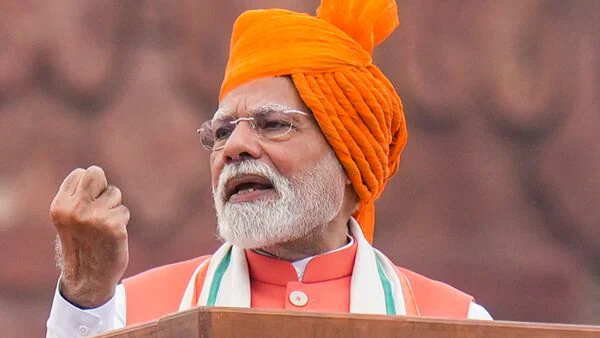
Modi's Clarion Call For Swadeshi, GST Relief, And Stronger Security Shield In Longest I-Day Speech


Speaking from the ramparts of the Red Fort on the 78th anniversary of India's independence, Modi outlined a roadmap that tied together increased domestic manufacturing, sweeping indirect tax reforms, and a strengthened national security architecture under the Sudarshan Chakra mission, as he looked to deliver a strong response to several challenges the country has been facing in recent months.
“If the sacrifices of crores of people can lead to an independent India, then the decisiveness, self-reliance, and choice of swadeshi products can lead to a prosperous India,” the Prime Minister said, urging traders to prominently display and market locally made products.
Modi's address, reflecting themes of 'New India' and 'Nation First', also included measures to improve ease of doing business, along with plans to curb illegal immigration.
Self-reliance was essential to insulating the economy from external disruptions, Modi said.“Self-reliance is not just about exports, imports, the rupee, or the dollar. It is about our capabilities, our strength to stand on our own,” Modi said.
“The'daam kam, dum zyada' mantra projects India's resolve to compete globally while insulating its economy from external shocks,” said Ajay Sahai, director-general of Federation of Indian Export Organisations (FIEO).
The PM's address comes in the backdrop of several geopolitical challenges – including punitive 50% tariffs announced by the US on Indian exports to that country for continuing to buy Russian oil, a standoff in India's trade deal talks with the US, and China's restrictions on exports of critical raw materials for Indian manufacturing, among others.
Also Read | PM Modi's defence roadmap puts sector back in focus GST bonanza comingIn a parallel, significant move to revive slack domestic consumption, Modi said the central government is working with states to reform the goods and services tax (GST) and bring significant relief to people.“In this Deepavali, you will be getting a double Deepavali,” he said. Noting that GST has lowered the tax burden nationwide, he said it was now time for a review after eight years.
A high-powered committee has reviewed the GST regime and the central government has consulted states, the Prime Minister said.“We are bringing the next generation of GST reforms. This will be a gift to you. By this Deepavali, tax will be reduced in the case of commonly used items in a big way. It will also benefit small businesses. With that, the economy will also benefit,” Modi said.
Meanwhile, a finance ministry statement on Friday said that the GST reform will include the removal of two GST slabs, correction of inverted duty structures to align input and output tax rates, streamline rate structures, minimise disputes, and reduce the compliance burden.
The reforms will also include rate rationalisation to make household items more affordable to boost consumption. That means the GST regime is set to have only two slabs – standard and merit – with only a few items under special rates, the finance ministry statement said.
Krishan Arora, partner at Grant Thornton Bharat, said GST rate structure rationalisation has been on the cards for a while now.“With the announcement from the Prime Minister, it seems the rate fitment work is complete and one could expect the rate rejig of items of daily consumption falling in 12% to 5%, which could help not only reduce end-product prices but also boost consumption and demand, especially for MSMEs,” Arora said.
The GST move follows a significant personal income tax relief to individuals in this year's Union budget, and the RBI lowering the benchmark repo rate by 100 basis points so far this year to stimulate economic growth.
Saurabh Agarwal, partner at EY India, said the Prime Minister's vision for GST 2.0 is a timely and strategic move to build a resilient Indian economy.“These are not merely procedural changes, they are essential structural reforms designed to mitigate the risks arising from global trade tensions,” said Agarwal.
“It is expected that this Diwali, items of mass consumption by the common man will be brought into the lower slab of 5% GST,” said Vivek Jalan, partner at Tax Connect Advisory Services LLP, giving an example of small ₹10 sachets supplied by FMCG companies.
He added that GST on autism centres, and on new-age goods like drones, which are now extensively used in warfare, should be reduced to 5%.“Also, GST on parts of lithium-ion batteries for electric vehicles, now 28%, should be reduced to 18%, removing inverted duty structure and corresponding inefficiencies in the GST System,” he added.
Mint had reported about the GST overhaul on Thursday.
Also Read | Modi I-Day speech: What word clouds show about PM's priorities Push for local manufacturingEven while expressing his desire to see an indigenous engine on an Indian fighter jet, Modi called for greater investment in domestic manufacturing to withstand global supply chain shocks and tariff disputes, and stressed the importance of ensuring a robust flow of raw materials for the manufacturing sector. He called for increased research and development funding, semiconductor chips made in India, as well as local electric vehicle batteries.
Modi also said India would bolster private sector investments in new energy sectors such as nuclear energy generation.
Sankalp Gurjar, professor of geopolitics at Gokhale Institute of Politics and Economics, said the semiconductor industry is a new battleground between major powers, and India has been making efforts to build a domestic semiconductor ecosystem.
“China has used its dominance in sectors like rare earth minerals processing as a geoeconomic tool,” Gurjar said.“For India, China is a strategic challenge. However, given the unpredictable policies of Donald Trump, China and India may perhaps find some areas of collaboration.”
Also Read | What is Sudarshan Chakra and how could it protect India from missile threats? Tightening national securityIn his address, Modi unveiled a new national security strategy under the Sudarshan Chakra mission to create a security shield against national security threats. With rapid advancements in defence technology, India needs to widen its security response after the recent victory in Operation Sindoor, the PM said.
“We need to constantly upgrade defence technology,” he said.“That is why, in the next 10 years till 2035, a new technological platform shield will be used to secure key public places in the country including hospitals, railways, and places of worship,” said Modi.
The shield will be widened to cover as many locations as possible to make the population feel secure, and will be modernized to counter any technological threat to the country.
To be sure, during Operation Sindoor in May, India's advanced defence systems had successfully thwarted Pakistani drone attacks. Operation Sindoor, where Indian forces attacked and destroyed terrorist targets in Pakistan and Pakistan-occupied Kashmir, was India's response against the 22 April Pahalgam terrorist attack, which left 26 individuals dead.
The PM reiterated that India will not be bullied by nuclear threats, and not distinguish between terrorists and terrorist-sponsoring governments.
“While this stance was asserted soon after Op Sindoor, the Red Fort reference can be seen as a nuanced response to the more recent nuclear sabre-rattling by field marshal Asim Munir,” said commodore (retired) Chitrapu Uday Bhaskar, director at Society for Policy Studies.“The inference is that Delhi may review and revise its NFU (no-first-use) nuclear doctrine to address new WMD-terrorism challenges.” WMD is short for weapons of mass destruction.
Demographic challengeModi also announced measures to guard against demographic shifts in India caused by illegal immigration.“The demography of the country is being changed by a planned conspiracy. Illegal immigrants are stealing Indian livelihoods, targeting Indian women. This will not be tolerated,” said Modi. He added that illegal immigrants are also capturing tribal land.
Changing demographics, especially in border regions, is a threat to national security and unity and peace in the country, said Modi.“We have decided to start a high-powered demography mission. The mission will address this looming threat of illegal immigration in a well-thought out manner in due time,” he said.
PM Modi also continued his drive against reducing obesity in the country. He has previously spoken about the issue in his Mann Ki Baat addresses. Mint reported on Friday that India is planning to further reduce sugar in baby food.

Legal Disclaimer:
MENAFN provides the
information “as is” without warranty of any kind. We do not accept any
responsibility or liability for the accuracy, content, images, videos,
licenses, completeness, legality, or reliability of the information
contained in this article. If you have any complaints or copyright issues
related to this article, kindly contact the provider above.


Comments
No comment