

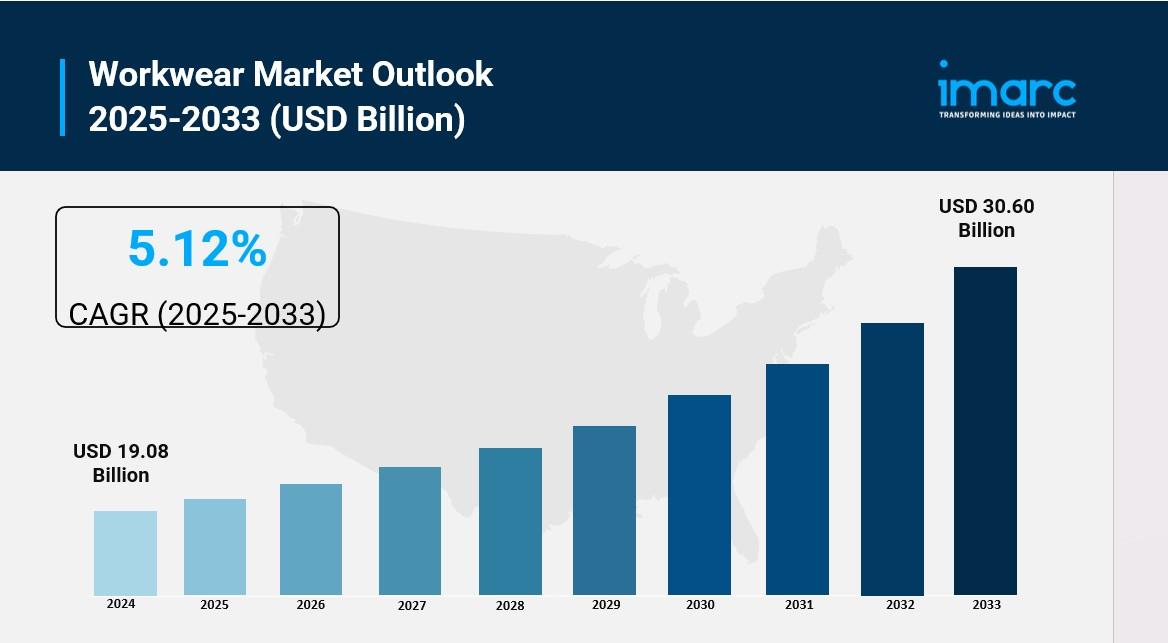
Workwear Market Is Projected To Reach USD 30.60 Billion By 2033 At CAGR 5.12%


The global workwear market size was valued at USD 19.08 Billion in 2024. Looking forward, IMARC Group estimates the market to reach USD 30.60 Billion by 2033, exhibiting a CAGR of 5.12% from 2025-2033. Asia Pacific currently dominates the market, holding a workwear market share of over 42.6% in 2024. The increasing recognition among employers of the importance of employee well-being in the workplace, along with the growing preference of workers for comfortable and ergonomically designed workwear, are key factors driving market growth.
Key Stats for Workwear Market:-
Workwear market Value (2024): USD 19.08 Billion
Workwear market Forecast Value (2033): 30.60 Billion
Workwear market Forecast CAGR: 5.12%
Leading Segment in workwear market in 2025: Apparel
Key Regions in workwear market: North America, Asia-Pacific, Europe, Latin America & Middle East and Africa
Top companies in workwear market: 3M Company, A. Lafont SAS (CEPOVETT Group), Alexandra Workwear, Alisco Group, Ansell Ltd., Aramark, Carhartt Inc., Engelbert Strauss GmbH & Co. KG, Honeywell International Inc., Hultafors Group AB, Kimberly-Clark Corporation, Workwear Group Pty. Ltd., etc.Workwear Group Pty. Ltd
Request for a sample copy of the report: https://www.imarcgroup.com/workwear-market/requestsample
Why is the Workwear Market Growing?The workwear market is growing due to increasing emphasis on workplace safety, rising industrialization, and stricter occupational health regulations across various sectors such as construction, manufacturing, oil & gas, and healthcare. Employers are investing in high-quality, durable, and protective clothing to ensure worker safety, comply with regulatory standards, and enhance productivity. Additionally, the rise in corporate branding initiatives has boosted demand for customized and stylish workwear. Technological advancements in fabric, such as breathable, flame-resistant, and antimicrobial materials, are also driving adoption. The expanding service sector, coupled with the growth of e-commerce channels, is further fueling market expansion globally.
AI Impact on the Workwear Market:AI is transforming the workwear market by enabling smarter design, production, and distribution processes. Advanced AI-driven analytics help manufacturers predict demand more accurately, optimize inventory, and reduce waste. In product development, AI-powered design tools allow for customization of fit, style, and functionality based on worker needs and industry requirements. AI-integrated supply chain management ensures faster, more efficient delivery, while predictive maintenance tools improve the durability and performance of workwear. Additionally, AI-driven wearable technologies, such as smart fabrics with sensors to monitor worker health and safety, are opening new opportunities for innovation, making workwear more functional, data-driven, and aligned with Industry 4.0 trends.
Segmental Analysis:Breakup By Product:
-
Apparel
Footwear
Apparel leads due to its essential role in providing comprehensive protection and comfort across various occupational sectors.
Breakup By Application:
-
Chemical
Power
Food and beverage
Biological
Others
The chemical application dominates due to stringent safety requirements for protective workwear in hazardous environments to prevent chemical exposure.
Breakup By Distribution Channel:
-
Supermarkets and Hypermarkets
Specialty Stores
E-commerce
Others
Specialty stores dominate as they offer a wide range of tailored, high-quality workwear designed for specific industrial and safety needs.
Breakup By End User:
-
Men
Women
Men represent the largest end user sector due to their predominant presence in high-risk industries requiring specialized workwear for protection and compliance.
Analysis of Workwear Market by Regions:-
North America (United States, Canada)
Asia Pacific (China, Japan, India, South Korea, Australia, Indonesia, Others)
Europe (Germany, France, United Kingdom, Italy, Spain, Russia, Others)
Latin America (Brazil, Mexico, Others)
Middle East and Africa
Asia Pacific leads the market due to rapid industrialization, infrastructure development, and increasing demand for workwear in growing economies.
What are the Drivers, Restraints, and Key Trends of the Workwear Market?Market Drivers
The workwear market is expanding rapidly, driven primarily by stringent workplace safety regulations, rising industrialization, and an increasing emphasis on employee protection across industries such as construction, manufacturing, healthcare, and oil & gas. Governments and regulatory agencies worldwide are enforcing more rigorous safety standards, compelling employers to invest in specialized protective apparel including flame-retardant, high-visibility, and chemical-resistant clothing. The surge in infrastructure and industrial activities, notably in regions like Asia-Pacific and North America, fuels sustained demand for durable and functional workwear. Technological advancements-such as smart textiles, ergonomic designs, and wearable sensors-are transforming the sector, offering greater safety, comfort, and efficiency for workers. Alongside safety, there is a heightened focus on sustainability; companies are increasingly adopting eco-friendly materials and ethical manufacturing processes to meet environmental mandates and consumer preferences.
Market Restraints
Premium protective and sustainable workwear entails higher production and maintenance expenses due to advanced fabrics and embedded technologies, deterring wider adoption. Additionally, price volatility in raw materials and the complexity of regulatory compliance across different markets add financial and operational challenges. The transition to remote and hybrid work models in some industries also temporarily reduces demand for traditional workwear, while balancing high protection and comfort in extreme environments continues to test manufacturers.
Key Market Trends
Key trends shaping the workwear market include the integration of smart technologies such as IoT and biometric monitoring for health and safety; the rise of sustainable fabrics and circular economy initiatives like recycling and rental schemes; increasing customization and corporate branding through personalized uniforms; and the expansion of e-commerce and direct-to-consumer sales channels, which make workwear more accessible and tailored to end-user needs. Industry players are also innovating with AR-enabled smart helmets, antimicrobial fabrics, and inclusive product lines for diverse workforce segments. Overall, the workwear market's trajectory is defined by regulation-driven innovation, sustainability imperatives, and technology-enabled personalization.
Leading Players of Workwear Market:
According to IMARC Group's latest analysis, prominent companies shaping the global IT workwear landscape include:
-
3M Company
Lafont SAS (CEPOVETT Group)
Alexandra Workwear
Alisco Group
Ansell Ltd.
Aramark
Carhartt Inc.
Engelbert Strauss GmbH & Co. KG
Honeywell International Inc.
Hultafors Group AB
Kimberly-Clark Corporation
Workwear Group Pty. Ltd
These leading providers are expanding their footprint through strategic partnerships, rich certification portfolios, and advanced digital platforms to meet growing corporate, academic, and enterprise demands in emerging technologies like cloud computing, cybersecurity, big data, and AI/ML
Key Developments in Workwear Market:
-
December 2024: RONA Inc. has partnered with Tilley Endurables to launch its first workwear line, Tilley Tuff Workwear, available at select RONA and RONA+ stores. Designed by Joe Mimran, the collection blends durability, functionality, and style for professionals and DIYers. RONA's Chief Merchandising Officer, Doug Young, highlighted the collaboration's unique value and future aspirations.
November 2024: Red Wing Shoes, a global leader in safety footwear manufacturing, has launched three new work boot lines-Draftsmith, Polar X, and VersaPro-designed for diverse trade environments. These innovations reinforce Red Wing's commitment to quality and protection across industries, from renewable energy to extreme cold-weather job sites. The launches follow a strong year for Red Wing, which introduced SuperSole X this summer and TruGuard Lite in the spring.
October 2024: Ororo® launched its first-ever Workwear Collection, featuring eight durable and versatile heated apparel pieces. The collection includes advanced heating technology, with the world's first jacket offering dual control and a dual-source heating system. Designed for tough environments, it ensures warmth, safety, and visibility across various industries.
February 2024: BRUNT Workwear expands into physical retail, partnering with 23 wholesalers to bring its bestselling boots, including The Marin and Bolduc, to over 110 U.S. locations. This marks a shift from its DTC model after three years of rapid growth. The move enhances accessibility for 23 million trades workers in construction, installation, maintenance, and repair industries.
January 2024: PULSAR® has launched the Life collection, a new line of environmentally responsible hi-visibility workwear made with GRS-certified fabrics. The collection includes 12 durable and inclusive garments, such as reversible puffer jackets, stretch combat trousers, and insulated parkas. Designed for professionals across industries, all pieces meet EN ISO 20471 standards and come in yellow and orange.
If you require any specific information that is not covered currently within the scope of the report, we will provide the same as a part of the customization.
About Us:
IMARC Group is a global management consulting firm that helps the world's most ambitious changemakers to create a lasting impact. The company provides a comprehensive suite of market entry and expansion services.
IMARC offerings include thorough market assessment, feasibility studies, company incorporation assistance, factory setup support, regulatory approvals and licensing navigation, branding, marketing and sales strategies, competitive landscape and benchmarking analyses, pricing and cost research, and procurement research.
Contact US:
IMARC Group
134 N 4th St. Brooklyn, NY 11249, USA
Email:
Tel No:(D) (+1-201971-6302)
United States: +1-201971-6302

Legal Disclaimer:
MENAFN provides the
information “as is” without warranty of any kind. We do not accept any
responsibility or liability for the accuracy, content, images, videos,
licenses, completeness, legality, or reliability of the information
contained in this article. If you have any complaints or copyright issues
related to this article, kindly contact the provider above.
Comments
No comment