


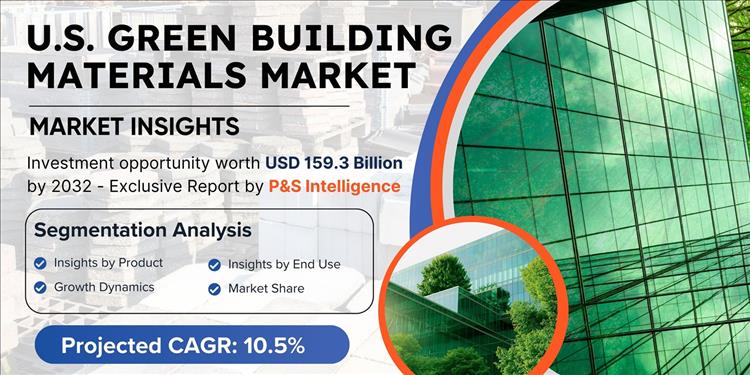
U.S. Green Building Materials Market to Surpass USD 159 Billion by 2032, Fueled by Sustainable Construction Boom


(MENAFN- P&S Intelligence) According to the latest market research study published by P&S Intelligence, the U.S. green building materials market reached a valuation of USD 72.5 billion in 2024 and is projected to grow to USD 159.3 billion by 2032, advancing at a robust CAGR of 10.5% from 2025 to 2032. This strong expansion is driven by the rising demand for sustainable, energy-efficient buildings and a growing recognition of the environmental impact of traditional construction methods among building owners, developers, and public organizations.
With climate change concerns at the forefront, stakeholders are increasingly adopting eco-friendly materials such as recycled wood, low-VOC paints, and solar panels. These not only enhance indoor air quality but also significantly lower long-term operational costs. Federal and state-level incentives, including tax breaks, environmental certification programs, and stringent building codes—such as the Leadership in Energy and Environmental Design (LEED) program—are further accelerating adoption.
Technological advancements are also making green building materials more durable, cost-effective, and appealing compared to conventional options. As production scales up and awareness grows, manufacturers are able to deliver high-quality, sustainable materials at increasingly competitive prices.
Key Insights
• Exterior products dominated the market with a 35% share in 2024, driven by demand for reflective roofing, water-efficient concrete, sustainable bricks, low-VOC paints, and salvaged wood. Materials such as fiber cement, recycled steel, bamboo cladding, and cork panels are increasingly used to cut heating and cooling costs while reducing deforestation.
• Solar products are the fastest-growing category, forecast to expand at a CAGR of 10.6%, supported by technological advances that enhance efficiency and affordability. The U.S. EPA’s USD 7-billion Solar for All initiative will provide decentralized solar energy to around 900,000 low-income households.
• Residential construction accounted for 55% of the market in 2024 and is set to grow at a CAGR of 10.8%, fueled by heightened awareness of energy efficiency and government-led sustainability programs. Households consumed 18.4 quadrillion BTUs of energy in 2023, prompting initiatives to reduce strain on the power grid through green construction.
• Northeast leads the U.S. market, representing 40% of the share in 2024, and is also the fastest-growing region with an 11% CAGR. Factors include strict environmental regulations, high energy costs, and extensive renovation of older buildings for energy efficiency. New York and Massachusetts rank among the top three states for green building adoption, with New York also leading in gross green building area.
• Innovative materials are transforming the industry, with hempcrete and algae-based bricks gaining attention. Hempcrete is a lightweight, breathable, carbon-negative insulator that regulates humidity, while algae bricks require far less energy to produce and can cut CO₂ emissions by up to 90%.
• LEED-certified buildings in the U.S. can achieve up to 11% higher sales prices and 20% higher rental rates, according to the U.S. Green Building Council. Energy-efficient buildings also reduce costs through improved ventilation, solar integration, and water-saving systems.
• Federal programs such as the Energy Efficient Commercial Buildings Deduction and the Inflation Reduction Act (2022) offer tax credits and deductions for properties demonstrating significant energy savings or using renewable technologies. State-level programs like California’s Title 24 Standards, New York’s NYSERDA, and the EPA’s ENERGY STAR for Buildings also drive adoption.
• The market is fragmented, with a mix of multinational corporations and specialized regional players. While major firms like BASF, PPG Industries, DuPont de Nemours, Sika AG, and Owens Corning provide broad solutions, niche companies focus on specialized products such as bio-based materials and recycled insulation.
• In corporate developments, March 2025 saw James Hardie Industries announce the acquisition of AZEK for USD 8.75 billion to strengthen its eco-friendly decking and exterior portfolio, while in February 2025, Holcim revealed plans to spin off its North American operations into a new company, Amrize.

Legal Disclaimer:
MENAFN provides the
information “as is” without warranty of any kind. We do not accept any
responsibility or liability for the accuracy, content, images, videos,
licenses, completeness, legality, or reliability of the information
contained in this article. If you have any complaints or copyright issues
related to this article, kindly contact the provider above.


Comments
No comment