


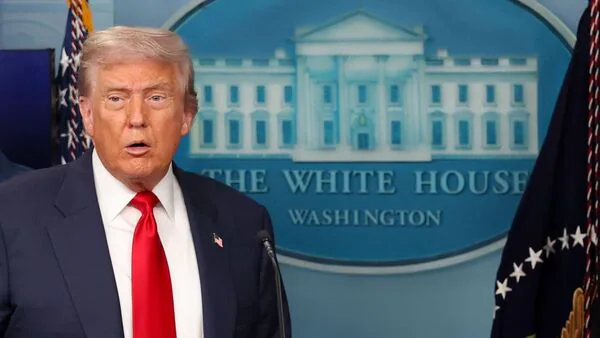
Trump's Deal With Nvidia And AMD Raises Corporate & National Security Risks: What Experts Say


The agreement allows the companies to resume exports of banned AI chips to China in exchange for a 15% revenue cut for the US government. This move has sparked debate among lawmakers and experts who warn of corporate and national security risks , reported Reuters.
Shift in National Security PolicyHistorically, the US government made non-negotiable decisions to control the export of sensitive technologies on national security grounds. Hence, it was certain that if a technology was controlled, companies could not buy their way around those controls.
Months earlier, the Trump administration banned the sale of H20 chips to China, with an aim to slow down China's growth in Artificial Intelligence (AI).
Also Read | Nvidia CEO Jensen Huang's kids started as interns in the company, not executivesThis latest deal with Nvidia and AMD signals a departure from this long-standing policy. The President has allowed Nvidia to sell its H20 chips to China, while making a similar deal with Nvidia's smaller rival AMD.
According to Reuters, Trump is also considering allowing Nvidia to sell a scaled-down version of its current flagship Blackwell chips to China.
Concerns surrounding the dealThe latest move drew condemnation from US lawmakers in both parties, who warned that it risked creating a pay-for-play framework for the sale of sensitive technologies to US adversaries. This concern was also echoed by analysts and legal experts.
Also Read | Nvidia CEO Jensen Huang's kids started as interns in the company, not executives"Export controls are a frontline defence in protecting our national security, and we should not set a precedent that incentivises the government to grant licenses to sell China technology that will enhance its AI capabilities," said US Representative John Moolenaar, a Michigan Republican who chairs the House Select Committee on China.
Is Trump's move legal?The deal is extremely rare in the US, as until now, Trump was pressuring executives to invest in American manufacturing and demanding the resignation of Intel's CEO, Lip-Bu Tan, for his ties to Chinese companies.
It is also unclear whether Trump's move to form such an agreement is legal, as the US Constitution prohibits Congress from levying taxes and duties on articles exported from any state. Trade lawyer Jeremy Iloulian said it is hard to tell if this would be considered an "export tax" or some other form of payment without having in-depth knowledge of the agreement.
Also Read | Nvidia just taught robots to think, roam, and simulate reality: Here's howAdded Kyle Handley, a professor at the University of California, San Diego School of Global Policy and Strategy: "It sure looks like an export tax to me ... they can call it whatever they want. It really looks a lot like the government is skimming a little bit off the top."
Reuters contacted Nvidia to ask whether the company had agreed to pay the US 15% of its revenue from the sale of H20 chips to China. A company spokesperson responded, "We follow rules the US government sets for our participation in worldwide markets."
The spokesperson added, "While we haven't shipped H20 to China for months, we hope export control rules will let America compete in China and worldwide."
A spokesperson for AMD said the US approved its applications to export some AI processors to China but did not directly address the revenue-sharing agreement, Reuters reported.
“I think it's fair to say that everything now in this administration seems negotiable in ways that were not the case before," said Sarah Kreps, a professor at the Brooks School of Public Policy at Cornell University. "I don't think this is unique in that this will be the last kind of deal like this that we see.”

Legal Disclaimer:
MENAFN provides the
information “as is” without warranty of any kind. We do not accept any
responsibility or liability for the accuracy, content, images, videos,
licenses, completeness, legality, or reliability of the information
contained in this article. If you have any complaints or copyright issues
related to this article, kindly contact the provider above.


Comments
No comment