


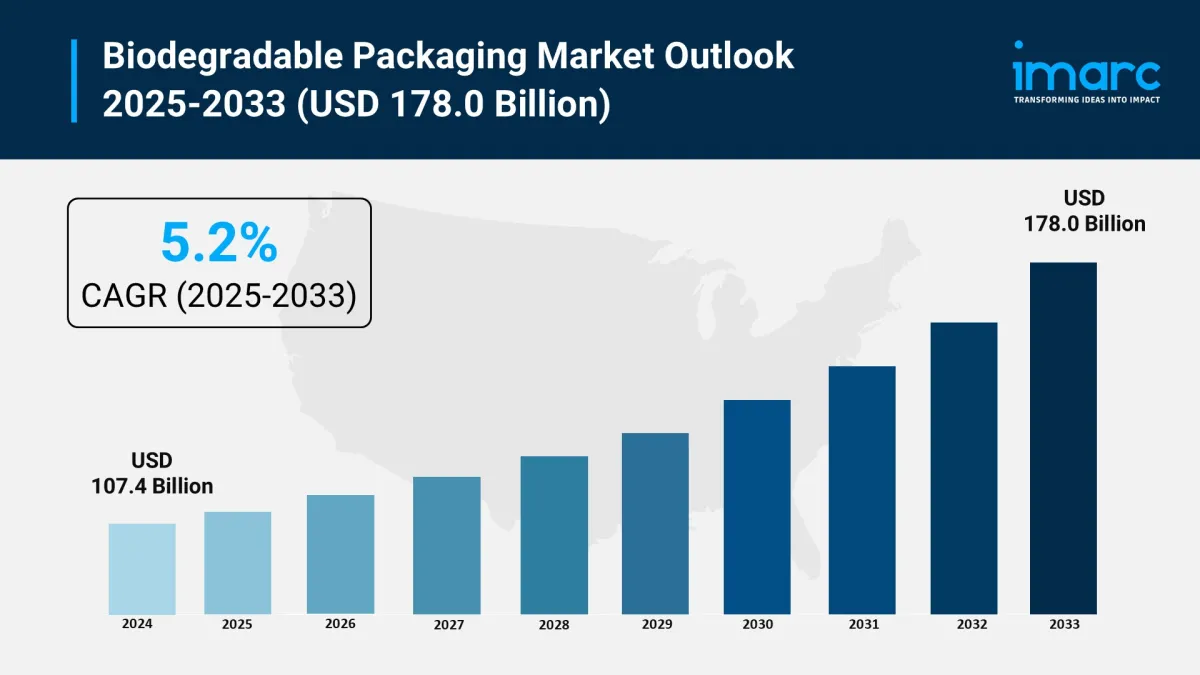
Biodegradable Packaging Market To Grow Worth USD 178.0 Billion By 2033 Exhibiting CAGR Of 5.2%


The Biodegradable Packaging Market is experiencing rapid growth, driven by Strict Government Regulations and Plastic Bans, Growing Environmental Awareness and Consumer Demand and Corporate Sustainability Goals and Initiatives. According to IMARC Group's latest research publication,“ Biodegradable Packaging Market: Global Industry Trends, Share, Size, Growth, Opportunity and Forecast 2025-2033 “, The global biodegradable packaging market size reached USD 107.4 Billion in 2024. Looking forward, IMARC Group expects the market to reach USD 178.0 Billion by 2033, exhibiting a growth rate (CAGR) of 5.2% during 2025-2033.
This detailed analysis primarily encompasses industry size, business trends, market share, key growth factors, and regional forecasts. The report offers a comprehensive overview and integrates research findings, market assessments, and data from different sources. It also includes pivotal market dynamics like drivers and challenges, while also highlighting growth opportunities, financial insights, technological improvements, emerging trends, and innovations. Besides this, the report provides regional market evaluation, along with a competitive landscape analysis.
Receive Your“Biodegradable Packaging Market” Sample PDF – Don't Miss Out!
Our Report Includes:
-
Market Dynamics
Market Trends And Market Outlook
Competitive Analysis
Industry Segmentation
Strategic Recommendations
Growth Factors in the Biodegradable Packaging Industry:
-
Strict Government Regulations and Plastic Bans
Government regulations are a huge catalyst for the biodegradable packaging industry. Across the globe, authorities are implementing bans and restrictions on single-use plastics to tackle the mounting waste problem. For example, the European Union's Single-Use Plastics Directive has mandated the phase-out of a range of plastic items, which has accelerated the shift towards biodegradable alternatives. Similarly, India's Swachh Bharat Mission has a goal to eliminate single-use plastics across urban areas by 2026. This regulatory pressure is not just a burden but a massive opportunity, forcing companies to innovate and adopt more sustainable materials to avoid penalties and remain competitive.
-
Growing Environmental Awareness and Consumer Demand
Consumers are increasingly conscious of their environmental footprint and are actively seeking out sustainable products. A survey by McKinsey & Company found that 50% of U.S. consumers are willing to pay more for products with eco-friendly packaging. This powerful consumer demand is a major driver, pushing brands to replace conventional plastic with biodegradable options to improve their brand image and meet customer expectations. Brands like UFlex are responding by developing green packaging and smart recycling technologies, aligning their business with this widespread consumer preference for sustainability.
-
Corporate Sustainability Goals and Initiatives
Major corporations are setting ambitious sustainability goals, which is significantly influencing the packaging industry. Companies are making public commitments to reduce plastic waste and achieve a circular economy. Amcor, for instance, has pledged to develop all of its packaging to be recyclable by 2025. This move by large-scale companies is creating a ripple effect, as they demand biodegradable and compostable solutions from their suppliers. This corporate push is not just about public relations; it's a fundamental business strategy aimed at reducing their environmental impact and future-proofing their supply chains.
Key Trends in the Biodegradable Packaging Market:
-
Innovation in Material Science
The biodegradable packaging market is being transformed by exciting innovations in material science. Researchers are developing new bio-based materials that offer the same performance as traditional plastics but with the added benefit of being compostable. For example, some companies are creating films and coatings from natural polymers, such as cornstarch, sugarcane, and even algae. A notable development is the use of Polylactic Acid (PLA), a versatile bioplastic derived from renewable resources like corn, which is now being used in everything from food containers to flexible films, offering a sustainable alternative to petroleum-based plastics.
-
The Rise of Intelligent and Active Packaging
Biodegradable packaging is getting a high-tech upgrade with the integration of active and intelligent features. Active packaging, for instance, uses materials embedded with antimicrobial agents or moisture absorbers to extend the shelf life of food products, reducing both food waste and plastic use. Intelligent packaging incorporates sensors and indicators that provide real-time information to consumers, such as a color change when food spoils. This not only enhances food safety but also creates a more engaging experience for the consumer, making the packaging part of the product's value proposition.
-
Focus on Circular Economy and Waste Management
A significant trend is the shift towards a circular economy model, where biodegradable packaging is designed to be part of a closed-loop system. This involves creating materials that can be easily composted or recycled back into new products. Many businesses are integrating their packaging with recycling and composting programs. For instance, brands are designing packaging with clear labeling to help consumers dispose of it correctly, whether through home composting or industrial facilities. This trend helps ensure that the environmental benefits of biodegradable materials are fully realized, as the packaging can break down without contributing to landfill waste.
Leading Companies Operating in the Global Biodegradable Packaging Industry:
-
Amcor PLC
Berkley International Packaging Limited
Biopak PTY LTD
Elevate Packaging Inc.
Greenpack Limited
International Paper Company
Kruger Inc.
Mondi Group
Ranpak Holding Corporation
Smurfit Kappa Group PLC
Tetra Pak International SA
Toray Plastics (America) Inc. (Toray Industries Inc)
Biodegradable Packaging Market Report Segmentation:
Breakup By Material Type:
-
Plastic
-
Starch-based Plastics
Cellulose-based Plastics
Polylactic Acid (PLA)
Poly-3-Hydroxybutyrate (PHB)
Polyhydroxyalkanoates (PHA)
Others
-
Kraft Paper
Flexible Paper
Corrugated Fiberboard
Boxboard
Paper accounts for the majority of shares on account of the rising demand for eco-friendly packaging solutions.
Breakup By Application:
-
Food Packaging
Beverage Packaging
Pharmaceutical Packaging
Personal/Homecare Packaging
Others
Food packaging dominates the market due to increasing preferences for natural and organic products.
Regional Insights:
-
North America (United States, Canada)
Asia Pacific (China, Japan, India, South Korea, Australia, Indonesia, Others)
Europe (Germany, France, United Kingdom, Italy, Spain, Russia, Others)
Latin America (Brazil, Mexico, Others)
Middle East and Africa
Europe exhibits a clear dominance, accounting for the largest biodegradable packaging market share.
Note: If you require specific details, data, or insights that are not currently included in the scope of this report, we are happy to accommodate your request. As part of our customization service, we will gather and provide the additional information you need, tailored to your specific requirements. Please let us know your exact needs, and we will ensure the report is updated accordingly to meet your expectations.
About Us:
IMARC Group is a global management consulting firm that helps the world's most ambitious changemakers to create a lasting impact. The company provide a comprehensive suite of market entry and expansion services. IMARC offerings include thorough market assessment, feasibility studies, company incorporation assistance, factory setup support, regulatory approvals and licensing navigation, branding, marketing and sales strategies, competitive landscape and benchmarking analyses, pricing and cost research, and procurement research.
Contact Us:
IMARC Group
134 N 4th St. Brooklyn, NY 11249, USA
Email: sales[@]imarcgroup.com
Tel No:(D) +91 120 433 0800
United States: +1–201971–6302

Legal Disclaimer:
MENAFN provides the
information “as is” without warranty of any kind. We do not accept any
responsibility or liability for the accuracy, content, images, videos,
licenses, completeness, legality, or reliability of the information
contained in this article. If you have any complaints or copyright issues
related to this article, kindly contact the provider above.


Comments
No comment