


Global E-Commerce Market Outlook 20252033: Digital Retail Boom, Consumer Trends & Growth Forecast


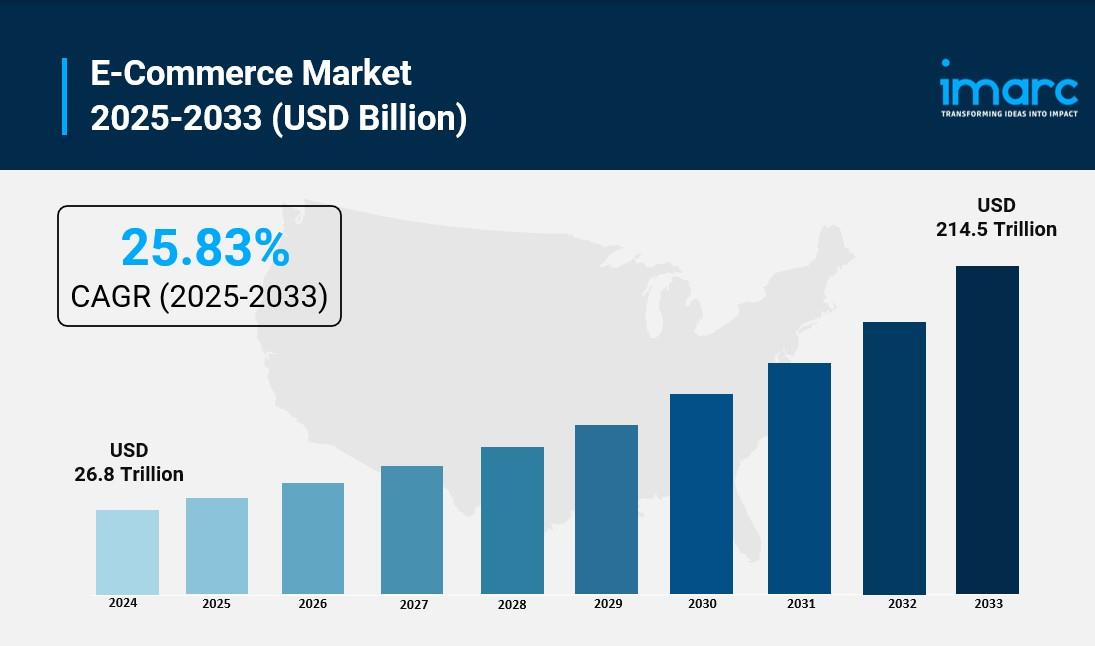
The global e-commerce market reached a valuation of USD 26.8 trillion in 2024 and is projected to soar to USD 214.5 trillion by 2033 , growing at a robust CAGR of 25.83% during the forecast period (2025–2033). The market's explosive growth is being fueled by the integration of AI-powered personalization , the expansion of cross-border trade , and innovations in secure digital payment systems . Increasing smartphone penetration and consumer preference for convenience are further propelling the industry into a new digital era.
Key Stats-
Market Value (2024): USD 26.8 Trillion
Projected Value (2033): USD 214.5 Trillion
CAGR (2025–2033): 25.83%
Leading Region (2025): Asia-Pacific
Major Companies: Alibaba Group Holding Limited, Amazon.com Inc., Apple Inc., Walmart Inc., Rakuten Group Inc., and others
AI integration has significantly reshaped the online shopping experience. Features such as personalized product recommendations and virtual fitting rooms enhance consumer engagement and reduce return rates. For instance, Zalando's virtual fitting room , introduced in 2023, allows shoppers to create 3D avatars to simulate clothing fit-improving satisfaction and loyalty.
2. Development in Cross-Border CommerceCross-border e-commerce is booming, supported by global internet access , smartphone proliferation , and digital payment availability . Consumers now enjoy access to a wider product range at competitive prices , while businesses benefit from an expanded global customer base.
3. Advancements in Secure Digital Payment MechanismsModern secure payment infrastructures-featuring multi-factor authentication , encryption technologies , and robust fraud prevention systems -are boosting consumer confidence in online transactions, thereby accelerating market growth.
AI or Technology ImpactArtificial Intelligence (AI) and Machine Learning (ML) are at the forefront of revolutionizing e-commerce. These technologies enable hyper-personalization , predictive analytics , automated customer service , and real-time inventory management . Additionally, AI improves operational efficiency and reduces return rates, making e-commerce platforms smarter and more responsive.
Segmental Analysis By Type-
Home Appliances: Includes all major and small electrical household devices.
Apparel: Clothing for all demographics sold online.
Footwear and Accessories: Shoes, bags, belts, and other items.
Books: Covers physical and eBooks.
Cosmetics: Online beauty and personal care products.
Groceries: Food and beverage items via digital grocery stores.
Others: Products not classified above.
-
Business-to-Consumer (B2C): Direct product sales to end consumers.
Business-to-Business (B2B): Transactions between corporate buyers and sellers.
Consumer-to-Consumer (C2C): Peer-to-peer sales via marketplaces.
Others: Alternative transaction types.
-
Asia-Pacific: The dominant region, led by countries like China , India , and Indonesia . Rapid urbanization , widespread smartphone usage , and strong internet infrastructure drive significant growth.
North America: A mature e-commerce market supported by a high degree of digital penetration and tech-savvy consumers.
Europe: Steady market expansion aided by regulations supporting consumer protection and cross-border commerce.
Latin America: Experiencing growing adoption driven by increasing internet access and logistics improvements.
Middle East & Africa: Emerging as promising markets due to youth population and improving digital infrastructure.
-
AI-enabled personalization and user engagement tools
Rising smartphone and internet penetration
Enhanced security and simplicity in digital payments
Global expansion of logistics and fulfillment services
-
Digital fraud and cybersecurity concerns
Regulatory differences in cross-border transactions
Logistics challenges in rural and remote regions
-
Eco-friendly packaging and ethical sourcing preferences
Growth in social commerce and mobile-first platforms
Integration of AR/VR in online shopping experiences
-
Alibaba Group Holding Limited
Amazon.com Inc.
Apple Inc.
B2W Companhia Digital (Lojas Americanas S/A)
Ebay Inc.
Groupon Inc.
Rakuten Group, Inc.
Walmart Inc.
Zalando SE
These industry leaders are leveraging strategic partnerships, platform innovations, and AI technologies to expand their global footprint and enhance customer retention.
Recent Developments-
Zalando launched virtual fitting rooms with 3D avatars in 2023 to reduce return rates.
AI-powered personalization tools are being widely adopted across major platforms.
Digital payment platforms continue to evolve with multi-layered authentication features.
Cross-border commerce infrastructure is expanding through improved logistics networks.
Retailers are investing in ethical sourcing and eco-friendly practices to meet evolving consumer expectations.
If you require any specific information that is not covered currently within the scope of the report, we will provide the same as a part of the customization.
🔗 Request Customization : https://www.imarcgroup.com/request?type=report&id=2243&flag=C
IMARC Group is a global management consulting firm that helps the world's most ambitious changemakers to create a lasting impact. The company provides a comprehensive suite of market entry and expansion services. IMARC offerings include thorough market assessment, feasibility studies, company incorporation assistance, factory setup support, regulatory approvals and licensing navigation, branding, marketing and sales strategies, competitive landscape and benchmarking analyses, pricing and cost research, and procurement research.

Legal Disclaimer:
MENAFN provides the
information “as is” without warranty of any kind. We do not accept any
responsibility or liability for the accuracy, content, images, videos,
licenses, completeness, legality, or reliability of the information
contained in this article. If you have any complaints or copyright issues
related to this article, kindly contact the provider above.


Comments
No comment