


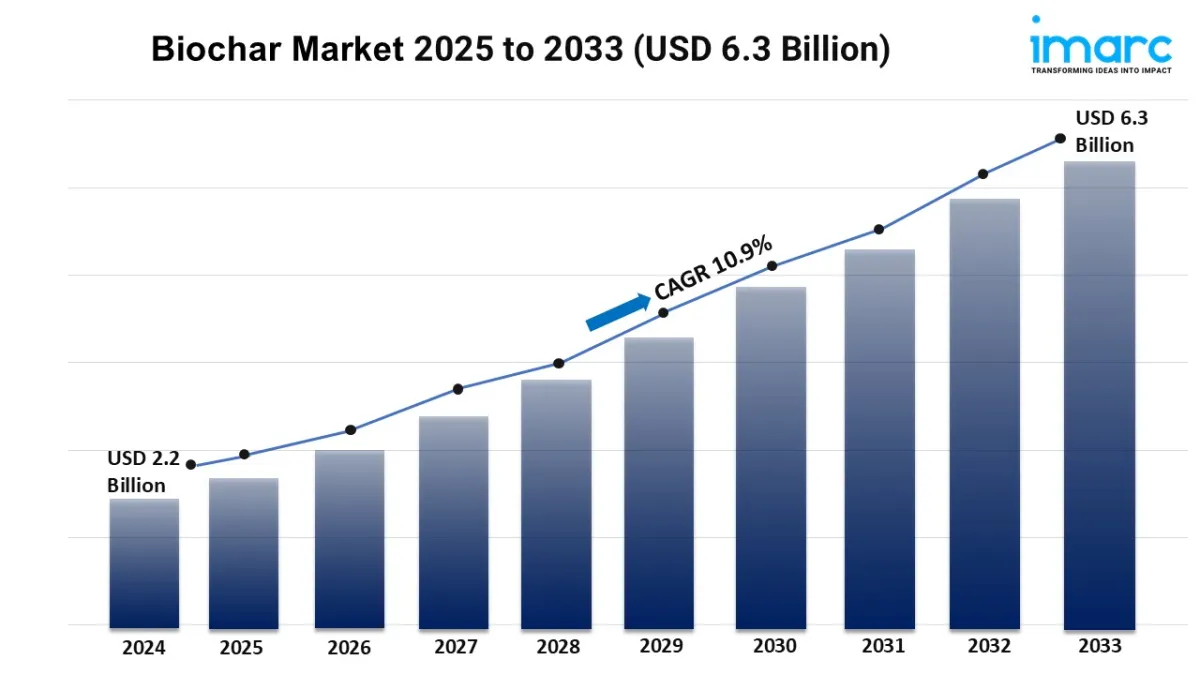
Biochar Market Size To Surpass USD 6.3 Billion By 2033 With A 10.9% CAGR


The biochar market is experiencing rapid growth, driven by rising demand for sustainable agriculture, growing interest in carbon sequestration, and supportive government policies and investments. According to IMARC Group's latest research publication,“ Biochar Market: Global Industry Trends, Share, Size, Growth, Opportunity and Forecast 2025-2033 “, The global biochar market size was valued at USD 2.2 Billion in 2024. Looking forward, IMARC Group estimates the market to reach USD 6.3 Billion by 2033, exhibiting a CAGR of 10.9% from2025-2033.
This detailed analysis primarily encompasses industry size, business trends, market share, key growth factors, and regional forecasts. The report offers a comprehensive overview and integrates research findings, market assessments, and data from different sources. It also includes pivotal market dynamics like drivers and challenges, while also highlighting growth opportunities, financial insights, technological improvements, emerging trends, and innovations. Besides this, the report provides regional market evaluation, along with a competitive landscape analysis.
Receive Your“Biochar Market” Report Sample PDF – Click to Get Started
Our report includes:
-
Market Dynamics
Market Trends And Market Outlook
Competitive Analysis
Industry Segmentation
Strategic Recommendations
Growth Factors Driving the Biochar Industry
-
Rising Demand for Sustainable Agriculture:
The push for eco-friendly farming is a big driver for biochar's growth. Farmers are turning to biochar to boost soil health, improve water retention, and cut down on chemical fertilizers. It's a game-changer for organic farming, which is gaining traction globally as consumers demand cleaner food. For instance, biochar can increase crop yields by 10-20% in certain soil types, making it a go-to for sustainable growers. In the U.S., the USDA's Conservation Innovation Grants program is funding biochar projects to enhance soil quality, encouraging farmers to adopt it. Companies like Biochar Supreme are scaling up to meet this demand, supplying biochar to organic farms across North America. This shift toward sustainable practices is fueling biochar's rise as a must-have for modern agriculture.
-
Growing Interest in Carbon Sequestration:
Biochar's ability to lock carbon in the soil for centuries is a major draw as the world tackles climate change. It's seen as a key player in carbon dioxide removal, with biochar projects delivering over 90% of carbon credits in voluntary markets. Governments are jumping in-take the U.S. 45Q tax credit, which rewards carbon capture projects, including biochar. Big names like Microsoft and Meta are investing heavily in biochar carbon removal credits, with deals ranging from $100–$200 per ton of CO2. This corporate enthusiasm, paired with biochar's ability to store 50% of carbon from its feedstock, is driving production. In Brazil, biochar is used to restore degraded land, showing its real-world impact. This focus on carbon storage is pushing the industry forward fast.
-
Supportive Government Policies and Investments:
Governments worldwide are backing biochar to promote greener practices. In India, Samunnati's Carbon Incubator Facility, launched recently, helps farmers turn crop residues into biochar, boosting soil health and creating income through carbon credits. The EU's Common Agricultural Policy also funds biochar projects to support organic farming and cut emissions. These policies are making biochar more accessible by funding research and subsidizing production. For example, over 350,000 metric tons of biochar are produced annually, with North America leading the way. Companies like Airex Energy are expanding thanks to government grants, building new plants to meet demand. This public support, combined with growing awareness of biochar's benefits, is creating a fertile ground for the industry to thrive, especially in agriculture-heavy regions like Asia Pacific.
Trends in the Global Biochar Market
-
Customized Biochar Solutions:
The biochar market is moving away from one-size-fits-all products toward tailored solutions for specific soils and crops. Producers are tweaking biochar's properties-like porosity or nutrient content-based on local needs. For example, wood-based biochar, which accounts for about 50% of the market, is popular for its high carbon content and soil-enhancing traits. In Israel, biochar is designed to retain moisture in arid soils, helping farmers in dry climates. Companies like Earth Systems are developing biochar for specific crops like hemp, which needs better water retention. This trend is gaining steam as farmers see yield boosts of up to 20% with customized biochar. By focusing on local conditions, producers are making biochar more effective and appealing, driving adoption across diverse regions.
-
Biochar in Non-Agricultural Applications:
Biochar is breaking out of farming and into industries like construction and water treatment. Its high surface area makes it a great filter for removing pollutants from water, with demand growing in emerging economies. In construction, biochar is being mixed into concrete to improve insulation and cut carbon footprints. For instance, some projects add biochar to concrete, reducing emissions by up to 10%. Companies like CarbonZero are pioneering biochar-based building materials, tapping into the green construction boom. In water treatment, biochar's use is rising, with systems filtering contaminants at lower costs than traditional methods. This versatility is opening new revenue streams, with biochar's non-agricultural applications expected to grow significantly as industries embrace its eco-friendly potential. It's a trend that's reshaping the market.
-
Expansion of Carbon Credit Markets:
The voluntary carbon market is buzzing with biochar's potential, as it delivers durable carbon removal. In 2023, biochar accounted for over 90% of carbon credits delivered globally, with prices for biochar carbon removal credits hitting $100–$525 per ton of CO2. Major players like JP Morgan and Klarna are snapping up these credits to offset emissions. In Kenya, BIOSORRA's new biochar plant supplies carbon-rich products to local agribusinesses, creating credits for sale. This trend is fueled by corporate demand for sustainable solutions and government policies like the U.S. 45Q tax credit. As more companies commit to net-zero goals, biochar's role in carbon markets is expanding, encouraging producers to scale up and innovate to meet this growing demand.
Leading Companies Operating in the Global Biochar Industry:
-
Agri-tech Producers
Diacarbon Energy Inc
Cool Planet
Pacific Biochar
Phoenix Energy
Biomacon GmbH
Vega Biofuels
Terra Char
Avello Bioenergy
Genesis Industries
Interra Energy Services
Element C6
Carbon Gold Ltd
Biochar Solution Ltd
Biochar Market Report Segmentation:
Breakup By Feedstock Type:
-
Woody Biomass
Agricultural Waste
Animal Manure
Others
Woody biomass represents the largest segment due to its abundance and favorable characteristics for biochar production.
Breakup By Technology Type:
-
Slow Pyrolysis
Fast Pyrolysis
Gasification
Hydrothermal Carbonization
Others
Slow pyrolysis accounts for the majority of the market share as it offers versatility in feedstock selection, allowing a wide range of biomass materials, including agricultural residues, forestry waste, and organic municipal waste, to be converted into biochar.
Breakup By Product Form:
-
Coarse and Fine Chips
Fine Powder
Pellets, Granules and Prills
Liquid Suspension
Based on the product form, the market has been divided into coarse and fine chips, fine powder, pellets, granules, and prills, and liquid suspension.
Breakup By Application:
-
Farming
Gardening
Livestock Feed
Soil, Water and Air Treatment
Others
Farming holds the biggest market share owing to its multifaceted benefits across agricultural practices.
Breakup By Region:
-
North America (United States, Canada)
Asia Pacific (China, Japan, India, South Korea, Australia, Indonesia, Others)
Europe (Germany, France, United Kingdom, Italy, Spain, Russia, Others)
Latin America (Brazil, Mexico, Others)
Middle East and Africa
North America enjoys the leading position in the biochar market on account of its increasing focus on renewable energy and waste management.
Research Methodology:
The report employs a comprehensive research methodology , combining primary and secondary data sources to validate findings. It includes market assessments, surveys, expert opinions, and data triangulation techniques to ensure accuracy and reliability .
Note: If you require specific details, data, or insights that are not currently included in the scope of this report, we are happy to accommodate your request. As part of our customization service, we will gather and provide the additional information you need, tailored to your specific requirements. Please let us know your exact needs, and we will ensure the report is updated accordingly to meet your expectations.
About Us:
IMARC Group is a global management consulting firm that helps the world's most ambitious changemakers to create a lasting impact. The company provide a comprehensive suite of market entry and expansion services. IMARC offerings include thorough market assessment, feasibility studies, company incorporation assistance, factory setup support, regulatory approvals and licensing navigation, branding, marketing and sales strategies, competitive landscape and benchmarking analyses, pricing and cost research, and procurement research.
Contact Us:
IMARC Group
134 N 4th St. Brooklyn, NY 11249, USA
Email: sales[@]imarcgroup.com
Tel No:(D) +91 120 433 0800
United States: +1-201971-6302

Legal Disclaimer:
MENAFN provides the
information “as is” without warranty of any kind. We do not accept any
responsibility or liability for the accuracy, content, images, videos,
licenses, completeness, legality, or reliability of the information
contained in this article. If you have any complaints or copyright issues
related to this article, kindly contact the provider above.


Comments
No comment