


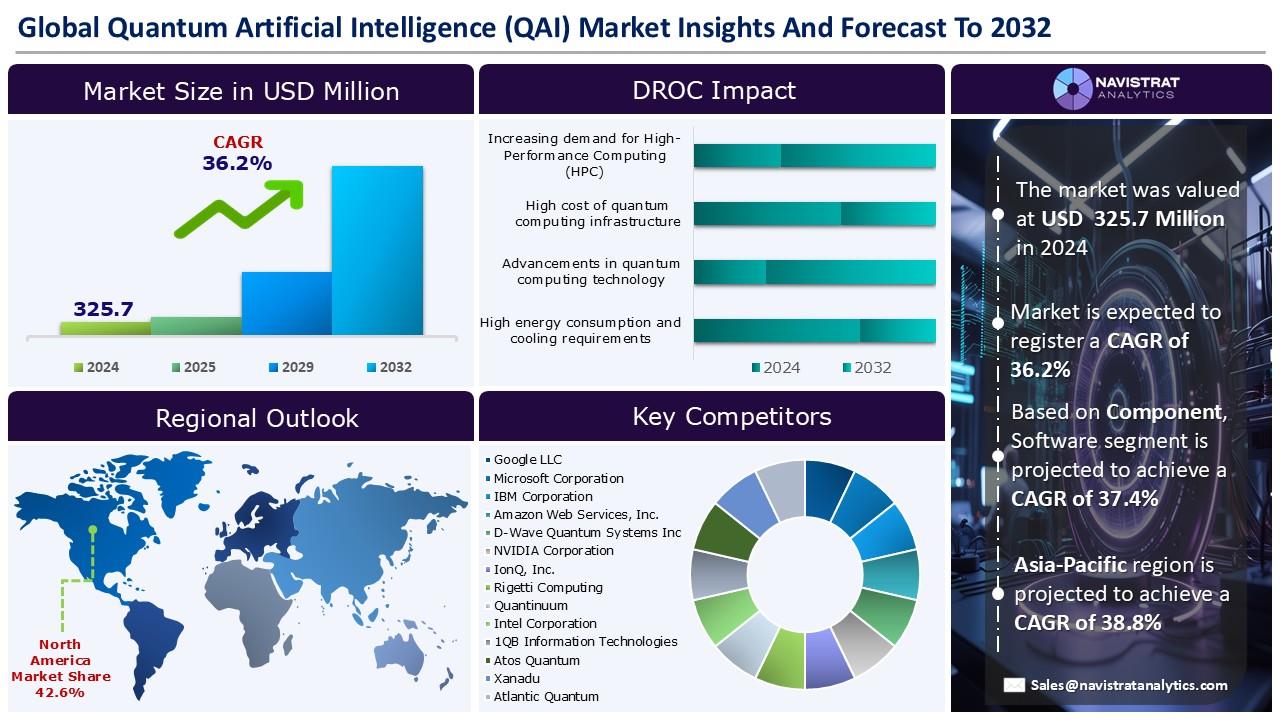
Quantum Artificial Intelligence (QAI) Market Size to Reach USD 3,736.1 Million in 2032


(MENAFN- Navistrat Analytics) July 09, 2025 - The rapid expansion of Quantum-as-a-Service (QaaS) is a major driver of revenue growth in the Quantum Artificial Intelligence (QAI) market. Leading cloud providers and quantum technology companies offer QaaS platforms that enable organizations to utilize quantum algorithms for AI-powered applications, including complex optimization, pattern recognition, and predictive analytics. These platforms are accelerating innovation across sectors such as finance, defense, healthcare, and cybersecurity, where AI models can significantly benefit from quantum-enhanced performance.
For instance, in March 2023, Oxford Quantum Circuits (OQC), a leading Quantum Computing as a Service (QCaaS) provider, partnered with Equinix to expand global access to one of the most powerful quantum computers. They empower enterprises to harness cutting-edge quantum technologies.
However, the high cost associated with quantum computing infrastructure is a significant barrier to the revenue growth of the market. Quantum systems depend on highly specialized components, such as superconducting qubits, cryogenic cooling systems, and sophisticated error correction technologies, which result in considerable capital and operational expenditures. Moreover, the need for highly skilled personnel to manage and scale these systems adds to the overall cost burden. These financial challenges confine the adoption of Quantum AI technologies primarily to large enterprises and well-funded research organizations, thereby limiting widespread commercial use and hindering the revenue growth of the market.
Want to Know What’s Fueling the Quantum Artificial Intelligence (QAI) Market Growth?
Get Exclusive Report Insights Here:
Segments Market Overview and Growth Insights:
Based on application, the Quantum Artificial Intelligence (QAI) market is segmented into optimization & simulation, data analytics & pattern recognition, drug discovery & molecular simulation, quantum cryptography, financial modeling & risk analysis, autonomous systems & robotics, fraud detection & predictive analytics, weather forecasting and others.
The quantum cryptography segment is expected to experience strong revenue growth during the forecast period due to the increasing need for advanced cybersecurity solutions in response to escalating cyber threats and data breaches.
According to the FBI’s Internet Crime Complaint Center (IC3), 800,944 complaints were reported in 2022, leading to losses exceeding USD 10.3 billion. In 2023, more than 40% of small businesses faced cyberattacks, underscoring the pervasive nature of cybersecurity risks across industries. As both enterprises and government entities increasingly focus on next-generation security measures, the demand for quantum cryptography continues to grow, which is expected to significantly contribute to the revenue growth of this segment.
Regional Market Overview and Growth Insights:
North America held the largest revenue share in 2024 due to the strong government backing, significant private sector investments, and the presence of major technology firms. The U.S. government has played a crucial role in advancing quantum technologies through substantial funding initiatives, including the National Quantum Initiative Act. It aims to accelerate the development of quantum computing and its integration with AI.
Since 2020, federal investment in quantum research has steadily grown, with allocations of USD 672 million in 2020, USD 855 million in 2021, USD 1.03 billion in 2022, and USD 932 million in 2023. It underscores the strong leadership of U.S. in quantum AI.
Competitive Landscape and Key Competitors:
The Quantum Artificial Intelligence (QAI) market is characterized by a fragmented structure, with many competitors holding a significant share of the market. List of major players included in the market report are:
oGoogle LLC
oMicrosoft Corporation
oIBM Corporation
oAmazon Web Services, Inc.
oD-Wave Quantum Systems Inc
oNVIDIA Corporation
oIonQ, Inc.
oRigetti Computing
oQuantinuum
oIntel Corporation
o1QB Information Technologies
oAtos Quantum
oXanadu
oAtlantic Quantum
Buy Your Exclusive Copy Now:
Major Strategic Developments By Leading Competitors:
SECQAI: On February 6, 2025, SECQAI, a UK-based company specializing in ultra-secure hardware and software and a participant in the NATO DIANA initiative, announced the launch of the world’s first hybrid Quantum Large Language Model (QLLM). This achievement marks a significant breakthrough in Artificial Intelligence (AI), as it integrates quantum computing with conventional Large Language Model (LLM) frameworks, greatly enhancing computational efficiency, problem-solving capabilities, and language understanding.
Quantinuum: On January 29, 2025, SoftBank Corp. and Quantinuum announced a strategic partnership in quantum computing to create innovative solutions that surpass the limitations of classical artificial intelligence and drive the development of next-generation technologies. As part of this collaboration, both companies emphasized the promise of a hybrid AI computing model that combines Central Processing Units (CPUs), Graphics Processing Units (GPUs), and Quantum Processing Units (QPUs).
Unlock the Key to Transforming Your Business Strategy with Our Quantum Artificial Intelligence (QAI) Market Insights –
Download the report summary:
Request customization:
Navistrat Analytics has segmented global Quantum Artificial Intelligence (QAI) market on the basis of component, technology, deployment, application, end-use and region:
•Component (Revenue, USD Million; 2022-2032)
oHardware
oSoftware
oServices
•Technology Outlook (Revenue, USD Million; 2022-2032)
oQuantum Machine Learning (QML)
oQuantum Annealing
oQuantum Optimization
oQuantum Neural Networks (QNNs)
oHybrid Quantum-Classical Computing
oOthers
•Deployment Outlook (Revenue, USD Million; 2022-2032)
oOn-Premises
oCloud-Based
•Application (Revenue, USD Million; 2022-2032)
oOptimization & Simulation
oData Analytics & Pattern Recognition
oDrug Discovery & Molecular Simulation
oQuantum Cryptography
oFinancial Modeling & Risk Analysis
oAutonomous Systems & Robotics
oFraud Detection & Predictive Analytics
oWeather Forecasting
oOthers
•End-Use Outlook (Revenue, USD Million; 2022-2032)
oBanking, Financial Services & Insurance (BFSI)
oHealthcare & Pharmaceuticals
oAutomotive & Transportation
oAerospace & Defense
oIT & Telecom
oEnergy & Utilities
oRetail & E-commerce
oGovernment & Research Institutes
oOthers
•Regional Outlook (Revenue, USD Million; 2022-2032)
oNorth America
a.U.S.
b.Canada
c.Mexico
oEurope
a.Germany
b.France
c.U.K.
d.Italy
e.Spain
f.Benelux
g.Nordic Countries
h.Rest of Europe
oAsia Pacific
a.China
b.India
c.Japan
d.South Korea
e.Oceania
f.ASEAN Countries
g.Rest of APAC
oLatin America
a.Brazil
b.Rest of LATAM
oMiddle East & Africa
a.GCC Countries
b.South Africa
c.Israel
d.Turkey
e.Rest of MEA
Get a preview of the complete research study:
~Navistrat Analytics~
Navistrat Analytics
Legal Disclaimer:
MENAFN provides the
information “as is” without warranty of any kind. We do not accept any
responsibility or liability for the accuracy, content, images, videos,
licenses, completeness, legality, or reliability of the information
contained in this article. If you have any complaints or copyright issues
related to this article, kindly contact the provider above.


Comments
No comment