


Can AI Bridge The Access To Healthcare Gap In Sub-Saharan Africa?


The World Health Organization (WHO) estimates that there will be a shortage of 11 million healthcare workers worldwide by 2030. The gap is bound to worsen a situation in which, according to the WHO, 4.5 billion people will not have access to basic medical care in 2021.
“We have to realise that there are people in the world who will never see a doctor their entire life. We are in fact talking about millions of individuals,” says Annie Hartley, a physician and professor at the Swiss Federal Institute of Technology Lausanne (EPFL) and Harvard in the US.
External ContentArtificial intelligence and bots could represent a paradigm shift in healthcare, - particularly in countries with limited medical infrastructure. These tools can support healthcare workers by offering diagnostic guidance and treatment recommendations.
Hartley developed an AI tool called Meditron, which is now involved in a collaboration with the Swiss Tropical and Public Health Institute (Swiss TPH) and D-tree, a US based NGO with a strong presence in Geneva, focused on improving healthcare access across Africa.
The initiative, known as MAM*AI, aims to roll out Meditron to healthcare workers on the island of Zanzibar, Tanzania. Tailored specifically for maternal healthcare, the tool supports midwives and health professionals in caring for pregnant women. Meditron is currently available as an invite-only app on a testing platform and belongs to the same family as chatbots such as ChatGPT, Gemini, or Claude, though it is focused exclusively on medical use.
“Large language models are extraordinary because they have the potential to bridge a huge information gap with simple conversation. This technology is massively scalable and has very concrete potential. It's a very exciting time,” Hartley says.
Originally launched by EPFL in 2023, Meditron is built to be adaptable to various regional and clinical contexts, whether in Africa, North America, or Europe.
“Right now, we're working to understand how a midwife responds to a clinical problem. In other words, to grasp the actual local dynamics so we can provide useful data to those programming Meditron,” explains Riccardo Lampariello, CEO of D-tree.
“Once development is complete, we hope every midwife in Zanzibar will be able to use this tool in their daily work. After that, the goal is to consolidate what we've learnt and scale to other countries adapting it,” he says.
The platform has not yet launched in Zanzibar, as D-tree continues discussions with local health authorities to assess needs and ensure readiness. The next steps will include platform promotion and staff training.
One of the main hurdles for healthcare access in Sub-Saharan regions such as Zanzibar is the lack of qualified health workers.
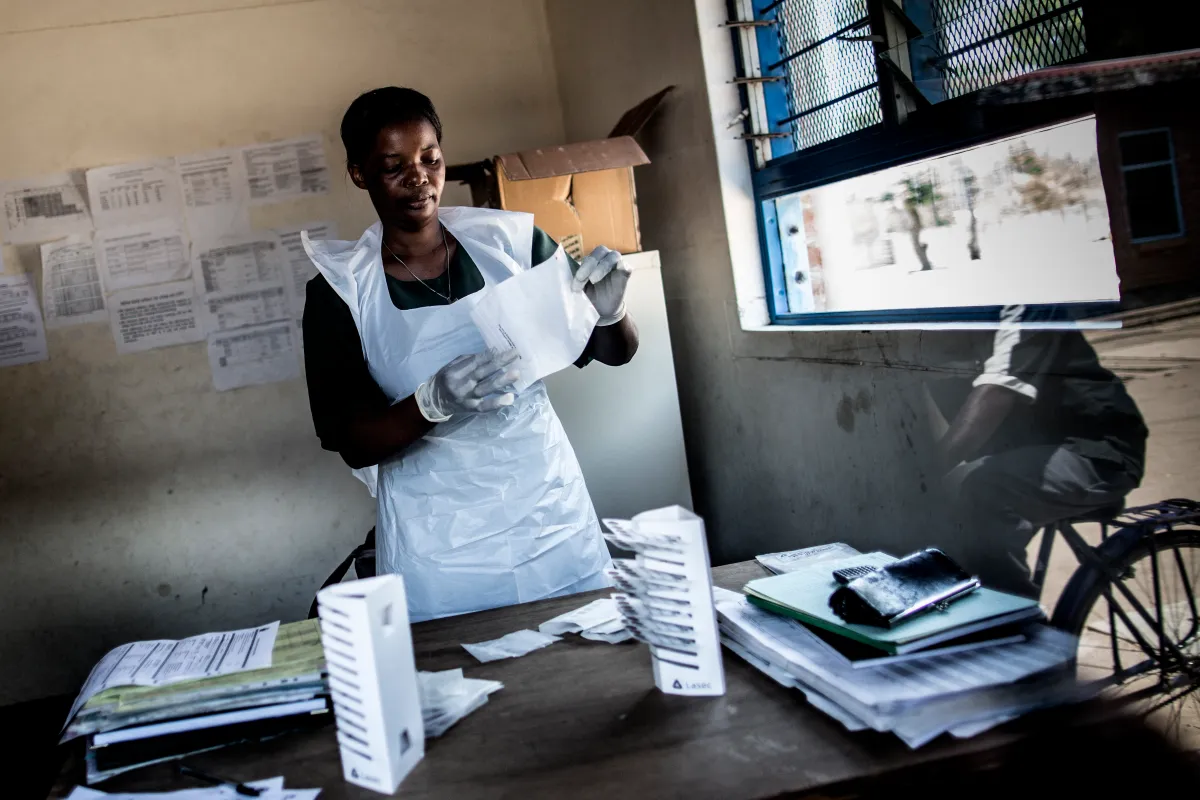
Frank Pancha Chisel walks in 2014 to the Mikolongwe health centre, three hours from his village, to get a month's worth of ARV therapy for himself and the other five members of his group of patients. Afp Photo / Marco Longari Lack of training
Medical knowledge and first aid are often entrusted to community health workers, generally volunteers who, after a few months'' basic training, act as a medical reference in the community to which they belong.
“You can have all the resources in the world – the most expensive drugs or the most advanced MRI [a medical imaging technique] – but if you don't know how, when or why to use them, they are useless,” Hartley says.“Information is the most valuable resource. And what is a doctor if not a source of information?”
This is where a tool such as Meditron can help, by interpreting a symptom, clarifying a doubt about which medicine to prescribe or offering guidance on how to carry out an emergency procedure. Meditron for instance can guide the health worker to ask the right questions to understand whether to refer the person to hospital or recommend certain treatments.
If a pregnant woman shows up with a headache, the system might instruct the health worker to ask if she recently measured her blood pressure to check if she is not suffering from preeclampsia, a disease that is easily treatable but if not identified becomes fatal for both mother and child.
“The data show that these systems increase the ability to make correct diagnoses,” says Lampariello.
Reliable informationWith so many chatbots available, building a trustworthy and specialised medical platform poses two main challenges.
The first one is to provide information that is reliable, as opposed to common chatbots such as ChatGPT that give no guarantee of what is provided.
The ChatGPT website, for example, reports that“ChatGPT is designed to provide useful answers based on patterns learned during training. However, like all language models, it can generate incorrect or misleading content”.
“In developing countries, people who rely on health apps for consumers often have no alternative. In settings where human and financial resources are limited, the impact of new technologies on health becomes even more significant, and their margin of error must be minimised as much as possible,” says Agata Ferretti, a bioethicist and former researcher at the Swiss federal technology institute ETH Zurich.
Read more: Pharmaceutical giants are betting big on artificial intelligence to discover new drugs.
More More Big Pharma steps up race for AI-discovered drugsThis content was published on May 30, 2024 AI is speeding up drug discovery but bringing an AI-discovered drug to market won't happen overnight.
Read more: Big Pharma steps up race for AI-discovered drug
Legal Disclaimer:
MENAFN provides the
information “as is” without warranty of any kind. We do not accept any
responsibility or liability for the accuracy, content, images, videos,
licenses, completeness, legality, or reliability of the information
contained in this article. If you have any complaints or copyright issues
related to this article, kindly contact the provider above.


Comments
No comment