


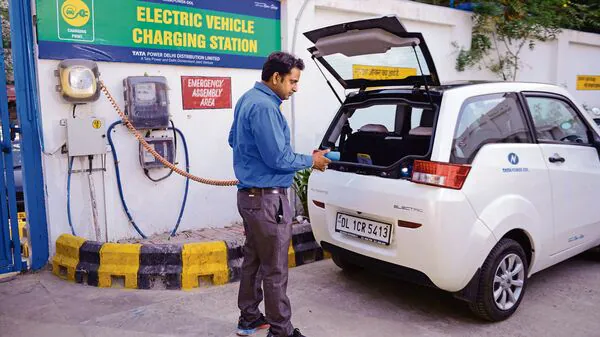
China Restricts Rare Earth Exports: Will It Put The Brakes On India's EV Ambitions?


The development comes at a time when the Indian government is heavily pushing the EV sector in the country by providing incentives and allocations in the Budget 2025 to boost domestic production of these vehicles and encourage e-mobility.
Why did China put restrictions on rare earth exports?The decision is viewed as a direct response to the US restrictions on Chinese technology, particularly the semiconductor industry.
Also Read | Insurance for EVs: Top factors to consider before buying battery insuranceChina's move also underscores the country's dominance in the critical mineral industry and is seen as leverage by China in its ongoing trade war with US President Donald Trump, reported Reuters.
China's decision to suspend exports of a wide range of rare earths and related magnets has disrupted the supply chains of automakers, aerospace manufacturers, semiconductor companies, and military contractors worldwide.
How does it affect India?India depends on imports for rare earth magnets - a small but vital component for the production of EVs. In FY25, the country imported 870 tonnes of these magnets valued at ₹306 crore, reported the Economic Times.
Also Read | Donald Trump says China's Xi Jinping is 'extremely hard to make a deal with'Moneycontrol reported that Chin accounts for about 70 per cent of global rare earth metals mining and nearly 90 per cent of its production, which makes the export curbs a pressing concern for the EV industry. The automakers might need to pass on the increased costs to consumers, raising costs by as much as 8 per cent.
The Indian vehicle manufacturers must now self-declare the magnets' end use, which is the only option to clear shipments. The long process can only be approved by the Chinese Embassy . About 30 applications have reportedly made it through the Indian side but are still pending Chinese clearance, said Moneycontrol.
How did auto sector react to the news?The Society of Indian Automobile Manufacturers (SIAM) has raised concerns with the government, cautioning that lower magnet inventories may cause delays in production.
Also Read | Automakers race to find workaround to China's stranglehold on rare earth magnetsIn response, the Indian government is reportedly considering dispatching a delegation of auto industry leaders to Beijing to press for a resolution.

Legal Disclaimer:
MENAFN provides the
information “as is” without warranty of any kind. We do not accept any
responsibility or liability for the accuracy, content, images, videos,
licenses, completeness, legality, or reliability of the information
contained in this article. If you have any complaints or copyright issues
related to this article, kindly contact the provider above.


Comments
No comment