


Kashmir's Grassroots Footsoldiers Fight For Fairness


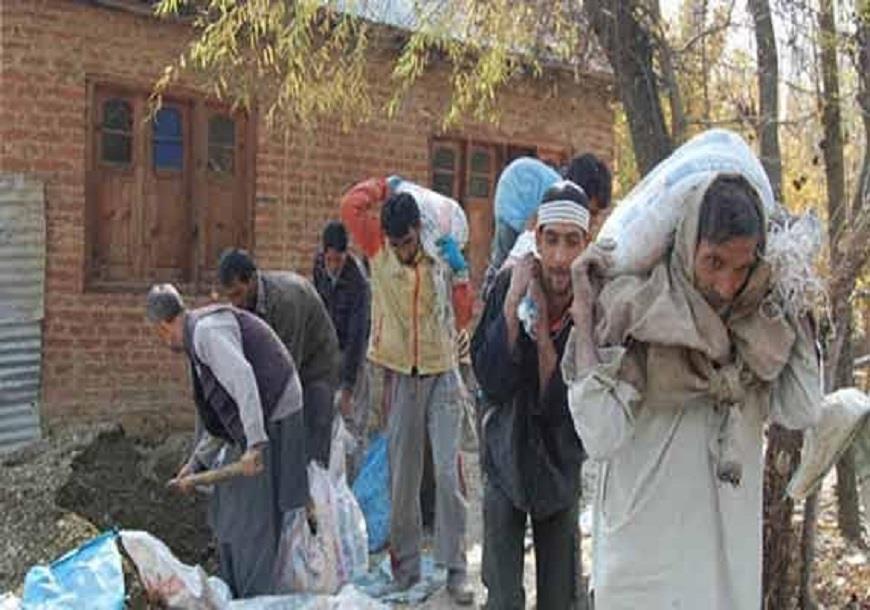
File photo
By Anu Malik
Every morning, before the sun climbs over the apple orchards of north Kashmir, 32-year-old Irfan Ahmad sets out on his motorbike.
On good days, he reaches his first stop-an MGNREGA worksite-by 9 a.m. On bad ones, he's forced to take a detour along unreliable fair-weather roads.
By evening, Irfan manages to sign in at three different Gram Panchayats, visit multiple work crews, and gather data for several government programs.
Irfan is a Gram Rozgar Sahayak (GRS), or village employment assistant. His job is to help implement one of India's most ambitious welfare programs, the Mahatma Gandhi National Rural Employment Guarantee Act (MGNREGA).
Read Also KO Impact- Govt To Push For Snow Clearance Under MG-NREGA Snow Clearance Under MG-NREGAIn principle, the scheme promises 100 days of wage work to every rural household willing to do unskilled labour. In practice, Irfan and nearly 4,000 others like him in Jammu and Kashmir are the bridge between this promise and the people.
But the bridge, many say, is crumbling.
The GRS is expected to do everything-from job card registration and site supervision to digital record-keeping and conducting social audits.
The Rural Development Department's 2021–22 circular lists over a dozen responsibilities for the post, including GIS mapping, geo-tagging of assets, organizing Rozgar Diwas, updating job cards, and ensuring that water and medical aid are available at worksites.
Over the years, GRS workers have also been assigned to non-MGNREGA duties.
During Back to Village programs, for instance, they serve as nodal officers. For PMAY housing surveys, they become field enumerators. Some serve as sanitation inspectors under Swachh Bharat. Others help verify PM Vishwakarma beneficiaries.
Each task, Irfan says, comes with expectations, but rarely any extra pay.
“We are expected to know everything and be everywhere,” said Irfan.“But at the end of the month, we barely make enough to cover our fuel costs.”
The monthly honorarium for GRS workers in J&K stands at Rs 10,200. It's a figure that hasn't changed in years. Even more troubling, payments often arrive two to three months late.
According to government rules, even unskilled MGNREGA labourers earn around Rs 250 to Rs 280 per day. That adds up to more than what a GRS makes per month, despite working full-time, and often more.
A GRS worker, who requested anonymity fearing reprisal, said he often uses his personal smartphone to upload geo-tagged photos of completed works, runs data-heavy apps like NMMS, and pays for mobile internet from his own pocket. The department provides no official equipment, despite its push for e-governance.
“We use our own phones, our own fuel, our own time,” he said.“We're digital workers, but without devices.”
Originally, GRS staff were appointed at the Panchayat level, with one worker assigned to one village. Their recruitment was done through transparent, district-level selection committees, and many selected were graduates or postgraduates from their own panchayats.
Today, that structure is largely gone. In many districts, one GRS now handles the workload for two or even three panchayats. This not only reduces their ability to effectively supervise worksites but also increases the risk of delays, errors, and even corruption.
Worse still, the J&K administration introduced a transfer policy for GRS workers, unlike most consolidated or contractual staff, forcing them to work far from home without transport allowance or travel reimbursement.
“We were selected for our own areas, where we know the people and terrain,” said a GRS from Anantnag.“Now we're sent 30 kilometers away, without any compensation.”
The issue goes beyond just low pay. Many GRS workers feel they're treated as disposable. They are spoken down to by senior officers, made to work without proper breaks, and subjected to threats of replacement.
Despite being essential to the success of MGNREGA, their legal status remains vague. They're not permanent staff, yet their roles are too central to be classified as casual or voluntary. There is no clear job policy for their future. No roadmap for regularization, pay hikes, or benefits.
The result is a silent but growing frustration.
According to the Ministry of Rural Development, J&K generated over 2.8 crore person-days of employment in 2023–24 under MGNREGA. Nearly all of this required GRS oversight.
Yet the number of GRS workers remains limited and under-resourced, leading to delays in wage payments and reduced trust in the scheme.
“If a GRS is overburdened, the whole program suffers,” said a former District Development Commissioner.“It's a weak link that shouldn't be weak.”
What the GRS workers in Jammu and Kashmir are asking for is not unreasonable: minimum wage, timely honorarium, proper tools, and respect for their work. They want a formal policy that protects their rights and outlines their future. Most of all, they want to be seen as part of the system, not just tools to run it.
As the government pushes for digitization and improved service delivery in rural India, it will need a stronger, better-supported workforce on the ground. In J&K, that means looking closely at the role of the GRS.
For now, Irfan continues to visit worksites on his bike, his phone full of government apps, and his heart full of questions.
“Sometimes I wonder,” he said quietly,“who's watching out for us while we're watching out for everyone else?”

Legal Disclaimer:
MENAFN provides the
information “as is” without warranty of any kind. We do not accept
any responsibility or liability for the accuracy, content, images,
videos, licenses, completeness, legality, or reliability of the information
contained in this article. If you have any complaints or copyright
issues related to this article, kindly contact the provider above.


Comments
No comment