


As Dutton Champions Nuclear Power, Indigenous Artists Recall The Profound Loss Of Land And Life That Came From It


Beyond this, however, the Coalition's nuclear policy has, for many First Nations peoples, raised the spectre of the last time the atomic industry came to Australia.
Indigenous peoples across Oceania share memories of violent histories of nuclear bomb testing, uranium mining and waste dumping – all of which disproportionately affected them and/or their ancestors .
Two sides of the same coinWhile it may be tempting to separate them, the links between military and civilian nuclear industries – that is, between nuclear weapons and nuclear energy plants – are well established. According to a 2021 paper by energy economists Lars Sorge and Anne Neumann:“In part, the global civilian nuclear industry was established to legitimatise the development of nuclear weapons.”
The causative links between military and civilian uses of nuclear power flow in both directions .
As Sorge and Neumann write, many technologies and skills developed for use in nuclear bombs and submarines end up being used in nuclear power generation . Another expert analysis suggests countries that receive peaceful nuclear assistance, in the form of nuclear technology, materials or skills, are more likely to initiate nuclear weapons programs.
Since the first atomic bombing of Hiroshima in 1945, Indigenous peoples across the Pacific have been singing, writing and talking about nuclear colonialism . Some were told the sacrifice of their lands and lifeways was“for the good of mankind”.
Today, they continue to use their bodies and voices to push back against the promise of a benevolent nuclear future – a vision that has often been used justify their and their ancestors' suffering and displacement.
Black mist and brittle landscapesIn 2023, Bangarra Dance Company produced Yuldea . This performance centres on the Yooldil Kapi , a permanent desert waterhole.
Dancers perform during rehearsals of Yuldea in Sydney, May 2023. Jenny Evans/AAP
For millennia, this water source sustained the Aṉangu and Nunga peoples and a multitude of other plant and animal life across the Great Victorian Desert and far-west South Australia.
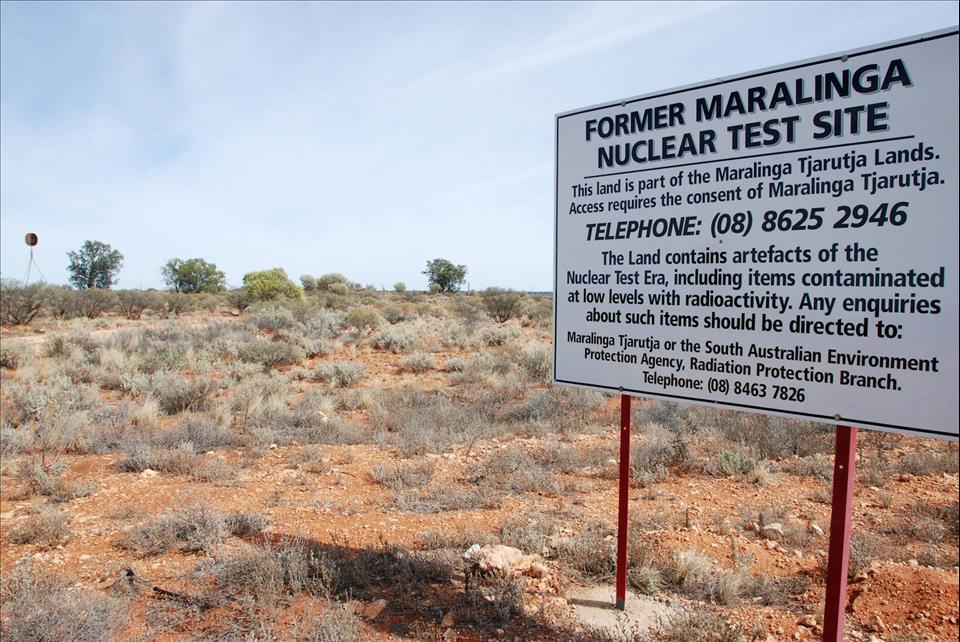
In 1933, Yuldea became the site of the Ooldea Mission. Then, in 1953, when the British began testing nuclear bombs at nearby Emu Field (1953) and Maralinga (1956–57) , the local Aṉangu Pila Nguru were displaced from their land to the mission .
A dust cloud rises from a British nuclear bomb test held on September 14 1952, in Maralinga, Australia. AP
Directed by Wirangu and Mirning woman Frances Rings, Yuldea tells the story of this Country in four acts: act one, Supernova; act two, Kapi (Water); act three, Empire; and act four, Ooldea Spirit.
The impacts of nuclear testing are directly confronted in a section titled Black Mist (in act three, Empire). Dancers' bodies twist and spasm as a black mist falls from the sky, representing the fog of radioactive particles that resulted from weapons testing. In reality, this fog could cause lifelong injuries when inhaled or ingested , including blindness .
But Yuldea is more than just a story of destruction. By exploring Aṉangu and Nunga relationships with Country before and after nuclear testing, it affirms their enduring presence in the region. This is captured in the opening prose :
To acknowledge is to rememberThe podcast Nu/clear Stories (2023-), created by Mā'ohi (Tahitian) women Mililani Ganivet and Marie-Hélène Villierme, uses storytelling to grapple with the consequences of colonial nuclear testing.
Ganivet and Villierme address the memories of French nuclear testing on the islands of Moruroa and Fangataufa in Mā'ohi Nui (French Polynesia) from 1963 to 1996.
Rather than using a linear understanding of time, which keeps the past in the past and idealises a future of“progress”, Nu/clear Stories draws on Indigenous philosophies of cyclical or spiral time to insist that by turning to the past, we can understand how history shapes the present and future.
As Ganivet says when introducing the first episode, Silences and Questions :
Protest march against French nuclear testing in the Pacific, Willis Street, Wellington. Evening post (Newspaper. 1865-2002) :Photographic negatives and prints of the Evening Post newspaper. Ref: 1/4-020364-F. Alexander Turnbull Library, Wellington, New Zealand. /records/22809366 , CC BY-NC Stories in the Tomb
In her 2018 poem video Anointed , Part III of the series Dome, Marshall Islander woman Kathy Jetn̄il-Kijiner pays homage to Runit Island. This island in the Enewetak Atoll was transformed into a dumping site for waste from US nuclear bomb tests between 1946 and 1958.
A huge concrete dome was built on Runit Island in the 1970s to cover about 85,000 cubic metres of radioactive waste. The island became known as“the Tomb” to the Enewetak people – a tomb that still leaks nuclear radiation into the ocean today.
Nuclear bombs were exploded above ground and underwater on the Bikini and Enewetak Atolls. A huge concrete dome on Runit Island, built to contain nuclear waste, has given the island the nickname 'the Tomb'. Wikimedia
However, like the creators behind Yuldea and Nu/clear Stories, Jetn̄il-Kijiner refuses to remember Runit Island as only a nuclear graveyard. Instead, she approaches it like a long-lost family member or ancestor who she hopes will be full of stories.
Jetn̄il-Kijiner speaks to the island through her poem, drawing a devastating contrast between what it once was and what it is now:
While Jetn̄il-Kijiner describes herself as“a crater empty of stories”, she continues to find stories in the Tomb: namely, the legend of Letao, the son of a turtle goddess who turned himself into fire and, in the hands of a small boy, nearly burned a village to the ground.
Juxtaposing this fire with the US's nuclear bombs, she ends her poem with“questions, hard as concrete”:
The link between past and futureIn their book Living in a nuclear world: From Fukushima to Hiroshima (2022), Bernadette Bensaude-Vincent and others explore how“nuclear actors” frame nuclear technology as“indispensable”,“mundane” and“safe” by neatly severing nuclear energy from nuclear history.
This framing helps nuclear actors avoid answering concrete questions. It also helps to hides the colonial history of nuclear technologies – histories which leak into the present. But not everyone accepts this framing.
Indigenous artists remind us the nuclear past must be front-of-mind as we look to shape the future.


Legal Disclaimer:
MENAFN provides the
information “as is” without warranty of any kind. We do not accept any
responsibility or liability for the accuracy, content, images, videos,
licenses, completeness, legality, or reliability of the information
contained in this article. If you have any complaints or copyright issues
related to this article, kindly contact the provider above.


Comments
No comment