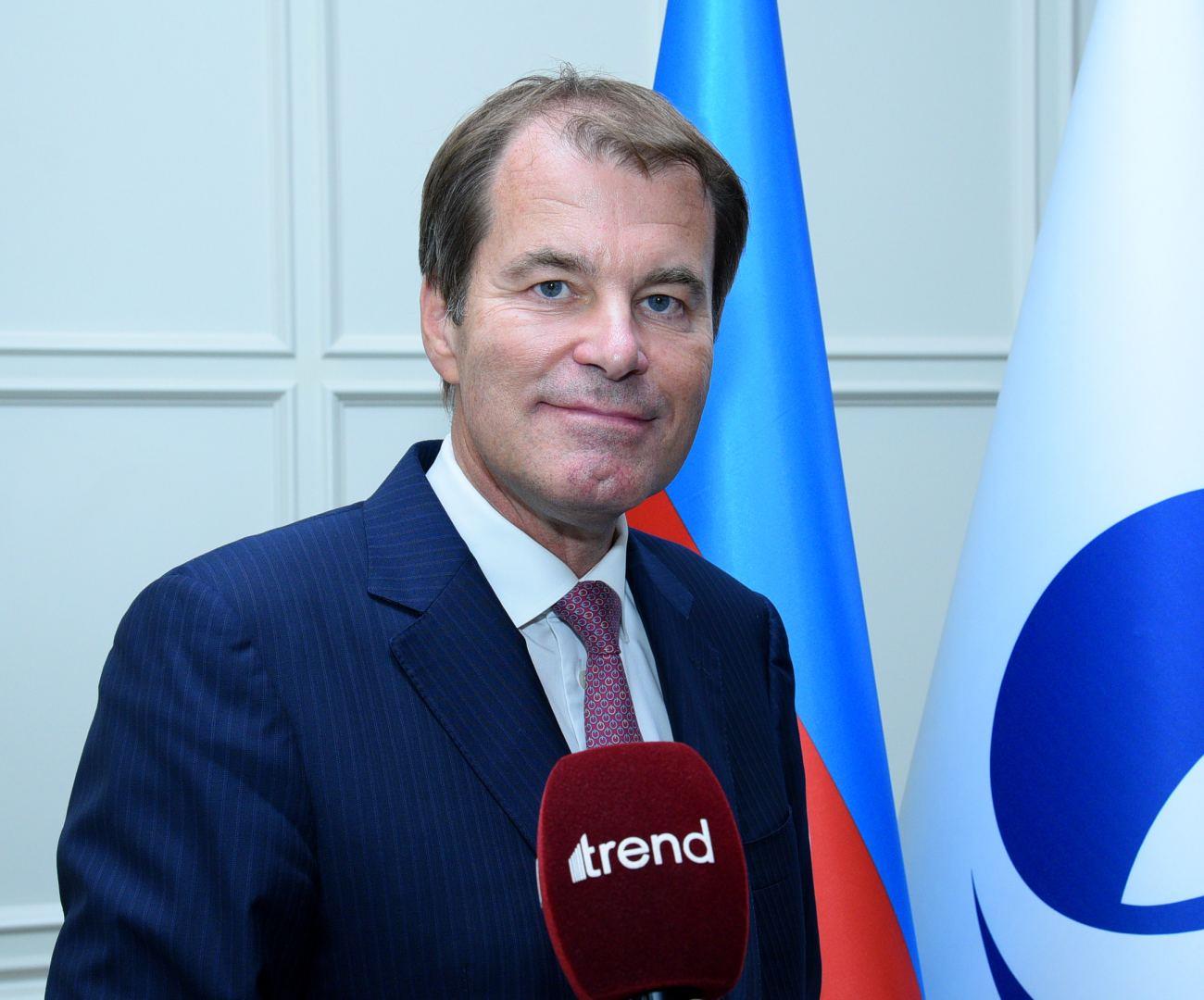
(MENAFN- Trend News Agency) BAKU, Azerbaijan, September 8. We have been
Azerbaijan's longstanding partner for over three decades now and
have a strong relationship with the country's public and private
sectors. But we still think that this is just the beginning, First
Vice President of the European Bank for Reconstruction and
Development (EBRD) Jürgen Rigterink, told Trend in an exclusive
interview.
Visit to Baku as another milestone in expanding
EBRD-Azerbaijan partnership
I am glad to be back to Azerbaijan which I last visited right
before the pandemic. It is great to see Baku now back to its full
vibrance.
The county has come a long way since our historic cooperation on
the Southern Gas Corridor, when we invested 1.7 billion euros in
Shah Deniz II, TANAP and TAP pipelines.
The economy has overcome many challenges and has become more
resilient and more forward-looking as well.
There is now an ambitidecarbonization agenda underpinned by
Azerbaijan's Paris Agreement pledges. We also see that the
country's vision for 2030 prioritizes market-oriented reforms,
business-friendly governance, and trade liberalization.
And now we are back to ask the question: how can we help to
achieve your renewed priorities?
After our meeting in Davos earlier this year, I was delighted to
have a great meeting once again with President Ilham Aliyev. We
discussed concrete steps towards accelerating the EBRD's activities
in the country and beyond, and I would like to thank President
Ilham Aliyev and his administration for this opportunity.
We also held sector-specific discussions with several key
government ministers and stakeholders and had an opportunity to
discuss further cooperation with some of our private sector clients
as well. The essence of these meetings and the warm welcome we
received fillwith expectancy that our partnership with
Azerbaijan will grow significantly for the years to come.
EBRD's role in Azerbaijan's decarbonization
agenda
We play an active role in Azerbaijan's decarbonization agenda,
both in terms of domestic green energy generation and its export.
Our support has a strong foon investment, combined with
complementary policy dialogue and technical assistance.
On the investment side, last year was a historic one as we
supported the construction of the first privately owned,
utility-scale solar power plant in Garadagh. I am confident that
this project will be one of many in Azerbaijan.
In terms of policy support, our teams have been working with
Azerbaijan's Ministry of Energy on the renewable energy auctions
schemes, and we are expecting the launch of the first such auction
already by the end of this year.
Concurrently, we have been working with our Azerbaijani partners
to assess the prospects for a low-carbon hydrogen production. Our
study found that the country is more than capable to produce it at
internationally competitive prices.
These measures coupled with our joint efforts towards grid
improvements across the country provide a good start, but there are
a few significant steps that need to be made for the country's
green ambitions to materialize.
Azerbaijan needs to develop a national hydrogen strategy
prioritizing sustainable development laws and frameworks that would
also be aligned with the relevant international regulations. The
country also needs to further strengthen its power grid.
Much will also depend on potential milestone projects like
repurposing investments in existing gas pipelines and the findings
of the feasibility studies of ambitiprojects like the Black Sea
Submarine Cable.
We are looking at these developments with great interest and
stand ready to offer further support to Azerbaijan's quest towards
greener and more sustainable future.
EBRD is keen to support the capacity development of
the Middle Corridor
Until recently, up to 95 percent of freight traffic between
China and the European Union went through the Northern Corridor.
But the war on Ukraine has shown everyone the urgent need to
diversify away from this route.
We can see that international carriers are increasingly looking
for alternatives, leading to greater interest in the so-called
Middle Corridor.
This development opens new trade opportunities for the Caucasus
and for Central Asia to facilitate and reap benefits from
China-Europe rail freight transportation.
We are supporting Azerbaijan and other countries on this route
to make the most of this potential pivot, and one of the ways to do
this is to invest in logistics and transport hubs across these
countries.
We are actively supporting our clients, private or sovereign,
involved in bridging Central Asia to the Caucasus. To name a few,
we have recently invested in a storage facility near Baku, financed
railway modernization in Kazakhstan, and engaged with the Maritime
Agency of Georgia to help improve its port management systems.
Moving forward, our support to Azerbaijan's transport and
logistics potential will remain one of our core priorities in the
country.
EBRD launches public-private partnership for
technical and vocational education
Yesterday's event was a testament to the merits of cooperation
between the public and private sectors.
Avrora is our steadfast partner and a leader in the country's
food production industry. We supported the company in identifying
skills gaps in its sector and co-developed a program to equip young
female and male students to acquire the relevant skills.
With our support, Avrora will now partner the Azerbaijan's State
Vocational Education Agency to pilot a new Technical and Vocational
Training.
The parties also signed the memorandum of understanding, joining
forces to help address the skills shortage within the wider
industry, in an inclusive and gender responsive way.
Apart from the benefits to the broader economy, such projects
make real impact by opening new economic opportunities for all. I
am confident that this will be one of the many other successful
public-private partnerships in Azerbaijan.
EBRD Green Cities thrives in Azerbaijan's
Ganja
The EBRD Green Cities program is attracting more and more cities
with over 50 participating now to sustainably address their
infrastructure and environmental problems.
Ganja is the only city in Azerbaijan that has joined the program
so far and we have already signed two projects there.
The first is set to improve the city's solid waste management,
improving the city's environment and public health. The second aims
to modernize the city's street lighting leading to significant
energy savings and better road safety.
We are proud to be improving the urban environment for more than
300,000 people in Azerbaijan's second largest city, but we would be
delighted if even more cities joined.
If, and when, requested by the relevant authorities, we will be
happy to evaluate investment opportunities in other regions of
Azerbaijan as well.
EBRD's broad support for Azerbaijani banks and
SMEs
To date, we have made the majority of investments in the private
sector. We are actively working to do more in this direction, and
where possible, to provide loans in the local currency.
One of our key priorities now is to strengthen local financial
institutions so the private sector has better access to finance for
growth. As part of this effort, we are actively looking to extend
the number of our partner banks in 2023 and beyond.
Additionally, we are working towards supporting the growth of
financial markets at the regional level, while increasing our
involvement in trade finance.
We are also seeking ways to increase our lending to micro,
small, and medium-sized enterprises and to support SME
competitiveness, green finance, women-led businesses, and youth
employment opportunities.
Opportunities are plenty, but there is still a lot of work ahead
of us. Our team in Baku will keep you updated on our progress.





Comments
No comment