(MENAFN- AzerNews)

Rena Murshud read more Iranian media recognized the Metsamor nuclear power plant as the
cause of the pollution of the Araz River.
An article published in the Iranian newspaper "Payame ma" refers
to the contamination of the Araz River with radioactive substances
and heavy metals, Azernews reports, citing Iranian
sources.
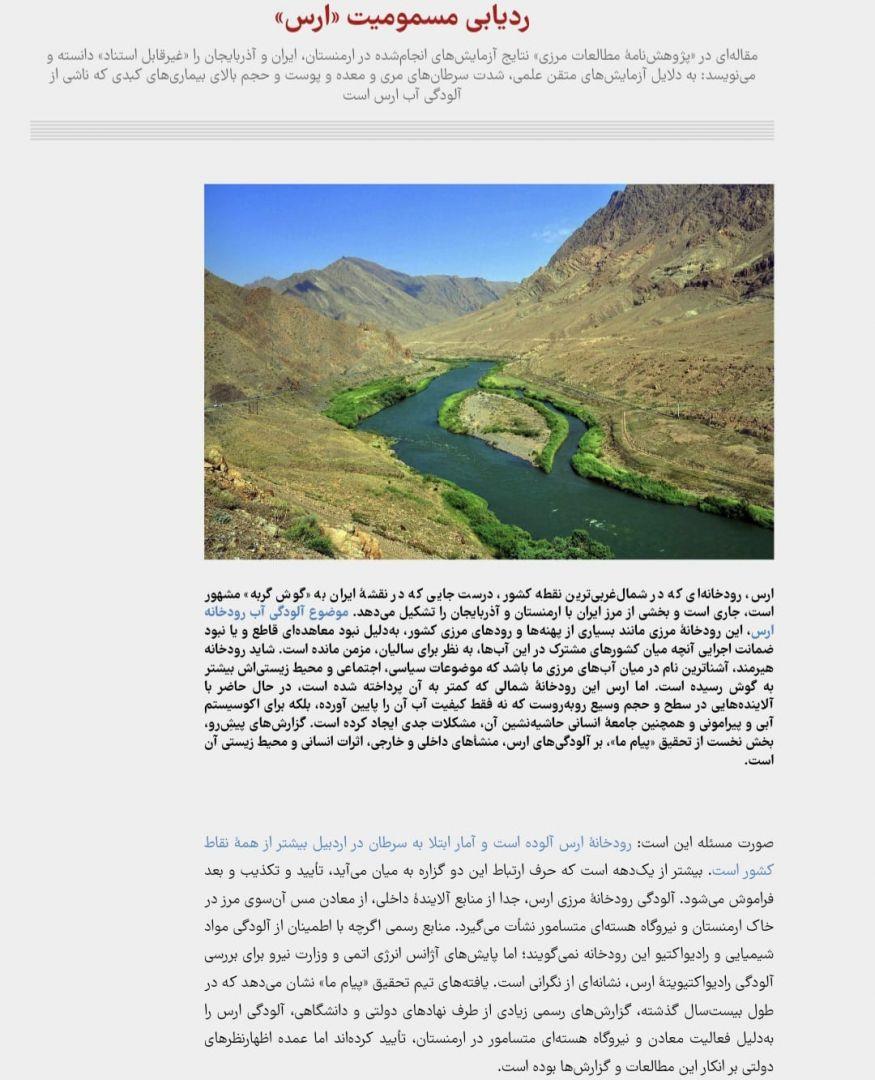
"In no way can it be denied that the Araz River is polluted with
radioactive substances and heavy metals, which has led to an
increase in cancer among the population," the article says.
According to the publication, the source of pollution is the
Metsamor Nuclear Power Plant of Armenia.
Araz River, suffering from pollution, originates in the Arpachay
region of Turkiye, passes through the border of Turkiye,
Nakhchivan, Julfa and Armenia, and after crossing the border of
Iran enters Azerbaijan, then enters the Kura River. This river
flows into the Caspian Sea, having passed a path of more than 10
thousand kilometers. Conflicts arise from sewage that is discharged
at the border points with Armenia, and when it reaches the
reservoir of the Khudafarin dam, it pollutes the drinking water
supply network and agricultural land of Mughan cities, towns and
villages, such as Horadiz and Kordasht.
The use of outdated technologies and non-compliance with safety
regulations during operation, as well as the Metsamor nuclear power
plant located within the borders of Armenia and 16 km from Turkiye,
poses a serious threat to all countries in the region. This power
plant also poses a great danger to nature.
It should be noted that the Metsamor Nuclear Power Plant was
built from 1969 to 1977 near the city of Metsamor. The nuclear
power plant consists of two power units with VVER-440 type reactors
(pressurized water power reactor with a power (electric) of 440
MW). Even when designing the station, the main difficulties were
associated with its location in one of the most seismically
dangerous points on Earth.
The first power unit of the NPP was put into operation in
December 1976, the second - on January 5, 1980. In 1988, a powerful
earthquake occurred in Armenia, the epicenter of which was the city
of Spitak (in Soviet times it was called Leninakan). Tremors with a
magnitude of more than 7 points claimed the lives of about 25
thousand people. However, the situation could lead to even more
catastrophic consequences if an accident occurred at the Metsamor
nuclear power plant, located just 84 km from Spitak.
Immediately after the earthquake, most of the plant's personnel
fled the plant, and its trouble-free operation was threatened.
Remembering the Chernobyl tragedy, the workers were afraid to
return, and only the emergency transportation of personnel from
other Soviet nuclear power plants made it possible to avoid an
accident.
A month after the earthquake, two reactors of the Metsamor
nuclear power plant were suspended. Only six and a half years
later, in 1995, the Armenian authorities decided to start the
second reactor. Today it generates 40% of the country's
electricity. The first reactor, which had never been launched since
1989, was dismantled in 2017.
Despite the fact that, in 2014, the EU called the facility“a
danger to the entire region” and was ready to allocate 200 million
euros for the closure of Metsamor free of charge, but Armenia
rejected the offer.
In addition, nuclear fuel for Metsamor is delivered from the
Russian Federation, and all complex work at the station is carried
out by Russian specialists under the guidance of Russian government
agencies.
Meanwhile, Armenia intends to extend the life of the nuclear
power plant until 2026, and in the future - until 2036.
According to an investigation by an Iranian publication, copper
mines in Armenia also pollute the river. The failure of the Atomic
Energy Organization and the Department of Energy to investigate
radioactive contamination is a matter of concern.
Despite numerous government reports of contamination of the Araz
River, Iranian officials deny the presence of uranium in the
river.
As a result of water pollution among the population living in
the border areas of the Araz River, cases of cancer of the
esophagus, stomach, liver and skin have significantly increased.
There are also reports of an increase in morbidity, in particular
stomach cancer, among residents living along the Araz River. Along
with Armenia, Iran is also the biggest polluter of the Araz River.
The situation is exacerbated by the Sungun copper mine in Iran.
And according to mining experts, the Sungun copper mine is
considered one of the largest copper mines in the world, containing
40% of the reserves discovered in Iran.
---
Rena Murshud is AzerNews' staff journalist, follow her on
Twitter: @r enatagiyeva





Comments
No comment