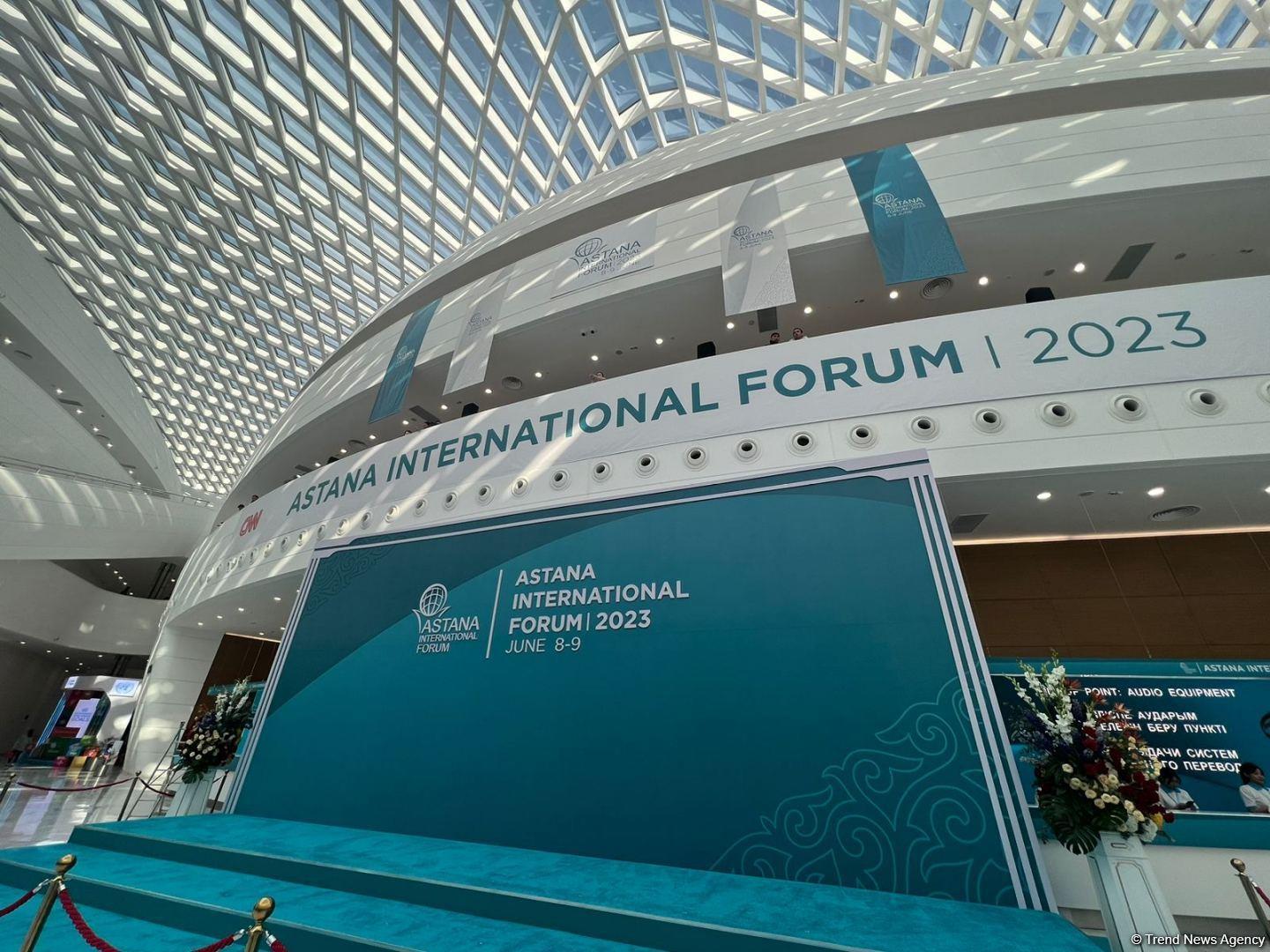
(MENAFN- Trend News Agency) BAKU, Azerbaijan, June 16. Kazakhstan, having
successfully hosted the Astana International Forum (AIF 2023) on
June 8-9, has unveiled a new diplomatic endeavor focused on
promoting dialogue among global leaders. With the aim of amplifying
voices for peace, progress, and solidarity, this initiative is
particularly significant in a time characterized by heightened
polarization and unprecedented geopolitical divisions across the
globe.
The agenda of the forum was extensive, encompassing a wide range
of topics including food security, water management, capital flows,
the role of the United Nations, and economic integration.
As the leading economy of Central Asia, Kazakhstan, is
strengthening its economic connections with various nations,
implementing numerous domestic reforms, and positioning itself as a
pragmatic international player that seeks friendly relations with
all countries. It is also actively working on multiple fronts to
consolidate its position as a significant hub for trade,
transportation, and finance, strategically located between the East
and the West.
“Despite geopolitical upheavals Kazakhstan keeps serving as an
economic engine in and for Central Asia. We continue to attract
significant foreign investment and provide exceptional conditions
to do business in Kazakhstan,” President Tokayev said in his
keynote speech at the opening ceremony of the AIF 2023.
With numerous countries developing sustainability and
decarbonization strategies to achieve climate goals, Kazakhstan, a
major energy producer, aims to actively contribute to the global
solution. The country is committed to attracting foreign investors
to assist in the implementation of a new green portfolio,
demonstrating its dedication to environmentally friendly
initiatives.
It may be considered overly simplistic to assume that green
energy has already become a significant component of global energy
security. However, it would be even more shortsighted to perceive
this as a passing fad that will soon lose its relevance. The truth
is that the energy landscape has already undergone a
transformation, and any nation reliant on oil and gas exports that
fails to acknowledge this shift will find itself falling
behind.
In his keynote speech, President Kassym-Jomart Tokayev has also
touched upon this issue as well, noting that Kazakhstan has signed
the Paris Agreement, committing to become carbon neutral by 2060.
The first milestone is to achieve 15-percent capacity of renewables
by 2030. Furthermore, in order to reach carbon neutrality,
Kazakhstan has set a target to produce 10 GW of clean energy by
2035. For this, the country is carrying out various projects,
mainly in solar and wind power, taking into account the vast
potential it has in these fields, with such energy giants as the
UAE's Masdar, Saudi Arabia's ACWA Power, TotalEnergies, China Power
and others.
"Kazakhstan could offer tremendous green economy opportunities
and finally emerge as a renewable energy hub. However, time is not
on our side. To decarbonize and build green economies at the
necessary speed, we need resources and partnerships," President
Tokayev noted.
In this regard, both Azerbaijan and Kazakhstan have embarked on
a significant shift in their energy policies, positioning
themselves as energy-exporting nations rather than simply relying
on hydrocarbon exports.
Azerbaijan stands out from other countries due to its proactive
approach in implementing green energy projects across the region.
While being recognized as a dependable provider of traditional
resources, Azerbaijan's aspirations extend beyond that. The
country's ambitious endeavors to export green energy are gaining
traction and are being translated into tangible initiatives.
The inclusion of green energy as a crucial aspect on the agendas
of Baku and Astana facilitates the establishment of long-term
cooperation in this field. The main point to emphasize is that the
energy cooperation between Baku and Astana remains ongoing and
holds great potential for growth.
For instance, Minister of Energy of Azerbaijan Parviz Shahbazov
has invited Kazakhstani companies to participate in green energy
projects in Azerbaijan, as he spoke at the the panel discussion
within the Astana International Forum, also noting that Azerbaijan
will put 1.8 GW of solar and wind power capacities into operation
by 2026.
At the same time, as his Kazakhstani colleague Almassadam
Satkaliyev pointed out while speaking at the same panel, both
Kazakhstan and Azerbaijan pay great attention to the development of
renewable energy projects and are striving to launch exports of
green energy to the West.
"In this regard, with our Azerbaijani colleagues, we have
already launched the implementation of a high voltage cable project
through the bottom of the Caspian Sea. This line will connect
Kazakhstan with Türkiye, and then further with Europe," he
said.
Azerbaijan and Kazakhstan established a solid groundwork for
fostering long-term partnerships several years ago, allowing both
countries to sustain their cooperation and progress into the
future. Despite the achievements thus far, there remains
substantial untapped potential that Azerbaijan and Kazakhstan can
explore in the coming years. And platforms like the Astana
International Forum play a crucial role in facilitating the
development of new business connections and embarking on fresh
economic opportunities, making a significant contribution to these
endeavors.








Comments
No comment