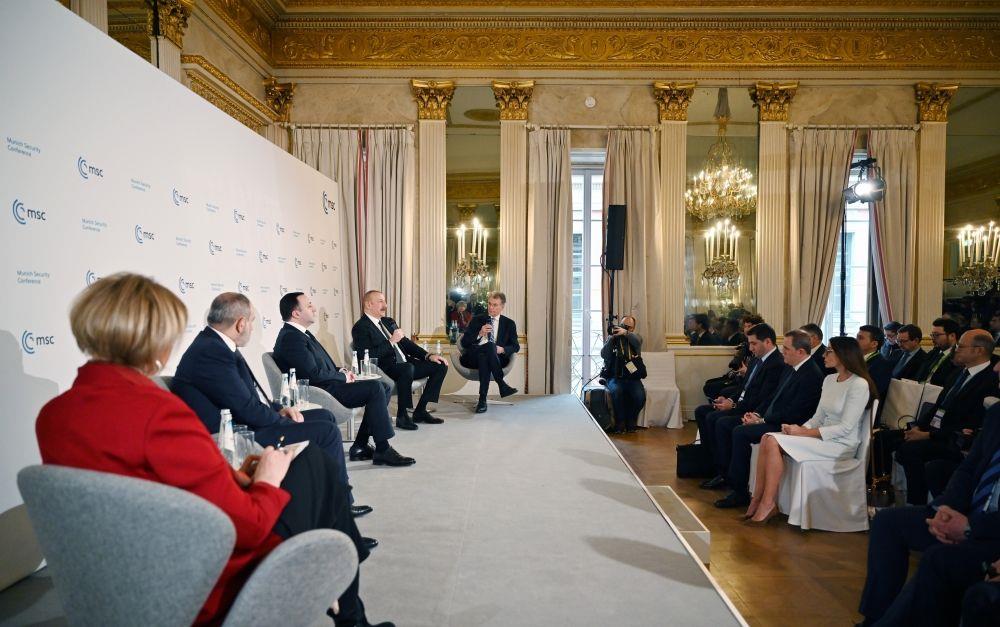
(MENAFN- AzerNews) A plenary session on“Moving Mountains? Building Security in the
South Caucasus” has been held as part of the Munich Security
Conference.
President of the Republic of Azerbaijan Ilham Aliyev and First
Lady Mehriban Aliyeva attended the event.
Moderated by Chairman of the Munich Security Conference
Christoph Heusgen, the plenary session was also attended by Prime
Minister of Georgia Irakli Garibashvili, Prime Minister of Armenia
Nikol Pashinyan and OSCE Secretary General, Deputy President of the
Foundation Council of the Munich Security Conference Helga Maria
Schmid.
Moderator Christoph Heusgen: Good afternoon,
everybody. It's good to have you here. We have with us President of
Azerbaijan and Prime Ministers of Armenia and Georgia. And I didn't
know this, but the President of Azerbaijan just told me that this
is a historic meeting. This is for the first time in history that
the three leaders of these countries meet. We have to check this in
the history book. I know that foreign ministers met, but Helga
Schmid, the Secretary General of the OSCE nods and if she nods,
this must be true. So, thank you very much for joining us here.
This conference, of course, as we all know, is happening one year
after Russia's invasion of Ukraine and this conference continues
like last year to have this as the main topic. Now, your countries
are not directly involved, but you are neighbors to Russia. And my
first question is, how has Russia's invasion, the war against
Ukraine, how has this affected your respective countries? President
Aliyev if I may ask you.
President of Azerbaijan Ilham Aliyev: Well, I
would say that there was not a direct impact on us. But definitely,
the general geopolitical situation has changed completely and
probably will not go back to the time before Russian-Ukrainian war.
So, we can see some disadvantages with respect to trade cooperation
with some traditional partners. At the same time, some advantages,
especially with respect to connectivity projects. Azerbaijan for
many years invested in creation of modern transportation and
logistics and infrastructure. And now, the diversion of cargo
transportation from Central Asia across Azerbaijan to Europe
creates additional opportunities. But you know that we had our own
war something more than two years ago, which lasted for 44 days.
And we know what is war. We know what kind of a devastation and
suffering it brings to the peoples. Therefore, we of course, want
peace to be established in Eurasia. And I think that Azerbaijan and
Armenia need to demonstrate that the transition from the
long-lasting stand of mutual hatred and hostility must end. We are
now working on a peace agreement between Armenia and Azerbaijan.
Hopefully, we would conclude it sooner or later. And I think that
could be a good example how countries which had serious historical
disagreements can get together and turn the page of hostility. So,
that would be my answer.
Christoph Heusgen: Thank you very much and
before I ask the Prime Minister of Armenia to respond to this, I
would pass through Georgia. Georgia, of course, has these occupied
territories Abkhazia, South Ossetia. And what is the effect now for
your country from the side of Russia? How about the Geneva talks?
Is there anything happening? How has how is this impacted you?
Prime Minister of Georgia Irakli Garibashvili: Thank you very much. First of all, thank you for organizing this
panel discussion. I think this is very good initiative and historic
meeting, as you mentioned. When the South Caucasus get together,
and I think this is a great already successful meeting and thank
you for organizing this discussion.
When it comes to the war in Ukraine, of course, this is a big
challenge for all of us. Since World War Two, I think Europe and
the world in general has not experienced such a big challenge. You
know that in 2008 we had a war with Russia. And since then, Russia
occupies our historic territories, Abkhazia and South Ossetia.
Russia has two military bases on our territory. And since then, we
have been facing lots of problems, challenges. But after we came to
power in 2012, we have made lots of efforts in order to de-escalate
the tension. De-escalate tension and at the same time, of course,
we have been very active on our European integration path. Georgia
signed association agreement. Deep and comprehensive free trade
agreement with European Union. We called it the visa free regime.
And last year this was a historic decision when the European
Council decided to give us European perspective. So to respond to
your question, how the war in Ukraine affects all of us in Georgia,
right now, we all see that Russia is focused on Ukraine. It's a
devastating war. And I have to say that we must do everything in
order to stop this war. There is no alternative to peace. And I
have to tell you that Georgia has been pursuing a peaceful
resolution policy when it comes to the restoration of sovereignty
and territorial integrity of our country. We have made it very
clear that Georgia has a peaceful plan to restore its territorial
integrity. I want to thank the OSCE, EU, US and other participants
who have been actively involved in the mediation process.
You mentioned Geneva international discussion, this is the only
platform that we have right now with the Russians. And so
therefore, I must repeat again that this war must be stopped. We
have seen this war in the effects of this war in our country in
2008. And lots of lots of people died and we lost control on our
territories completely. And as I said Russia has military bases on
our territory and it's ongoing. It doesn't stop. I also want to
mention that since 2008 war, we haven't seen any sanctions that
were imposed on Russia, or the country we saw that business
continued as usual. Therefore, it was a very, let's say, bad
signal.
To conclude, I think the international community now must decide
how we move forward. Because if this work continues, it means more
devastation, more killings of civilians. So therefore, once again,
I want to repeat that our intention our main, let's say, goal has
to be to stop this war.
Christoph Heusgen: Yes, I think you're
absolutely right. The killing has to stop. But, let me just briefly
come back to your country, you mentioned 2008. And I was at the
time advisor to the Chancellor and it was a very, very difficult
situation where we don't have to go into detail. But going back to
2008, may I ask you, at that time we had, we dealt with President
Saakashvili. And we have seen alarming pictures, photos of
President Saakashvili in a very delicate situation and people are
afraid for his life and there's also a journalist, who is in a
different situation. I have the impression your country that what
is called in times of in harsh times, in times where you have war
in the region that you called for a national unity. There's
something where from the outside one has felt that this is
happening in your country. And as I said, President Saakashvili was
a host was a guest very often here at the Munich Security
Conference and they sent these alarming pictures there, isn't there
another possibility so that he can get out and get some treatment
in hospitals outside Georgia?
Prime Minister Irakli Garibashvili: Well, first
of all, thank you for this question. I don't want to talk about and
speculate about the health of President Saakashvili who is now in a
private hospital. I want people to know that he arrived in Georgia.
He came back in Georgia two years ago, actually, more than a year
and a half ago. October 1st, to be more precise. The idea of his
comeback was to make another revolution in Georgia, to organize
mass killings and bloodshed. He failed and he ended up in jail. So,
he requested that we transfer him in private hospital. I don't want
to bother the audience about the details, but since you asked this
publicly, I have to respond. So, he has been in the private
hospital for more than eight months and the Georgian Government has
been providing maximum support, maximum comfort, all the privileges
that other prisoners are not receiving. You mentioned the pictures
and photos. I want to say that Mr. Saakashvili was a good actor.
The Georgian government has been doing everything we can to maximum
support. Again, I'm want to repeat we even made a proposal, offer
to his family to bring any doctors from any hospital or from any
country to provide medical in case he needs a medical support in
Georgia. So, this is my answer. And I also want to mention that
probably you have seen lots of fake news, disinformation that has
been spreading by the lobbying firms of Mister Saakashvili, and his
family. For example, I want to give you just a fact. Last month, it
was disclosed that his family officially paid $1 million to launch
him aggressive media campaign all around the world. So, what you
hear, what you see on the videos or on Facebook or social network
does not actually describe the reality. So, therefore, no one
stands above the law. We are building a strong democracy in
Georgia. We are building strengthening democratic institutions.
This is the understanding of democracy, I guess, that no one should
be above the law. Saakashvili committed the grave crimes, such as
the killings of former banker Girgvliani, this was a famous case,
beaten up to death former member of parliament and many of the
cases, seizure of private TV channel Imedi, for example. Plus, he
added another crime which is the crossing illegally state border.
By the way for your information, he spent two days in the container
truck, refrigerator, when to get the ferry boat from Ukraine from
Odessa to come back to Georgia, to do the revolution. So, this is
the story. I didn't want to talk about this individual here at this
panel to bother you all the details. But, since you asked Mr.
Heusgen, I want to respond about this.
Christoph Heusgen: I don't want to deepen into
it, it just a humanitarian appeal. I would like to get back to
Prime Minister Pashinyan, coming back to the question asked at the
outside, also to President Aliyev. The repercussions of the war of
Russia against Ukraine on your country?
Prime Minister of Armenia Nikol Pashinyan: Thank you. I also would like to express my gratitude to you for
organizing such a format. And, really, I agree maybe it is historic
meeting. But, it's very important to identify the content of the
history that now is being created. Because we can have different
outcome, consequences or results, and I think we need to be
result-oriented. And, that is our approach.
And, as far as your question is concerned, you know, global
instability can make things in our region better, because, you
know, for a long time, a whole international attention is
concentrated on Ukraine understandably. And, it creates new risks
for our region. And, it's very important to keep the international
attention to our region as well, because I think, there are many
risks to be managed. What is our approach to this whole situation?
We are devoted to our democratic reform agenda, because we believe
that democratic reforms, the development of democratic
institutions, rule of law, human rights, independent judiciary,
etc, would make the overall situation in our region better. We
think that it is a benefit for whole region, for us to do our part
of the job.
Christoph Heusgen: Yes, thank you very much.
This leads me now directly to the Secretary General of the OSCE
Helga Schmid. Wonderful to be here in your hometown, in Munich. The
OSCE is an organization where the three countries are member of, by
the way, an organization where Russia is still a member of. What
can the OSCE at this stage do to help also cooperation between the
countries to help to stabilize to have the instruments that the
OSCE has at its disposal at a different, at a difficult time for
your organization, but what can you do to try to lower tensions and
promote cooperation?
OSCE Secretary General, Deputy President of the
Foundation Council of the Munich Security Conference Helga Maria
Schmid: Thank you. And I'm also very happy to be part of
this meeting today. But I would, before I come to your question,
Christoph, let me just say that we are also witnessing the impact
of a horrible earthquake that is affecting Türkiye and Syria. And I
actually would like to start by paying tribute to all three of you
because you have been providing life-saving very quick support. And
I know, particularly, I want to pay tribute to you, Prime Minister
Pashinyan. I know your foreign minister was in Türkiye, I think,
only a couple of days ago, he met with his Turkish counterpart. And
in the face of this tragedy, we actually may find a way to work
together. And I think this is very important. But now, there,
maybe, no direct impact, as you said, President, when it comes to
the war against Ukraine, but we know for sure is that there is
really a very strong feeling of insecurity in the wider Black Sea
region. And I think the only way forward is really keeping of the
processes. I agree with you on the Geneva international
discussions, dialogues but also regional cooperation. The OSCE, and
this brings me to your question, has a mandate to promote regional
cooperation, also to promote trade links, connectivity. I think
that's very important. Now, it's very difficult to build a
sustainable peace, reconciliation. There are outstanding issues
that need to be addressed. Related to the board, missing people,
detainees, also mines. So this is why it's very important to use
all the means we have, also on confidence-building measures for
example, regional monitoring, demining efforts could be envisaged.
We work a lot already with youth. Youth are the stakeholders of
tomorrow to bring together the leaders of tomorrow with all three
countries. You will not be surprised to hear me say that women have
to be a part of all of that. But regional cooperation is important.
I also, I'm very supportive of the Brussels-led dialogue. I think
because it can deliver very concrete results and also the
implementation of the roadmaps agreed. In the end, it's about
people, it's about conflict that affected people that deserve a
better life for the future.
Christoph Heusgen: Thank you, Helga. You
mentioned also Prime Minister Pashinyan, that you are helping in
Türkiye also now in the face of this horrible earthquake. Do you
see perspective that between Armenia and Türkiye, what we have been
looking for over many, many years, decades that there is actually
an improvement of relations? In some state, we were close to
getting rid of the blockade and where do you stand there? Is there
a perspective that this horrible crisis, this catastrophe
humanitarian catastrophe is something good may come out in your
relationship? Thank you.
Prime Minister Nikol Pashinyan: Thank you, you
know deciding to send humanitarian rescuers to Türkiye, we had
humanitarian motivations only because millions of people suffered
next to us. But in the process, we see quite a positive reaction
from the Turkish Government. And if this step will have political
results, as well it's better. But our initial motivation, purely
humanitarian, and as we announced, we're ready to provide as much
humanitarian support as it is in our capacities. And we're ready to
do that.
As far as political dialogue is concerned, to be honest, before
earthquake, we had political dialogue through the special envoys. I
believe that in reality, this dialogue was very important. I mean,
in the creating atmosphere, where these decisions were made. And I
believe that through this humanitarian conversation and
communication may be the opportunities for concrete political
decisions will be higher. Especially minister, you mentioned,
visited Türkiye and some political arrangements were mentioned
there. And we are ready to go forward because we believe that
really, the establishment of diplomatic relations with Türkiye and
the opening of our border will be very positive, not only in terms
of the original situation, but for international situation as
well.
Christoph Heusgen: Yeah, let's hope that this
comes out. We had originally, the Turkish foreign minister
Cavusoglu surely wanted to come here, but of course due to the
situation in the country he decided to stay home, but let's hope
that this will lead to something. Because this border was closed
for far too long, and we have to come also to improvement for the
relations there. Now, let me come to the elephant in the room. If
you allow me, this is, of course, the question that President
Aliyev alluded to at the very beginning. The war that started two
years ago already and we see a situation which is still very
critical. We are not here to do any negotiations. But then, of
course, we are when you look at it from the outside, the
international community, we are concerned about the humanitarian
situation and one looks always as we have been looking right now
with regard to humanitarian aid to Türkiye, we're looking at
humanitarian steps. We see the Lachin corridor that is seen from
the outside blocked and we wonder. And maybe prime minister, you
can tell us a bit about, maybe efforts to have some
confidence-building measures there to see that somehow the
situation improves. All, and afterwards, I would like to turn to
President Aliyev again. We would like to see that through some
small steps we come to a de-escalation and come closer to a
resolution of this conflict.
Prime Minister Nikol Pashinyan: Thank you.
You're right. It's already 70 days that the Lachin corridor is
blocked. And now unfortunately, we have humanitarian crisis in
Nagorno-Karabakh and energetic crisis as well. Because electricity
supplies to Nagorno-Karabakh have been shut down. And the gas
supplies as well have been shut down and we counted and during last
70 days, the gas supplies were cut at least 10 times and it is the
problem that should be addressed. And our position is that in the
trilateral Statement from 9 November, 2020, we have very precise
provisions connected with Lachin corridor. And according to that
statement, it is the obligation of Azerbaijan and Russian
peacekeepers to keep Lachin corridor operable. But now
unfortunately, we have a totally different situation and I meant
Lachin corridor as well, saying that international attention should
be kept on the situation. Because we afraid that continuation of
this situation can cause unturnable humanitarian consequences for
Armenians in Nagorno-Karabakh.
Christoph Heusgen: President Aliyev, as I said,
we are not here, we cannot negotiate the substance of the agreement
and how to come to a final conclusion. I think the President of the
European Council has been working with you on this. We don't want
to get into this. My question is just is there do you see, because
you are saying that we should use this opportunity now, to come to
a more stable situation. Can you do some humanitarian gestures so
that this blockade is being stopped? And the people that according
to what the Prime Minister is just saying are in Nagorno-Karabakh,
are living in very difficult circumstances. That's something you
can do as kind of a good way to measure confidence-building? So
that talks have a chance to succeed and system for substantial
questions, of course, are not resolved yet.
President Ilham Aliyev: As far as we understand
in our communications with our American partners and partners from
European Union, and also, as far as I understood from today's
trilateral meeting with Prime Minister Pashinyan, which was
organized by Secretary Blinken, we have a common understanding that
there should be a two-track approach to the situation in the
region. First, Azerbaijan-Armenia peace talks track. Second,
Azerbaijan's communications with the Armenian population in
Karabakh.
Just for your information, the word Nagorno-Karabakh is no
longer valid. This is actually the Russian word.“Nagorno” means
mountainous. And in Azerbaijan, there is not such an administrative
unit like Nagorno-Karabakh. Therefore, of course, I would like to
ask our partners to respect the sovereignty and the constitution of
Azerbaijan. There is a Karabakh region of Azerbaijan, where there
is Armenian population. So, this two-track-solution actually
separates our talks with Armenia from our internal issues like our
communications with Armenians in Karabakh. And also it was agreed
with our international partners that there will be discussions on
rights and securities of Armenian minority in Karabakh. And we are
ready to do it. But with those representatives of Armenian
community who lived, who were born, and who lived in Karabakh
throughout their life. But not with the person who was exported
from Russia to have the leading position in Karabakh. Maybe export
is not the right word. I would probably prefer the word“smuggled
into”. Because nobody knows how he emerged in Karabakh and how he
is trying and achieving to go back to Yerevan and from there to
Moscow, and then back to Yerevan and then to Karabakh. The only
this fact demonstrates that there is no blockade. Second fact,
which demonstrates that there is no blockade, is that since 12th
December until today when our activists from civil society came to
the checkpoint, there have been more than 2,500 vehicles, including
tracks of Russian peacekeepers and representatives of Red Cross.
Almost 100 medical patients from Karabakh were taken by Red Cross
to Armenia for treatment. So, how can we call it a blockade when
there is an open road? And if Armenians in Karabakh try to use this
road, I'm sure no one will stop them. So, this is important to
understand the current situation. And also, in order to properly
evaluate the current situation, we need to go back a little bit to
the history. For almost 30 years our lands were under Armenian
occupation. Prime Minister Garibashvili mentioned that in 2008
after the Russian-Georgian war, there were no sanctions imposed on
Russia. But I also can say that Armenia occupied twenty percent of
Azerbaijan's territory, violated international law, did not comply
with UN Security Council resolutions for 27 years. And no sanctions
were imposed on them. And we always were asking for sanctions to
Armenia to be imposed to avoid the war. We were waiting for Minsk
Group to deliver result. We were waiting for the Security Council
of the United Nations to respect their resolutions. But we thought
that there is no movement, and there is a common understanding that
this conflict is frozen. So, we proved that it is not frozen. We
had to fight. We had to sacrifice 3,000 lives in order to restore
our dignity, our territorial integrity and justice, and implement
UN Security Council resolutions. Therefore, we cannot take out of
the context today's situation in Karabakh or our communications
with the Armenian community there and just forget about the thirty
years of occupation, forget about that the territory equal to the
territory of Lebanon is totally in ruins, and that was done not by
aliens. That was done by our neighbors who came, occupied our land,
made a million Azerbaijanis homeless, destroyed 65 out of 67
mosques, desecrated them. And then, when we kick them out, they now
plea for justice. They accuse us of occupation. Those who occupied
us for 30 years. And also one thing also should not be forgotten
that the trilateral declaration of November 2020, which Prime
Minister referred to, actually de-facto is the capitulation act by
Armenia. We fought the war. And the results of the war have been
accepted by international community and by Armenian society. And
the best indicator to that was the new mandate which Armenian
population gave to Prime Minister. That was the mandate for peace.
Therefore, we need to look to the future. And I think that if we
look to the future, today, as we discussed just prior to the
session, is a historical day. Because for the first time three
leaders get together in the independent country. There was cases
like that during the Soviet times. And we should not miss this
opportunity.
Karabakh Armenians are Azerbaijani citizens, are minority.
Azerbaijan is a multi-ethnic country. And all minorities in
Azerbaijan enjoy same rights and privileges including cultural,
linguistic, and any other and also security. And we are ready to
start practical communications with representatives of Armenian
community in Karabakh. And today in front of Secretary Blinken, I
told my Armenian colleague about that. But we can do it only when
Russian citizen-criminal oligarch, a person who was involved in
money laundering in Europe, Vardanyan is out of our territory.
Christoph Heusgen: As I said, we cannot replace
negotiations here, but I would like to give Prime Minister
Pashinyan a possibility to react to what he heard from President
Aliyev, and then also I would like to give the audience, of course,
a chance to ask questions to the panelists. Prime Minister,
please.
Prime Minister Nikol Pashinyan: Thank you.
About Nagorno-Karabakh, you know, President mentioned the
trilateral statement, and on the trilateral statement we have
provision and we have“Nagorno-Karabakh” on trilateral Statement,
and we have a signature of the President of Azerbaijan under this
document. And, we have Lachin corridor that should be freely
operable, and by the way, according to that trilateral Statement,
out of control of Azerbaijan, and it is according to the signature
of the President of Azerbaijan. And recently, you know, some
Armenian children from Nagorno-Karabakh, they tried to travel by
bus to Lachin corridor, and they were stopped, and some Azerbaijani
persons with masks intruded into bus and children there were
screaming and that was the last attempt of the Armenians of
Nagorno-Karabakh to freely commute through Lachin corridor.
President Aliyev mentioned destroyed mosques. You know, I would
like to say that in 2017 in Azerbaijan, several mosques were
destroyed for building new roads. And President Aliyev mentioned
that several, I don't know how many thousands mosques that were
destroyed. And by the way, in the Soviet time, and when, in
Azerbaijan, approximately 1,560 mosques were destroyed. And it was
usual thing for Soviet Union. In Armenia as in Soviet time churches
were destroyed, mosques were destroyed. And you know, Armenians of
Nagorno-Karabakh, they don't, they shouldn't pay the debts from the
Soviet time. And you know, it's very important. It is very
dangerous narrative.
Because I'm afraid some time there is an impression that
Azerbaijan want to give some religious context to this whole
situation. It is very dangerous, there is no any religious context
in the conflict and the proof is that that we have very good and,
by the way, in our country, we have Muslim minority, and we have in
our country acting mosque. That is the reality. And you know, the
wording of Azerbaijan, what is concerning using the wording of such
kind of almost offensive wording, capitulation etc, you know, from
aside, it can be impression that now, Azerbaijan wants to show that
and that is maybe reality that Azerbaijan adopted a revenge policy.
And maybe that is the policy of Azerbaijan. But, as it was
mentioned, we have very complicated history. And I just said, yes,
maybe it is historical meeting, but for what purpose we want to use
this? For inflaming intolerance, hate, aggressive rhetoric in our
region? Or in opposite, we want to use this platform for making
things better. We think that this platform should be used for
constructive purposes. Of course, we can now tell many stories of
enmity. But what is the meaning of our leadership? To deepen that
enmity or to use our capacities, our authorities, our mandates? I'm
proud that I have I've been able, our government was able, even
after the devastating war to have free, democratic elections in our
country that was worldwide, acknowledged as free democratic,
transparent and competitive. And as I said, from our point of view,
the solution is democracy, the solution is transparency, the
solution is dialogue, the solution is respect for all countries in
our region. We're ready to work to that direction. Thank you.
Christoph Heusgen: Thank you very much. We will
not be able to go any deeper into this again. My appeal is what I
said at the beginning that maybe this will help a bit to have some
confidence-building measures to see if that when the Lachin
corridor is used by children to get humanitarian aid to get, you
know, have people traveled there, that this is possible so that
people don't have to suffer from the political differences that
exists there also, that they have access to energy. So this is only
the appeal we can launch here from this from this podium.
Now, we have a few minutes left to ask questions there. This is
a topic where you can have not asked question but give a long
statement. So I just warned please, only short questions. Yes,
please.
Questions: Thank you very much. I'd like to put
one common denominator. Probably would be much easier for
President, to prime ministers. Regarding the situation with Russia.
The war Ukraine wasn't expected to most of us forced you to
consider your perception of Russia. Russia has turned itself from
the stability into the country of instability in terms of
security.
My question to the Armenian prime minister. As you mentioned a
couple of times the Collective Security Treaty Organization is not
very productive at the moment and Armenia may leave the
organization. Can you comment on that?
For the prime minister of Georgia, What do you think of
potential strategic moves of Russia while they are losing in
Ukraine might be considering of making some blitzkriegs in the
countries they consider a much more vulnerable and easy targets
like Moldova and Georgia. Do you see the threats for your
country?
For the President of Azerbaijan, you mentioned peace
negotiations and talks with the participation of US as a mediator.
So, it looks like Russia has lost its role with regards to
Nagorno-Karabakh. Can you have comment on this issue?
Christoph Heusgen: I mean these are these are
very good questions. But this is very unfair, because by having
three people. But since you're from a partner organization well
what choice do I have? Prime Minister, please.
Prime Minister Nikol Pashinyan: Well, you know,
and it was public and transparent. We have some concerns connected
with the CSTO. And we raised those issues with our partners, and
actually, we made it public and we're working and the concerns are
there in the place and by working to address all the issues and all
the questions and concerns that we have.
Prime Minister Irakli Garibashvili: Thank you
for the question. You mentioned about the threats that are coming
from Russia. Well, first of all, I have to say that, you know,
talking to our European friends, American friends, our
international partners. Everybody has the same position that we're
not in a position now to say something more precisely, concretely
right, what will happen in Ukraine? Of course, the consequences the
results of this war will have impact on countries like Georgia, you
mentioned Moldova. Let's say, let's be very frank, on the entire
European security architecture, on the world. Because what Russia
is trying to do now is – they are trying to change the
international order - rules-based international order. So, I think
what the experts have been saying to us within two or three months,
we will have a clearer picture about where we are. So, you know
about Georgia. Georgia is partially occupied, 20 percent of our
territories were occupied by Russia. We experienced this war in
2008. We had indirect let's say so, war in the beginning of 1990s
when the separatists in Abkhazia and Ossetia were backed by the
Russians. So, we have a good experience. So therefore, it's really
hard to say what will happen. I think time will show us where we
are now. Where will be the world, the region and Europe, after
Ukraine. So, but I think too, I have to repeat what I said in my
opening remarks. There is no alternative to the peaceful
negotiation and peaceful talks. Because, we have witnessed that
nuclear war rhetoric has come back which is catastrophic for the
entire world, not only for Ukraine and for Europe, but for the
entire planet, right? So therefore, we must expect that big players
such as United States, China, Russia, European Union, will sit down
and talk about the future of this planet. Because once again, the
war is not a solution. Georgia is a small country with only 4
million population. Again, with our own challenges, but what we
have managed to achieve in the last decade, this is the only
peaceful period - this ten year period. When we have been in power,
we ensured peace and stability. This is what people need. We need
peace, stability and prosperity. So by war we cannot achieve
prosperity, we cannot achieve stability. Thank you.
President Ilham Aliyev: We have several of
platforms to address the issues related to normalization of
Azerbaijani-Armenian relationship. One of them is the so-called
Brussels format. And yesterday, during the meeting with the
President of the European Council Mr. Charles Michel, we once again
reconfirmed our commitment to the Brussels process. Today, during
the trilateral meeting hosted by Secretary Blinken, we also
discussed Brussels process as a trilateral format. And I think that
there is a common understanding that this is only a trilateral –
EU, Azerbaijan, and Armenia. There is certain legacy from the
so-called former Minsk Group, which already retired and actually
does not exist, maybe exists only on the paper. Therefore, the
former co-chairs of the Minsk Group, which actually did not deliver
any result for 28 years, they still have some leverage on the
situation. Therefore, we have a platform which is hosted by the
United States, by Russia and now by European Union, but no longer
by France. Because of one-sided pro-Armenian position of the French
government. And it is clear when you are a mediator you cannot take
sides, and you cannot demonstrate that you take sides. So, this I
think, is an answer to your question. And above that, I want to say
that whoever will help both countries to come to an agreement, of
course, will have the champions' medal. But with respect to the
peace talks, you know, we can understand this position. But judging
from our experience, I can tell you, that peace talks sometimes
last too long. We had peace talks for 28 years. Can you imagine
from 1992 till 2020? And if we did not resolve Karabakh conflict on
the battlefield, these peace talks would have continued for 28
years more.
It was absolutely acceptable for Armenia, because they wanted to
seal the situation, to keep our lands under occupation forever. It
was acceptable for Armenian friends in different parts of the
world. But it was not acceptable for us. And we were preparing, we
were mobilizing our efforts, we were growing a new generation.
Growing a new generation, which came and liberated the lands which
they have never seen because they were young. They were not even
born when Armenia occupied our lands. Therefore, peace talks, yes,
I am not against, but you have to restore justice by force. And
this is your legitimate right. This is a right given to you by
Chapter 51 of United Nations. And we used that right. And we fought
on our territory. Our war was a war of liberation. And that's why,
it was a just war. Our war was not a war of occupation. And that's
why we did not have a single one from our army who left the
battlefield. For 44 days, when our cities and villages were shelled
by Iskander missiles no one left the battlefield. In Armenia, there
have been 11,000 deserters. Why? Not because they were losing on
the battlefield, because their war was the occupational war. There
was no motivation for people who were born in Armenia to go to
Azerbaijan and to fight for the lands which do not belong to them.
And what we have seen as one of the results of our liberation war -
the main factor is motivation.
Weapons are important, tactics is important, planning is very
important, but motivation is number one. And you cannot conquer the
people who want liberty. They can wait. They can wait like we
waited for 28 years. But one day they come to their land. They kick
out the aggressor and they put their flag on top of all our
historical buildings.








Comments
No comment