(MENAFN- Trend News Agency) BAKU, Azerbaijan, February 15. Azerbaijan has
been conducting a very strict monetary policy for several years,
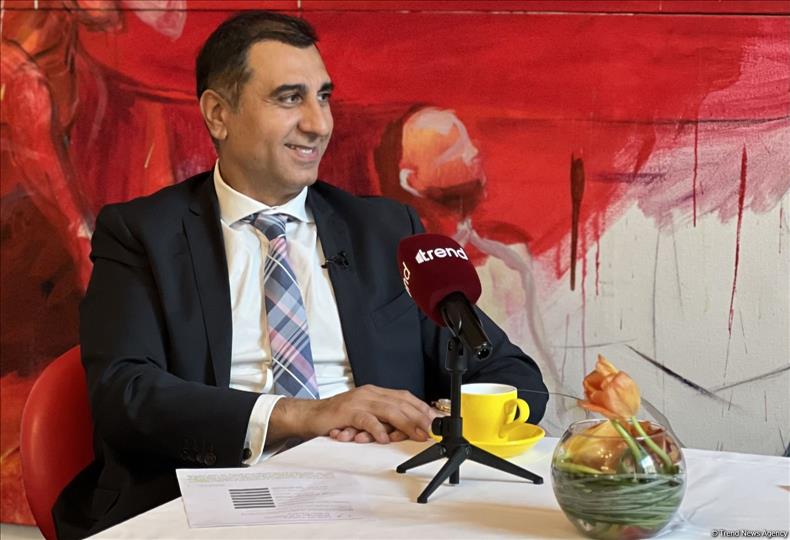
Movlan Pashayev, Managing Partner of PwC in Azerbaijan, told
trend in an exclusive interview.
According to him, this policy continues today.
'Due to the strict monetary policy, we are able to curb
inflation. There are several reasons for the inflation that is
observed globally, including in Azerbaijan. This can include a
sharp waste of funds, which the population saved during the
pandemic, resulting in the 'overheating' of the economy in many
countries,' he said.
He stated that the Russia-Ukraine war can be considered another
factor of global inflation growth, as it caused significant
'shocks' in the supply chain and rising prices for household
goods.
'Due to the fact that Azerbaijan sticks to a strict monetary
policy, it manages to curb inflation to a certain level. Increases
in wages, pensions, scholarships, and other social benefits, as
well as tightening monetary policy, still allow for some
compensation for existing price growth. In addition, we also see
the active work of the antimonopoly service, which strictly
controls the consumer market and prevents artificial price
increases,' he added.
Pashayev noted that Azerbaijan's tax reforms further promote
economic development and attract foreign investments.
According to him, taxes and preferences are of the
utmost importance since they help create the image of the country,
and favorable conditions for running businesses and investing.
'Nevertheless, tax preferences cannot be seen as the
main factor for business promotion. First of all, a stable economy
and regulatory mechanisms are important for business, that is, the
protection of businessmen and their investments. I also consider
the role of intellectual property protection to be important. From
the point of view of economic and social stability, Azerbaijan has
no problems attracting investments and creating business in the
country,' he said.
As Pashayev explained, Azerbaijan is currently
undergoing a profound transformation in the tax field, and,
moreover, a new tax strategy is expected to be adopted in the near
future, which will reflect all the key and necessary actions that
will further stimulate the development of the economy and attract
foreign investments.
He pointed out that future development prospects for
the country's economy, and the business sector in particular, is
quite optimistic.
According to him, many directors see great prospects
for their development given the current reforms.
'We have completed the collection of information as
part of the 6th annual survey of company executives. The survey was
conducted among the heads of more than 100 companies in various
sectors of the economy, both private and public organizations. At
the moment, the information is being processed, and we expect that
by the middle of March this year, the full report will be ready. I
can note for now that the level of optimism in the development of
the economy and companies of Azerbaijan was quite high in 2022.
Many directors see great prospects for their development given the
current reforms. Of course, there are still problems with various
aspects of doing business. First of all, it is the regional and
global volatility of the economy,' he said.
Speaking about the global survey of company
executives, Pashayev noted that 40 percent of heads believe that
their companies will not survive if they start to reform quickly
enough.
'First of all, it concerns technologies and the
retraining of personnel. They also take into account various global
risks such as inflation, macroeconomic instability, and
geopolitical conflicts, in particular, the Russia-Ukraine war.
Resuming the survey, we can say that there are five new megatrends
in the world. Among those trends are climate change, advanced
technology and its impact on the economy, and demographic changes,
in particular, in Europe, Japan, and other countries, where the
rapid aging of the population is observed while society is getting
younger,' he said.
According to him, the other megatrends are social
instability and deglobalization.
'According to our survey, it is precisely these
challenges that the heads of our companies face. If the business
does not change, at least for the next five years, the companies
will not survive,' he added.
Further speaking, Movlan Pashayev pointed out that the
launch of the Alat Free Economic Zone will be of great benefit to
Azerbaijan.
'Azerbaijan is implementing a combined model of free
economic zones - both using the experience of various countries and
its own initiatives. None of the economic zones will be successful
unless there is an accurate regulatory system in place and
investors understand what they will face and what preferences
exist. I would like to note that the benefits of the free economic
zones for our country are attracting know-how, further
strengthening the country's image, as well as creating a
professional and qualified workforce, and accelerating the
development of various sectors of the economy,' Pashayev said.
As he explained, Alat Free Economic Zone meets the
country's interest and contributes to the attracting of additional
investments. Currently, work is underway to establish
infrastructure, and the first investment contracts have already
been signed.
Furthermore, speaking about the financial sector of
Azerbaijan, Pashayev said that for many years this field has
remained advanced in terms of attracting and utilizing
technologies, as well as training personnel.
He noted that, from the point of view of the mentioned
features, Azerbaijan's financial sector is one of the most
advanced.
According to him, great transformation processes are
expected in the financial sector of Azerbaijan.
'Based on our conversations and the audits we do, we
can conclude that the financial sector of the country is stable.
However, in this changing environment, banks, both ours and those
around the world, must introduce new innovations, products, and
services in order to 'survive,' he added.
Pashayev also believes that the ongoing reforms in
Azerbaijan create a favorable investment environment. The approach
currently taken by Azerbaijan is directed towards liberalization of
the country's economy, increasing the efficiency of enterprises,
public ones in particular, and increasing the competitiveness of
goods and services both on the regional and global markets. From
the point of view of achieving the set goals, the PwC manager
believes that, to a certain extent, Azerbaijan is modernizing the
old system and creating an absolutely new approach.
Summing up, Pashayev noted that the PwC strategy in
Azerbaijan is primarily aimed at promoting local business, both
private and state successfully to transform and become effective
and competitive.
'PwC is aimed at assisting Azerbaijan in the
development of enterprises and businesses, strengthening their
competitiveness, changing their structure, and improving the form
of doing business in accordance with the challenges that it faces.
These risks will continue for at least another 2-3 years, and we do
not expect the global economy to stabilize - it will keep changing.
Azerbaijan, as a part of the world economy, will definitely be
subject to these shocks. And we advise the heads of enterprises on
how they can resist them and how companies can survive in a rapidly
changing time,' he concluded.








Comments
No comment