

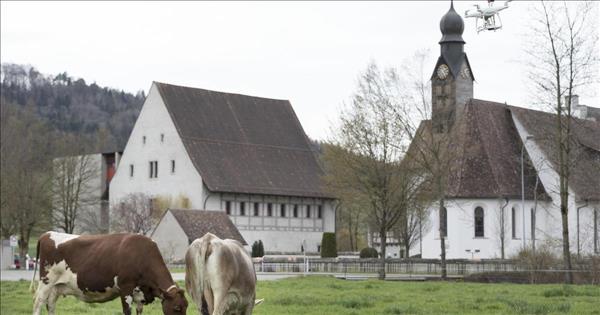
How Swiss drones and robots are changing farming


(MENAFN- Swissinfo) Remote sensing, big data, artificial intelligence and robotics are being integrated into everyday farm management.
Based on information relayed by a Swiss start-up, the owner of a sugar mill in India tells local cane farmers it's almost time to harvest their crop. The information provided to the sugar mill owner came from Gamaya, a spin-off of Lausanne's Federal Institute of Technology (EPFL), which applies its own crop and region-specific algorithms to satellite imagery. Gamaya teamed up with India's largest tractor manufacturer Mahindra & Mahindra last year in a deal worth CHF4.3 million ($4.4 million).
'Mounted on a drone, our hyperspectral camera captures very rich images,' says Thomas Peyrachon of Gamaya. The camera can capture 40 different bands of light, he explains, compared to three in standard cameras. That allows it to detect subtle variations in light reflected on the plant and read its condition – letting the farmer know when the cane has the most sugar content and is ready to harvest.
Connected agriculture The rise of the machines: robots and the future of farmingSwiss economics ministry is calling for farmers to embrace a 'digital revolution', but this is not without risk.
By Samuel Jaberg See in other languages: 7 See in other languages: 7 Languages: 7- Arabic (ar)حين تحل الروبوتات محل الجرارات والحاصدات
- German (de)Wenn Traktor und Mähdrescher auf einmal Roboter sind
- Spanish (es)Cuando los robots reemplacen a los tractores
- French (fr)Quand les robots remplaceront les tracteurs
- Italian (it)Quando i robot sostituiranno i trattori
- Portuguese (pt)Os robôs e o futuro da agricultura
- Russian (ru)Робот вместо трактора в полях Швейцарии?
Between 20 and 40% of the world's grain harvest is currently lost to pests and disease, according to the Food and Agriculture Organization. Meanwhile, the average farm can generate half a million data points per day, everything from soil temperature to individual milk yields to the presence of pests in a crop.
When this information is converted into sound advice, farmers can operate in a much more precise way, using fewer resources. Even in one field of maize, for example, there may be different patches that need replanting, or the application of fertiliser, pesticides, herbicides or fungicides at a given time.
The rationale behind all the new developments is the same as it's always been in farming – to get the best yield and quality across the board. But now, looking at the damage done to agricultural land, we are in the era of 'less is more'. We still need more food, but we want to conserve resources in a way that protects the environment from further degradation.
This change towards micro-managing farms with sophisticated information while reducing their ecological footprint has been referred to as the Fourth Agricultural Revolution. The so-called agritech sector is experiencing a boom worldwide and promoting innovation and digitalisation in agriculture is one of the stated aims of Switzerland's new agriculture strategy for 2022–2025.
A hyperspectral camera image of a barley field.
'There is plenty of research activity in all directions. We hope to build Switzerland up to become a strong hub, especially for data capturing and data analytics, where we have a lot of expertise,' says Roland Siegwart, professor for autonomous mobile robots at the Federal Institute of Technology in Zurich (ETHZ). He previously worked with Gamaya on a project in Ukraine involving the European Space Agency.
Gamaya is currently focusing on the Brazilian sugarcane and soybean markets, since large-scale farming countries like Brazil and the United States are looking to agritech companies for help with drone and satellite imagery. In sugarcane, where some farms are up to 100,000 hectares in size, the Swiss start-up has developed a solution to detect planting gaps with its drone detectors.
Gaps on the ground are one of the major causes of yield loss due to the perennial nature of the crop. When the gaps are identified, the grower can replant in the most problematic areas.
Apart from gathering data or spraying crops from the air, there are also developments taking place at ground level, with autonomous robotic vehicles being developed for various tasks such as weeding, the application of fertiliser or fruit harvesting.
At the ETHZ's research station for plant sciences in Eschikon, outside of Zurich, scientists are testing machines that can intervene in the field. Ten engineering students on a teaching project have been tasked to construct a robot that will go through beet fields and find and destroy weeds. The prototypes are due to be ready in May or June.
Listening to plantsAnother Swiss start-up, Vivent in the French-speaking canton of Vaud, is taking a novel approach to analysing plants by monitoring and interpreting biosignals.
The company has developed a sensor which is attached to a plant, for example a greenhouse-grown tomato. Plants emit different signals depending on the stress or stimulus, as co-founder Carrol Plummer explains.
'We can interpret plant signals to detect different crop conditions. For instance, we can tell whether the plant is being attacked by a chewing or sucking insect or whether it has a fungal infection or a nutrient deficiency. The grower can then respond to this information.'
Vivent's sensors in action
(Vivent)The signals are processed in a similar way to how automatic voice recognition software works. 'We record the signals when the plant is healthy, stressed or stimulated and use artificial intelligence to interpret the signals. It's akin to learning a language.'
Vivent has received funding to continue working on two new projects with Agroscope, the Swiss federal body for agriculture research. With the wealth of information and new systems now available to farmers, including a plethora of farm management apps, the challenge at this point is to match farms with the right technology package. It may well be that the next growth area in smart farming is consultancy.

Legal Disclaimer:
MENAFN provides the
information “as is” without warranty of any kind. We do not accept any
responsibility or liability for the accuracy, content, images, videos,
licenses, completeness, legality, or reliability of the information
contained in this article. If you have any complaints or copyright issues
related to this article, kindly contact the provider above.
Comments
No comment