




403
Sorry!!
Error! We're sorry, but the page you were looking for doesn't exist.
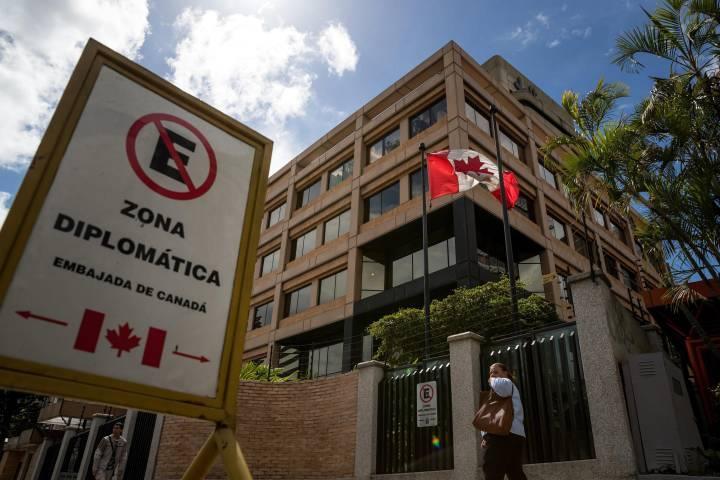
Canada temporarily closing Venezuela embassy
(MENAFN- Caribbean News Now) Canada's embassy in Caracas (Miguel Gutierrez / EPA)
By Caribbean News Now contributor
OTTAWA, Ontario – Foreign Affairs Minister Chrystia Freeland has announced the 'temporary' closure of Canada's embassy and the removal of diplomatic staff from Venezuela, insisting Ottawa had 'no choice.'
In a Sunday press statement, the Canadian diplomat blamed the Maduro administration of having 'taken steps to limit the ability of foreign embassies to function' by its failure to renew visas for diplomatic staff. No proof was presented to back the claim. She also alleged that that the Caribbean nation is 'slid[ing] deeper into dictatorship.'
The decision is to take immediate effect, with diplomatic visas reportedly expected to expire at the end of June. All consular and embassy services are to be assigned to the Colombian capital of Bogota over 1,500 kilometres away. Freeland further indicated that Ottawa would 'evaluate' the status of Venezuelan diplomats in Canada 'appointed by Maduro.'
Canada was the second country to acknowledge Juan Guaidó after he swore himself in as 'interim president' on January 23. Canada continues to back Guaidó's efforts to remove the Maduro regime and has started to forge diplomatic relations with the opposition leader's representative in Canada, Orlando Viera Blanco, who has held many conferences with government diplomats and members of parliament in Vancouver and Ottawa. Canada has also followed the United States in imposing several rounds of sanctions on Venezuela.
It is undetermined how many Canadian citizens in Venezuela this decision will affect, but recent opposition-led assessments indicate that there are up to 50,000 Venezuelans living in Canada.
This latest diplomatic dispute follows a parallel argument in March when the US and Venezuela both removed their diplomatic personnel, cut diplomatic connections and abandoned the embassies. The US had equally recognised Guaidó envoy Carlos Vecchio as Venezuela's diplomat in the United States.
The diplomatic impasse came to a head in Washington when the United States government forces violated the Vienna Convention and stormed the Venezuelan embassy building to remove a group of US citizens safeguarding it with the support of the Caracas regime, which led to many arrests.
The diplomatic fray comes as Guaidó's team faces a hold-up in its attempts to supersede Maduro's diplomatic representation in Brazil.
The far-right Bolsonaro regime, which likewise acknowledges Guaidó as the lawful Venezuelan president, had earlier invited his envoy, Maria Teresa Belandria, to present her credentials at the Presidential Palace Tuesday, only to inform later that the invitation was rescinded. 'I was uninvited,' she told reporters, downplaying the political effect of this new development.
According to a professor of foreign relations at the Getulio Vargas Foundation in São Paulo, Oliver Stuenkel hints, however, that this development may indicate Brasilia is losing faith in Guaidó's attempts to remove Maduro. '[The government] realize[s] Brazil has to deal with the reality that Maduro is not going anywhere right now,' Stuenkel emphasised.
Paulo Roberto de Almeida, a Brazilian diplomat, equally shares this view, declaring that the snub points to increasing friction between Brazil's civilian and military leaders. 'Recognition of Guaidó's envoy was never agreed to by the military,' he stated. Guaidó, for his part, assured followers in Venezuela that he will fulfil his goal to take power by year's end.
Addressing a small group in Barinas State, Guaidó declared, 'We are in times of definitions, of advances, of actions (…) This didn't start in 2019, but I'll tell you something, it will end in 2019.' Guaidó has beforehand assured followers that he would drive humanitarian 'aid' into Venezuela, influence the armed forces to join his cause and call new presidential elections. He also led a failed putsch in April.
Taking to Twitter Monday, Guaidó further reiterated his pledge to do 'what is needed' to oust Maduro, resonating Washington's statements that 'all options are on the table' concerning Venezuela.
Guaidó has directly called for foreign intervention into Venezuela and is presently calling for Venezuela's reincorporation into the Inter-American Treaty of Reciprocal Assistance (TIAR), a mutual defence pact involving sixteen nations in the Western Hemisphere which have been mentioned as a possible legal justification for US military action.
Meanwhile, in Washington, President Donald Trump's administration clamped down on US tourist visits to Cuba Tuesday, intending to stem the flow of dollars to a country that Washington accuses of helping propped up Maduro.
The US Treasury Department halted group educational travel, cruise ship and private yacht visits by Americans, aiming for the most popular ways US tourists and Cuban-Americans visit the Caribbean island.
The strategy could create a massive economic hit on Cuba, which received more than a quarter-million US travellers in the first four months of 2019, nearly double the total the year prior.
"The administration has advanced the president's Cuba policy by ending ‘veiled tourism' to Cuba and imposing restrictions on vessels," Bolton said on Twitter. "We will continue to take actions to restrict the Cuban regime's access to US dollars."

Legal Disclaimer:
MENAFN provides the
information “as is” without warranty of any kind. We do not accept
any responsibility or liability for the accuracy, content, images,
videos, licenses, completeness, legality, or reliability of the information
contained in this article. If you have any complaints or copyright
issues related to this article, kindly contact the provider above.
Most popular stories
Market Research

More Story
Comments
No comment